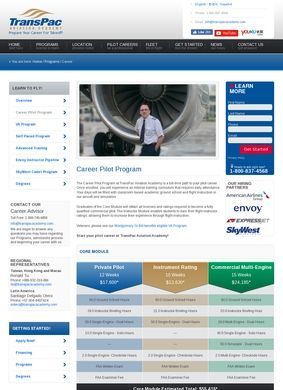
More than 60 aircraft, a stated path from no experience to a commercial certificate in ten months, and a Phoenix base picked for its roughly 360 flyable days a year: that was the pitch behind TransPac Aviation Academy: Pilot training. The flight school operated out of West Deer Valley Road in Phoenix, Arizona, and ran its instruction under both FAR Part 141 and Part 61, which let it serve structured academy students and self-paced learners from the same building. The catch worth stating up front is that the career-programs page now returns a 404, and the wider transpacacademy.com domain answers the same way. So this is a review of a school that was, more than one a prospective student can walk into today.
Certificates and ratings offered
What it offered was a full ladder of certificates and ratings rather than a single course. The roster at TransPac Aviation Academy: Pilot training covered Private Pilot, Commercial Pilot, and the Airline Transport Pilot certificate at the top end, plus the instructor track most career pilots pass through to build hours: Certified Flight Instructor, Instrument Flight Instructor, and Multi-Engine Instructor. Instrument and Multi-Engine ratings rounded it out.
Private pilot through airline transport pilot
The academy aimed squarely at people starting from zero who wanted a professional cockpit job, and it paired that with on-site maintenance for its aircraft, which is a real operational point for a school flying that many airframes daily. Running a fleet that size out of one Phoenix base is a heavy logistical job, and keeping mechanics on the property instead of farming the work out is the kind of choice that separates a serious operation from a hobby setup.
Instructor certifications
The ten-months-or-less claim sat at the centre of the marketing, and the Phoenix weather argument behind it holds up on its own terms. Desert flying weather means fewer cancelled lessons, and fewer cancellations are how an accelerated timeline becomes plausible instead of aspirational.
Fleet size and operational model
TransPac Aviation Academy: Pilot training also held a partnership with SkyWest Airlines and advertised incentive pay for graduates who stayed on as instructors before moving into a SkyWest first-officer seat. That kind of named airline relationship is the sort of concrete detail a prospective student can actually check against a hiring pipeline, and it held up better than a generic promise of job placement would have. The instructor-to-regional pathway is the standard career ramp in American aviation, and a school that bakes a specific airline into the plan is at least being honest about where its graduates are meant to land.
On-site maintenance for daily operations
The harder reading sits in the reputation record, and most of it comes from people who worked there rather than students who trained there. On Glassdoor, TransPac Aviation Academy: Pilot training carries 46 employee reviews and an overall 2.4 out of 5, with only 34 percent of reviewers saying they would recommend the company to a friend. Compensation and benefits scored even lower, at 2.1. Those are not numbers you can wave away, because the people leaving them are the working instructors, the same CFIs who were meant to be the school's main teaching resource.
Employee reviews and working conditions
Indeed adds more of the same. The recurring themes there are pointed: worries about safety culture, pressure tied to billable hours, and weak management. For a flight school, a safety-culture complaint is the one that should make any reader slow down, since it speaks to the core of what the place was selling. Billable-hour pressure is a familiar grievance at high-volume academies, where instructor pay and student throughput pull against each other, and it lines up with the low compensation score on Glassdoor. When a flight school pushes flight hours hard to keep revenue moving, the people feeling that squeeze are the same instructors flying with students every day, and the math behind it rarely stays invisible for long.
Safety culture concerns on Indeed
There is also a discussion thread on the Airline Pilot Central forums where instructors traded notes on TransPac Aviation Academy: Pilot training, and the CFI experiences there run mixed. Student-facing reviews are sparse by comparison. The Yelp page exists but shows no visible rating or count in the search results, and the BestAviation.net listing has no student reviews submitted at all. So the picture leans heavily on the staff side, which tells you a lot about working conditions and rather less about whether a paying student walked out with a commercial certificate on schedule and felt the money was well spent. This school does appear in at least one business directory, but nothing there speaks to student outcomes.
Sparse student feedback across platforms
Pinning down how to reach TransPac Aviation Academy: Pilot training now means going through outside listings, because the school's own site is gone. The Phoenix address and a toll-free line, +1 (866) 857-2374, show up on third-party sites such as BestAviation.net and MapQuest, but there is no live contact page, no working form, and no confirmation that the published number still connects to anyone. When a flight school's domain stops resolving, the safe assumption is that operations have changed or stopped, and a stale phone number on a directory does not undo that.
Contact information no longer verified
That offline status reframes everything above it. The fleet size, the SkyWest tie-in, the accelerated timeline, the Part 141 approval: all of it describes a school that was running, and none of it can be verified by visiting TransPac Aviation Academy: Pilot training today. A reader who finds this entry while researching pilot academies should treat the program list as a historical record, useful for understanding what TransPac Aviation Academy: Pilot training was structured to deliver, but not as a live enrollment option.
If the school were still trading, the read would be split. The training menu was complete, the aircraft count was genuinely large, and the airline partnership gave the career claim something solid to stand on. Set against that, a 2.4 employee rating, recurring safety-culture and management complaints, and bottom-tier pay scores are exactly the things a prospective student would want to weigh before handing over the cost of a zero-to-commercial program. Strong on paper, shaky in the staff testimony: that tension defined the place even before the site went dark.
For anyone comparing flight schools, the practical takeaway from TransPac Aviation Academy: Pilot training is twofold. The model it ran, a large fleet in good-weather Arizona feeding instructor graduates toward a regional airline, is a legitimate template that other Phoenix academies still use. And the review record is a reminder to read employee feedback alongside student feedback, because the working conditions behind the flight line shape the quality of instruction a student actually receives. The instructor reviews here were doing more honest work than the brochure copy ever did.
What remains is a name, an address that may or may not still house a flight school, a toll-free number of uncertain status, and a body of reviews that outlived the website. The programs that defined TransPac Aviation Academy: Pilot training, from the Private Pilot certificate through the ATP, are documented across aviation directories even though the pages describing them no longer load. Someone arriving at this listing today is looking at the footprint of a school, not its front door. The 404 is the most current fact about it.