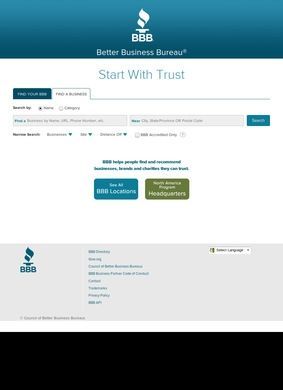
Where does a shopper go when a company name means nothing yet and the reviews online look suspiciously glowing? For a lot of people in the US and Canada, the answer has been the Better Business Bureau, and the site at bbb.org is where that decades-old habit lives now. Type a company or a category and a location into the search box and you get back a profile: the letter grade the organization assigns, whether the business paid to be accredited, the complaints filed against it, and reviews left by other customers. That is the core loop, and the whole Better Business Bureau site is built to make it fast.
How grades and reviews work together
The letter grades run from A+ down to F, and understanding what they mean takes a minute of reading the About material, which the site provides without much fuss. A grade is not a popularity score. It reflects things like how long a company has operated, how it responds to complaints, and whether it has a pattern of unresolved disputes. A business can hold an A+ and still have a pile of one-star customer reviews sitting right below it. The Better Business Bureau keeps the two separate on purpose: the grade is its own assessment, the reviews are the crowd talking, and putting them side by side lets a visitor weigh both instead of trusting either one blindly.
What letter grades measure
Complaint handling is the part that has always set the Better Business Bureau apart from an ordinary review site. A consumer can file a formal complaint against a business through the profile page, and the process is structured as a mediation rather than a public shaming. The company gets notified, gets a window to respond, and the back-and-forth becomes part of the record. Anyone reading a profile later can see whether someone was unhappy, sure, but also whether the business bothered to answer and how the matter closed. For a service business or a contractor, that trail is often more telling than any single angry paragraph.
Mediation and complaint records
Beyond the profiles, the site leans into fraud prevention through BBB Scam Tracker, a searchable log of scams that people report from across the two countries. Somebody who just got a strange text about an unpaid toll or a too-good job offer can look up whether others have flagged the same trick, and can add their own report so the next person has a warning. It works as a rough early-warning system, and it is free to browse. The value scales with how many people use it, which is the quiet strength of a national operation that has been collecting this kind of data for a long time.
Scam Tracker for fraud prevention
There is also a newer BBB AI Hub, which offers free workshops, short courses, and plain guidance aimed at small operators trying to use artificial intelligence without stepping on a rake. It sits a little apart from the ratings machinery, more educational than investigative, but it fits the broader mission of helping owners run cleaner, more trustworthy shops. Whether a given small business finds it useful will depend on how much hand-holding it wants, and the material stays general enough to suit someone just getting started.
Tools for businesses and operators
For businesses themselves, the site is the front door to accreditation. A company can apply for the seal, which signals that it has been vetted against the organization's standards for ethical and trustworthy operation and pays to maintain that status. This is where a fair-minded reader should stay alert. Accreditation is a paid program, and the Better Business Bureau has drawn criticism over the years for the perception that paying members might fare better. The site is upfront that the seal and the grade are meant to be independent, and the presence of accredited companies with mediocre records supports that claim, but a visitor is right to read a profile in full rather than stopping at a badge.
Accreditation as a paid program
What makes the whole thing genuinely useful is breadth. Because the Better Business Bureau covers such a wide range of industries and both countries, most established companies have some kind of profile, even the ones that never asked for one. That means the search rarely comes up empty, and a visitor can compare two plumbers or two moving companies on the same terms: same grade scale, same complaint format, same review layout. Consistency across millions of listings is harder to build than it looks, and it is the reason ordinary shoppers who have never thought about how the sausage is made still bother to run a quick check here.
Why consistency matters across listings
The site is not flawless as an experience. Profiles can feel dense, the difference between an accredited and non-accredited listing is not always obvious at a glance, and a first-time user may need a moment to figure out whether they are looking at the organization's grade or at customer sentiment. None of that undercuts the substance. The information is there, it is organized, and it is checkable, which is more than can be said for the endless pages of anonymous star ratings scattered elsewhere online.
Used well, a Better Business Bureau profile is a starting point, not a verdict. It tells a shopper how long a company has been around, how it treats people who complain, and whether strangers have flagged it as a scam, and it lets a business owner learn the rules of good conduct and put a recognized seal on the door.
Somebody researching a contractor before signing a contract, or checking a suspicious offer before handing over a card number, gets real footing here that generic search results rarely provide. The Better Business Bureau does not decide who a person should trust; it hands over the raw material and a framework for reading it. A company's own website can swear it is the most reliable in town all it likes, but the record on file here, kept by someone else, is a better place to check that claim.
Business address
Council of Better Business Bureaus
3033 Wilson Blvd, Suite 600,
Arlington,
VA
22201
United States
Contact details
Phone: 703-276-0100