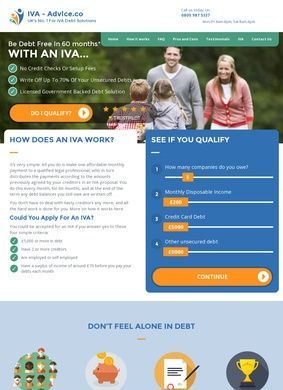
Letters from creditors keep arriving, the phone rings at hours that feel deliberate, and the monthly numbers no longer add up no matter how they get rearranged. That is roughly the moment someone lands on IVA Debt Advice, a UK service built around one specific route out of unsecured debt: the Individual Voluntary Arrangement. The first thing it puts in front of a worried visitor is a free two-minute calculator that estimates an IVA position without touching the credit score, which is a sensible piece of design. People in this state are often terrified that asking for help will itself do damage, so a tool that promises no credit footprint removes the most obvious reason to hesitate.
What an IVA is and how this service works
An IVA is a formal, legally binding agreement with creditors, usually for people carrying unsecured debts of around 5,000 pounds or more, and the site is honest about who that suits. It points squarely at residents facing creditor pressure, the threat of legal action, or repayments that have simply stopped being survivable. Where an IVA looks appropriate, the consultations are confidential and the actual arrangement is handed to a licensed Insolvency Practitioner, since only a licensed practitioner can set one up. That hand-off matters. A guidance service that quietly admitted it was the one signing the paperwork would be a red flag, and IVA Debt Advice is clear about where its role ends.
Comparing IVA with other debt solutions
The content goes beyond the product it would most like to recommend. Plain comparisons of debt management plans, debt relief orders, and bankruptcy sit alongside the IVA material, which is the even-handedness a reader would want before agreeing to anything formal. An IVA is the wrong answer for many people, and IVA Debt Advice lets a reader who works through these pages reach that conclusion on their own terms. The information is broken down by debt type too, with separate guides for council tax arrears, utility arrears, gambling debt, and bailiff action. Anyone dreading a bailiff visit or staring at a council tax demand is dealing with a different fear than someone juggling several credit cards, and the site treats those situations as genuinely distinct.
Specialist guides for specific debt types
One section worth attention on the IVA Debt Advice site is the comparison guide to IVA companies, attributed to an advisor holding a CII certification and more than fifteen years in UK debt advice. Naming a real qualification and a real stretch of experience is unusual in a corner of the internet crowded with anonymous lead-generation pages, and it gives a reader something to weigh. There is also a FAQ area, a blog, and a customer reviews portal, so the resource is broader than a single sales page pushing one outcome.
Reviews and contact information
On reputation, the picture is mixed but encouraging enough. IVA Debt Advice works with reviews.io to gather independent feedback, and the site cites 565 customer reviews collected through that platform, which is a meaningful volume for a service of this kind. A Trustpilot profile also exists for the domain, though the count there could not be confirmed from publicly available figures. No Google, Yelp, or BBB presence turned up. For a debt service, verified reviews on a dedicated platform are more useful than open submissions, and 565 is enough to suggest a real flow of clients rather than a handful of staged comments. A prospective user would still do well to read the actual reviews and skip the headline figure, since debt advice is a deeply personal experience and the variance between accounts tells you more than the total.
How to reach the service
Contact is the one area where IVA Debt Advice has room to improve. The homepage shows no phone number, email address, or postal address. There is a Contact link in the footer, so the details are reachable, but a visitor has to navigate away from the landing page to find them. For most businesses that would be a minor quibble. For a debt service catching people at a frightening moment, a visible phone number on the first screen would do real reassurance work, and its absence is a small missed opportunity. The route exists; it is just less prominent than it could be.
The offering is coherent. A calculator to break the ice, layered guides that explain the alternatives without forcing the IVA conclusion, specialist pages for the debts that scare people most, and a clear referral path to a licensed practitioner when an arrangement makes sense. IVA Debt Advice is free at the point of guidance, which removes the worry that asking a question will itself cost money someone does not have. The strongest evidence here is the refusal to flatten every reader's situation into the same recommendation, paired with named expertise behind the central comparison guide.
If there is a caveat worth holding onto, it is the obvious one that applies to any debt guidance: a calculator and a set of articles can frame the decision, but they cannot make it. An IVA affects credit, can involve home equity in some cases, and is a serious commitment that runs for years. IVA Debt Advice does a fair job of laying out the trade-offs, and the licensed-practitioner hand-off means the binding advice comes from a regulated source. The formal arrangement is a long-term legal step, and the verified review volume should be read rather than simply counted. The site explains an IVA clearly and without burying the alternatives, which is worth something in a space where plenty of sites do neither.