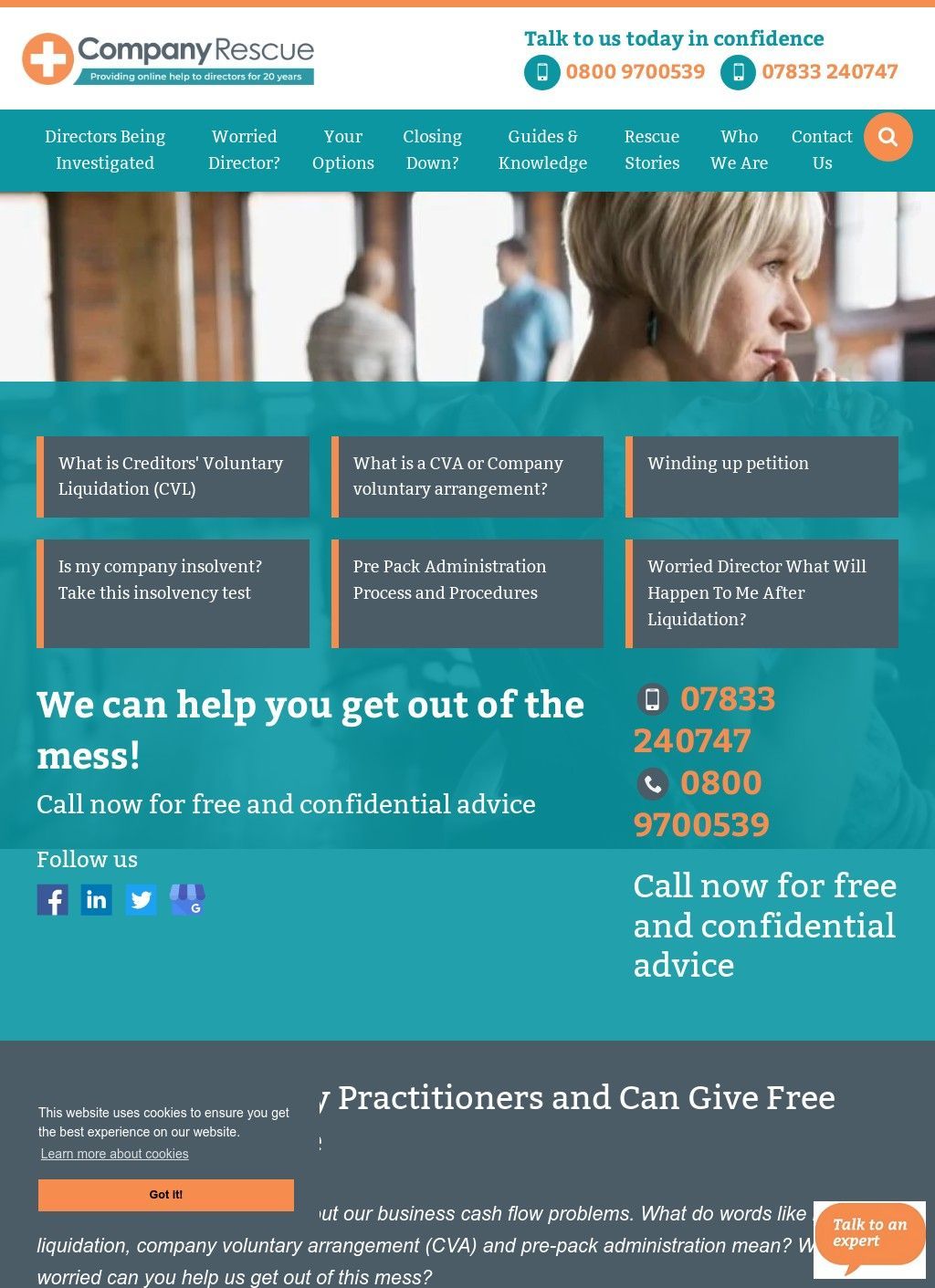
Company Rescue puts a Company Voluntary Arrangement at the front of its offer, which tells you immediately who the site is built for: directors of trading businesses that might still be salvageable. The firm covers CVAs alongside Creditors Voluntary Liquidation, compulsory liquidation, administration, and pre-pack administration, so the full range of options runs from rescue at one end to an orderly wind-down at the other. For a director trying to work out whether the company can survive or whether liquidation is the honest answer, having both extremes covered on one site is genuinely useful, because most directors approach this subject knowing almost nothing about it and needing a map before they can even frame the right question.
CVA and liquidation options
Beyond the formal procedures, Company Rescue covers the practical situations that tend to arrive before a director is ready for them. Time-to-pay arrangements with HMRC get their own dedicated treatment, which makes sense because tax arrears are usually the first visible crack. Winding-up petition defence is covered in detail too, and that is help a director needs at short notice, typically with a court date already set. There is also material on directors' trading advice, the uncomfortable territory where someone has to judge whether continuing operations is defensible or whether it tips into wrongful trading. The site does not skip past those tensions or reduce them to reassuring generalities.
Tax arrears and winding-up petitions
The sector-specific content is one of the more useful things Company Rescue has done with its structure. Hospitality, construction, retail, and manufacturing each get dedicated pages, and that segmentation is sensible because the pressures in those trades differ in kind as much as in degree. A construction firm bleeding cash on retentions operates nothing like a restaurant caught by seasonal swings, and the guidance reflects that. Generic insolvency content assumes a generic business; the sector pages at least try to match the advice to the actual circumstances a director is likely to be sitting in.
Sector-specific guidance
Company Rescue states 27 years of experience in the field. More informative than the headline number are the professional affiliations it lists: the Insolvency Practitioners Association, R3, and the Turnaround Management Association. R3 is the recognised trade body for insolvency and restructuring professionals in the UK, and membership places Company Rescue inside the regulated framework, not operating at its edges. In an area of work where a director is handing over real control at a vulnerable point, those affiliations are the part of the page a careful reader should stop on. They are checkable through the relevant registers, which is exactly the kind of independent verification worth doing before any serious conversation begins.
Checking professional credentials
A resources section sits alongside the sector pages. For directors who want to read up before speaking to anyone, that reference material does useful work: understanding the difference between a CVL and an administration before a first call means the conversation can get to specifics rather than spending an hour on definitions. Insolvency is a subject most directors face once, under stress, with no prior preparation, so a body of plain-language explanatory content has more practical value here than it might in a less specialised field. Company Rescue appears to understand that and has built the site accordingly.
Reference material for directors
The review picture is mixed. Company Rescue holds seven reviews on Trustpilot at around 4.3 out of 5. That score is healthy but seven reviews is a small sample for a firm claiming nearly three decades of cases. A listing on Traders Union assigns the domain a rating of 0.7 out of 5, though that figure appears to be an algorithmic credibility score rather than client feedback, so it deserves to be read with that caveat in mind. A Facebook page exists, linked to RMT Accountants and Business Advisors, but it shows no ratings. No counts surfaced from Google, Yelp, or the BBB.
Review ratings and feedback
That light review presence deserves an honest reading. The professional memberships and the long operating history suggest Company Rescue is an established, regulated practice. The low volume of independent client feedback simply means there is not much to weigh. Insolvency is also a sector where clients are rarely inclined to publicise that they needed such help, so a quiet review profile does not on its own discredit the firm. It does mean a prospective client should ask for case references directly and look up the named insolvency practitioner on the IPA register to confirm their standing and licence status.
Assessing credibility without reviews
The connection between Company Rescue and RMT Accountants and Business Advisors is worth understanding before engaging. Insolvency work frequently intersects with tax and accounting questions, so sitting within a wider accountancy practice can be an advantage. But Company Rescue does not spell that relationship out clearly on the public-facing material, and a director would need to ask specifically about who would handle their file and in what capacity.
Relationship with RMT Accountants
Company Rescue does the most important thing well: the content is built around the decisions a distressed director actually has to make. Defending a winding-up petition, negotiating with HMRC, and choosing between rescue and closure are not abstract concepts on this site; they are presented as practical problems with a process attached. The regulatory credentials are visible and checkable. The main gap is the low volume of independent client feedback, and the gap is real enough that due diligence here means going beyond the website and speaking to the firm directly to satisfy yourself about the specific practitioner and their track record before proceeding.
Business address
Company Resque
99 Bishopsgate,
London,
EC2M 3XD
United Kingdom