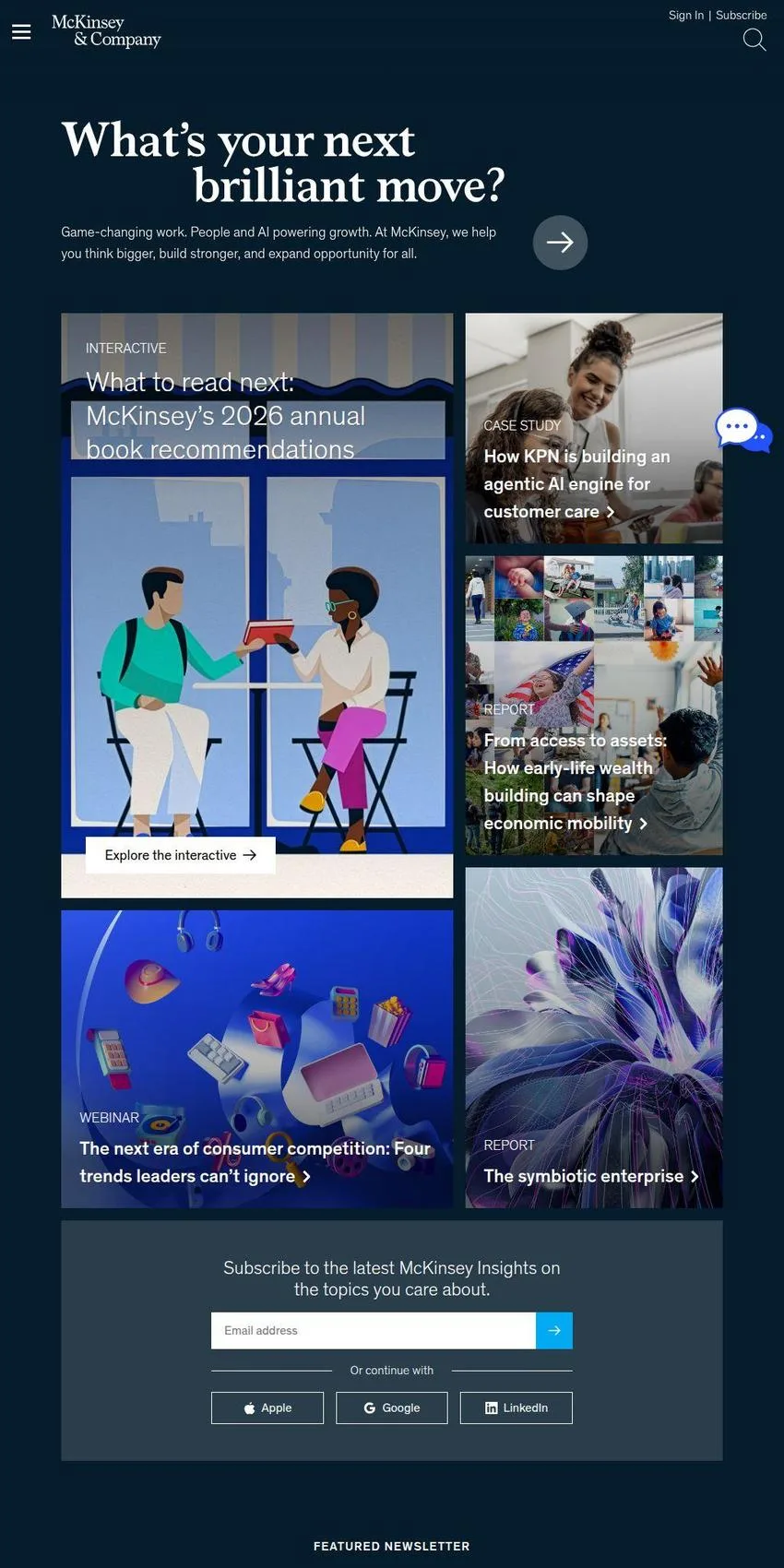
McKinsey & Company is the firm most people mean when they say management consulting. Founded in Chicago in 1926 by James O. McKinsey, an accounting professor with the then-novel idea that management could be studied like a discipline, the firm has grown into a partnership of tens of thousands of consultants serving clients in more than sixty countries. Its New York office at 3 World Trade Center functions as the practical center of gravity, though the firm has been deliberately global for half a century, and mckinsey.com reflects that scale: it is less a brochure than a publishing platform with a consultancy attached.
What McKinsey actually sells
What McKinsey actually sells is senior judgment applied to hard problems. The classic engagement is board-level strategy, where a company should compete and what it should stop doing, but the modern firm earns most of its fees closer to execution: large-scale cost and operations programs, post-merger integrations, digital and AI transformations, pricing overhauls, supply chain redesigns.
Industry and capability practices
The industry practices cover essentially everything, from banking and insurance through energy, healthcare, retail, telecom and the public sector, and the capability practices cut across them with specialists in operations, marketing, risk, people and organizational performance, and technology. QuantumBlack, the firm's AI arm, and a bench of designers and engineers acquired over the past decade mean that a McKinsey team today often ships working software alongside the slide decks it remains famous for.
Confidential clients and the alumni network
The firm's client list is confidential by policy, which has always made its public reputation an odd construction: everyone knows the name, few engagements are ever confirmed. What can be verified is the alumni network, which is unmatched in business.
How alumni become chief executives
Former McKinsey consultants run or have run a striking share of the world's largest companies, Sundar Pichai at Google and Sheryl Sandberg of Meta among the best-known alumni, and that pipeline into chief executive roles is a large part of why ambitious graduates keep applying in six-figure volumes. The firm hires from the top of every class, works its people hard for two to five years, and releases most of them into senior industry roles predisposed to hire their old firm. It is a flywheel a century in the making.
Free research on mckinsey.com
For the website visitor, the most valuable thing on mckinsey.com is free. McKinsey Insights, together with the McKinsey Global Institute, publishes research at a pace and depth that embarrasses some commercial publishers: sector outlooks, the widely cited annual reports on banking and technology trends, workforce and productivity studies, and the McKinsey Quarterly, which has been running since 1964. The Global Institute papers on productivity, urbanization and the economics of AI get cited by central banks and finance ministries, not just by consultants pitching work.
Syndicated feeds reach global readers
All of it is available without payment, most of it without registration, and the firm syndicates the stream through a standard feed that researchers and executives pipe into their readers. Whatever one thinks of consultants, the research operation is a genuine public resource.
The site itself is organized the way the firm thinks: by industry, by capability, by insight. A visitor from, say, a mid-market manufacturer can open the Industries section, find advanced electronics or industrials, and read what the relevant practice has published recently before ever speaking to a partner.
What does the careers section involve?
The Careers section is a small site of its own, with the application process, interview preparation guidance including the famous case interview, and honest descriptions of the lifestyle. McKinsey receives on the order of a million applications a year and accepts around one percent, so the careers pages are written for a mass audience the firm knows it will mostly reject.
Scandals and settlements over the past decade
Balance requires saying that McKinsey's name has taken real knocks in the past decade. The firm paid roughly six hundred million dollars in settlements over its consulting work for opioid manufacturers, faced criticism over engagements with authoritarian governments, and was entangled in the South African state-capture scandal, where it repaid fees from work linked to the Gupta network. The firm has since published its client service policies, tightened who it will and will not serve, and made its risk processes a matter of public record on the site. A reader weighing the firm should know that history; it is part of why the modern McKinsey talks about client selection at all.
None of that has dented demand in any visible way. Revenue has kept climbing past the sixteen billion dollar mark, the partnership keeps electing new leaders from within, and when boards face a decision too large to get wrong quietly, the shortlist still tends to start with the same three firms, McKinsey first among them by size and mindshare. Governments, foundations and health systems hire the firm as readily as private companies, and the public sector practice has grown into one of its largest.
Office locations with contact details
Practical details are handled cleanly on the site. Office pages exist for each location with addresses and phone numbers, the New York office at 3 World Trade Center, 175 Greenwich Street, reachable at +1 (212) 446 7000, standing in for a headquarters in the flat way partnerships prefer. The contact routes are clear about which door to knock on for client inquiries, media, alumni and recruiting. The site is fast, multilingual, and disciplined about accessibility, and the firm's social channels carry the research output to audiences in the tens of millions rather than functioning as advertising.
The criticisms a careful visitor might make of mckinsey.com are the flip side of its strengths. The sheer volume of published material can bury the specific answer you came for, and the search function works better for insights than for finding the right practice contact. Like every elite professional services firm, McKinsey publishes no prices and describes its work in terms general enough to avoid confirming any client. You will learn what the firm thinks about the future of retail banking in ten minutes; you will not learn what it would charge to help yours.
A century of established credibility
As a business-to-business listing, McKinsey & Company is about as established as an entry can be. It is a century-old institution at the top of its industry, with verifiable offices, published contact details, active and heavily followed social profiles, and a research library that gives any business reader a reason to visit regardless of whether they will ever engage a consultant.
For executives evaluating advisers, students weighing an application, or analysts tracking what the corporate world will be worrying about next year, mckinsey.com is a first-order source, and the firm behind it remains the reference point against which the rest of the consulting industry measures itself.






Business address
McKinsey & Company
3 World Trade Center, 175 Greenwich Street,
New York,
NY
10007
United States
Contact details
Phone: +1 (212) 446 7000
Our new analysis reveals the odds of reaching $1 billion in sales—and how the paths to that milestone differ by category and…
Bret Taylor, Sierra cofounder and OpenAI chair, believes AI’s near-term cybersecurity risks are real but solvable, and its…
At Cannes Lions 2026, LinkedIn CMO Jessica Jensen and McKinsey senior partner Dianne Esber discussed what it takes to turn AI…
AI could improve both safety and productivity by anticipating problems before they arise, detecting worker fatigue, and…