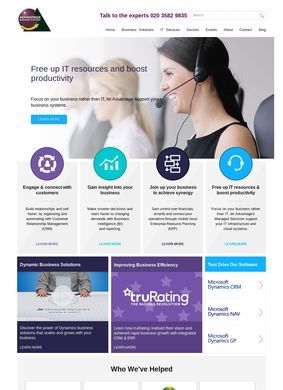
Two of the headline managed-IT products here carry a trademark symbol: Advantage Secure365 and CloudVault365, branded names for what most IT firms would simply call security monitoring and disaster recovery. That small branding choice tells you something about how Advantage Business Systems wants to be read: a packaged, productised technology partner with defined offerings, not a loose collection of billable hours. Whether that packaging delivers in practice is the harder question, but the intent on the page is clear enough.
Microsoft Dynamics 365 core services
The core of Advantage Business Systems is Microsoft. The firm positions itself as a UK Microsoft partner aimed squarely at small and medium-sized companies, and the bulk of the work falls into two camps: business applications built on Dynamics 365, and the managed IT and cloud side that keeps those applications running. On the Dynamics front, Advantage Business Systems lists Customer Engagement, Business Central and Field Service modules, plus the Power Platform for the low-code and automation crowd. There is also support for Dynamics GP, Microsoft's older ERP product, which points to a willingness to look after clients still sitting on legacy systems instead of pushing everyone onto the newest thing. That is a practical detail, and a slightly unfashionable one, which is partly why it is easier to trust than the glossier claims around it.
Industry accelerators built for four sectors
What gives Advantage Business Systems a sharper edge than a generic Microsoft reseller is the set of vertical accelerators. The firm calls out four sectors specifically: accountancy practices, care homes, travel and tour operators, and the mergers and acquisitions space. An accelerator in this world usually means a pre-configured layer on top of Dynamics, tuned to how a particular industry actually works, so the buyer is not paying to invent the same configuration from scratch. A care home and an accountancy practice have very different reporting and compliance needs, and naming them by name is a stronger pointer than promising to serve "any business." It implies real project history in those areas, even if the page itself does not enumerate clients.
Support that covers security and backup
Beyond the application work, Advantage Business Systems runs a managed services arm covering day-to-day IT support, security management and disaster recovery. The support is described as AI-enhanced, which is the kind of phrase that can mean a great deal or very little depending on what sits behind it, and the page does not go far enough for an outsider to judge. The branded wrappers around security and backup, Secure365 and CloudVault365, at least imply a fixed scope and a repeatable process, which tends to matter to smaller firms that want a known monthly cost over an open-ended consultancy relationship.
Consulting services for digital transformation
Rounding out the offering is the consulting layer that usually accompanies this kind of implementation work: digital transformation advice, data migration, and user adoption training. The last of those deserves a nod. Plenty of technology projects stall not because the software fails but because nobody in the office wants to change how they work, and Advantage Business Systems acknowledges that the human side of a rollout is where these deals tend to live or die. Cloud infrastructure ties the whole thing together, which fits the SME target neatly, since few small companies want to run their own servers anymore.
The audience is stated plainly and Advantage Business Systems sticks to it. Advantage Business Systems is selling to UK SMEs that are modernising their technology or their operations, and nearly everything on the site lines up with that. There is no attempt to look bigger than it is by chasing enterprise logos or splashing into markets it clearly does not serve. A buyer can read the Advantage Business Systems proposition in a minute and know whether they are the intended customer, which is a point in the firm's favour.
What employee reviews reveal
The third-party record for Advantage Business Systems is patchier than the polish of the site might lead you to expect, and it pays to be careful here. The Better Business Bureau entries that surface under this name belong to US firms that happen to share it, not the London operation, so they should be set aside entirely. For the actual UK business, the visible external feedback leans toward employee rather than customer commentary: Glassdoor carries around a dozen employee reviews, and Indeed shows seven with a rating near 3.0 out of 5. Those describe what it is like to work there, not what it is like to hire the firm, and a buyer weighing Advantage Business Systems as a supplier should keep that distinction in mind.
On the customer side the evidence is sparse. A client review on Cloudtango praises the firm's communication and its fixed-package approach, which chimes with the productised branding described earlier, but it stands fairly alone. No Google or Trustpilot customer rating totals turned up for Advantage Business Systems. That is not damning for a B2B IT consultancy, where references often pass privately between buyers and many satisfied clients never post anything publicly, but it does mean a prospective customer should ask for case studies and referenceable clients in their own sector rather than relying on a star count that does not really exist yet.
Finding the London office
Contact, by contrast, is handled credibly. Advantage Business Systems offers a direct phone line, a general email address, and a full street address at the White Chapel Building on Whitechapel High Street in London, alongside a contact form. A real, verifiable London location reassures clients of a managed-services provider in a way a purely online business cannot, because they are effectively trusting this company with their systems and their data, and a named building they could in principle visit lowers the perceived risk. Nothing here is hidden behind a form-only wall.
Pulling it together: Advantage Business Systems has a coherent and unusually well-targeted proposition. The firm knows its sectors, packages its managed services into named products, and keeps its sights on UK smaller businesses without pretending to be anything grander. The transparency around contact details supports that impression. What is missing is the customer-side proof, where the public record is limited and most of what exists speaks to the employer experience, not client outcomes. An SME in accountancy, care, travel or M and A that fits the target profile should push for reference calls and a written scope as a baseline. The site makes a confident case; the published evidence does not yet close it on its own.