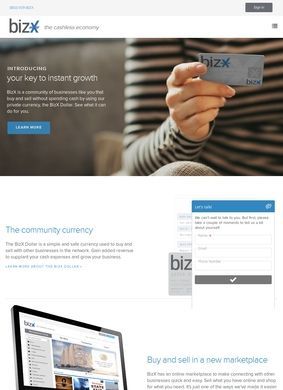
What happens to a hotel's empty rooms in the off-season, or a printer's slow Tuesday, or a dentist with gaps in the appointment book? Bizx.com answers that question with a barter network: member businesses sell their spare capacity to each other and get paid in a closed-loop currency called BizX dollars, which they then spend on things they need without touching their cash reserves. The platform, run out of Bellevue, Washington, has built a whole economy around the simple idea that one company's idle inventory is another company's wanted purchase.
How the barter network works
The mechanics are worth understanding before deciding whether it fits a given business. A member lists what they can supply, earns BizX dollars when another member buys it, and then turns around and spends those dollars across the network. No money changes hands at the point of trade. For a restaurant sitting on Tuesday-night tables or a consultant with unbooked hours, the appeal is that you convert something that would otherwise expire into purchasing power for advertising, equipment, travel, or whatever else the network carries. Bizx.com puts the figure for collective member savings at over twenty million dollars a year in cash that stays in the bank, which is a bold number, though it is the company's own accounting and worth treating as a marketing claim rather than an audited stat.
Marketplace and member directory
The heart of the service is the Marketplace, where members browse what is on offer and transact in BizX dollars. Alongside it sits a Member Directory, and in a barter setup the value of any exchange depends entirely on whether you can find businesses that want what you sell and sell what you want. A thick, varied membership is the whole game. Bizx.com says it covers a decent spread of industries, naming events, health and wellness, construction, travel, restaurants, and professional services, so the network is broad enough that a member is not stuck holding dollars they can never spend.
Mobile app for tracking balances
There is a mobile app for both iOS and Android, so members can check balances and transact away from a desk. That is a sensible inclusion for a system where opportunities to spend or earn come up on the move. I found the breadth of supporting tools more reassuring than the headline pitch, because it points to a platform that has been operating long enough to need infrastructure.
Line of credit for members
A line-of-credit application is also part of the offering, which lets members spend BizX dollars before they have earned them, smoothing the timing problem that often trips up barter arrangements when your selling season and your buying season do not line up. A new restaurant could draw down credit to fit out its kitchen through the network, then repay it later in covers, which is the kind of timing flexibility that pure cash trading cannot match.
Who joins and what it costs
The audience Bizx.com targets is specific: small businesses, nonprofits, and entrepreneurs, the kinds of operations most likely to have uneven cash flow and underused capacity. Membership is free to join, which lowers the barrier to testing whether the network has buyers for what you produce. That free entry point is a fair signal, since a barter exchange has no value to a new member until the directory delivers real trading partners, and charging upfront for an unproven fit would be a hard sell.
Reaching support and staff
On the practical question of whether someone can reach Bizx.com, the site does well. There is a phone line at the toll-free 800 number, a help email, and a real street address in Bellevue, with weekday hours posted clearly for the Pacific time zone. A dedicated contact route lives at the company's contact page. For a financial-adjacent service where members are tracking balances and processing transactions, that visible, multi-channel access is exactly what you want; a barter platform that hid its phone number would be a red flag, and Bizx.com does the opposite. Knowing there is a staffed office during business hours takes some of the abstraction out of trading in a currency you cannot deposit at a regular bank.
Accounting guides and success stories
Bizx.com also runs a Help Center with transaction-processing guides and publishes accounting resources, which speaks to the bookkeeping reality of barter. Trades in BizX dollars still carry tax and accounting implications, and a platform that hands members documentation on how to record and process transactions is treating that seriously instead of leaving people to figure it out alone. Success stories round out the site, giving prospective members a sense of how others have used their dollars, though those are self-selected testimonials and should be read as such.
Comparing employee reviews across sites
When looking for what outsiders say about Bizx.com, almost everything that surfaced was about working there, not trading there. That distinction shapes how much anyone should rely on the ratings. Glassdoor carries around 35 employee reviews with an overall rating near 2.8 out of 5 and only about a third of staff saying they would recommend the place. Indeed shows employee reviews leaning negative, with the familiar complaints about pay and management. CareerBliss has a much smaller sample, three reviews averaging 3.4 out of 5. Scamadviser, for its part, flags the site as legitimate and shows no user complaints.
Those numbers measure internal culture, not the barter service itself. What is genuinely missing is the customer side: no Trustpilot, no Better Business Bureau profile, no Google or Yelp ratings from actual members describing their experience trading on the platform turned up. For a service that asks you to accept payment in a private currency, the absence of independent member reviews is a gap worth weighing, ideally by talking to existing members directly before putting inventory into the system.
None of that makes Bizx.com a poor operation. Legitimacy is not in question, the contact transparency is strong, and the feature set around the Marketplace, the directory, and the credit line is mature. But a barter exchange lives or dies on liquidity and trust, and the public evidence on the member experience is sparser than the polish of the site suggests. That mismatch is the single most useful thing to know going in: do your own diligence on whether the network in your industry and region is deep enough to be useful to you specifically.
Against an alternative like ITEX, the long-running national barter exchange that many small businesses already know, Bizx.com competes on a similar promise with its own twist toward a digital marketplace and app-first experience. ITEX has the wider geographic footprint and a longer public track record, while Bizx.com leans on a tighter, regionally rooted network and clearer in-house tooling around credit and accounting. For a Pacific Northwest business with seasonal slack to monetize, Bizx.com is a credible option, provided you confirm the directory holds the trading partners that would make those BizX dollars worth earning. If your operation runs nationally and you want the broadest possible pool from day one, the older, larger exchange may match you faster.
Business address
BizXchange
Seattle/Puget Sound Area,1100 Olive Way,Suite 1720,
Seattle,
WA
98101
United States
Contact details
Phone: (206) 447-9933
Fax: (206) 447-9966