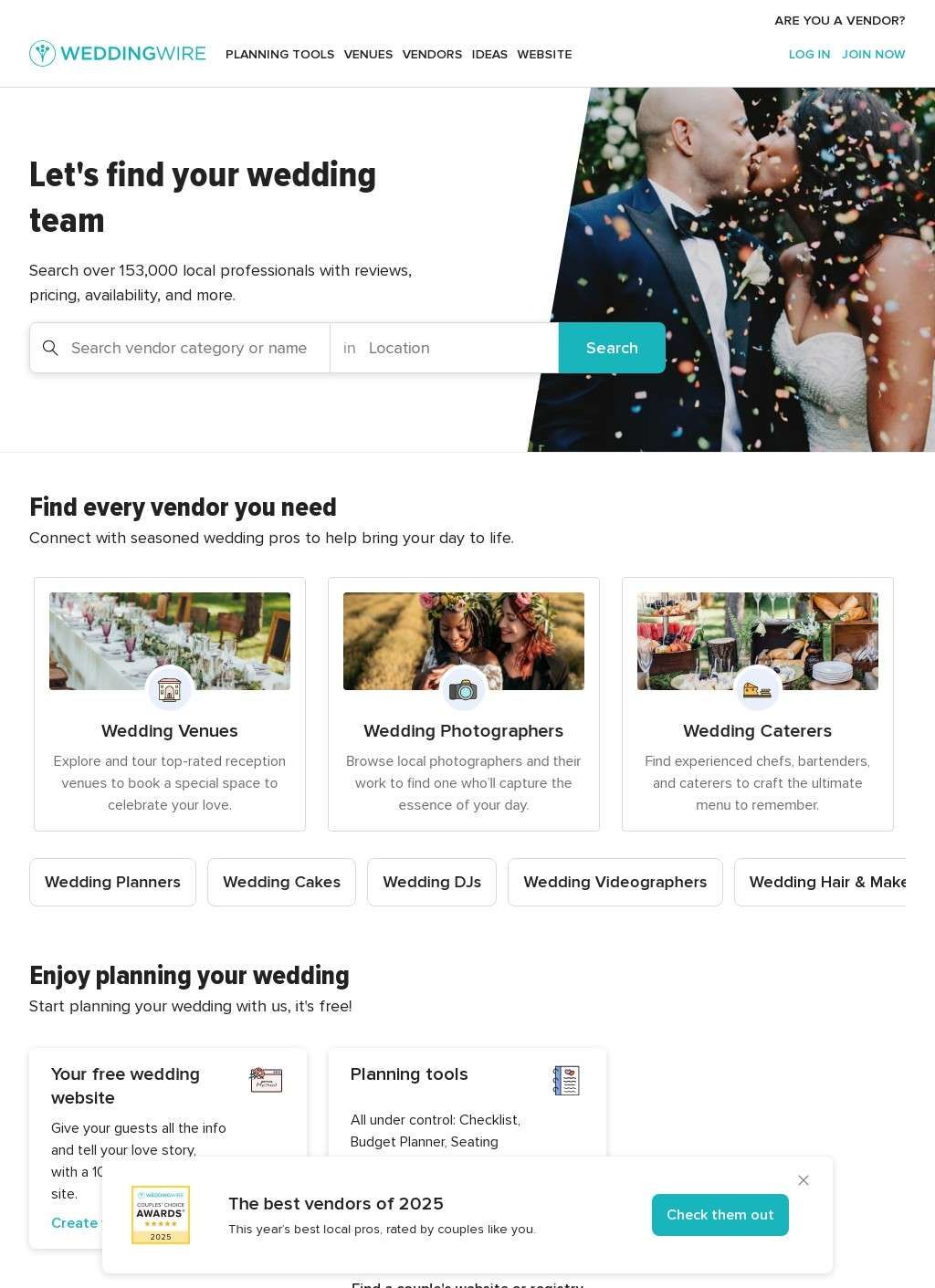
Getting engaged is the easy part. What follows is a logistics problem dressed up as romance: a venue to secure before someone else books the date, a photographer whose style you trust, a caterer who can feed two hundred people without bankrupting you, and a hundred smaller decisions that all have to land on one afternoon. WeddingWire exists to absorb that chaos, functioning as both a vendor marketplace and a planning workspace so a couple can move from "we need a florist" to "we have booked one" without leaving the site.
Marketplace of 156,000 wedding professionals
The marketplace side is the larger draw, and the numbers behind it are genuinely substantial. WeddingWire lists more than 156,000 local wedding professionals, sorted into the categories you would expect and several you might not think to search for until you need them. Venues alone are broken out by type, so a couple who knows they want a barn, a beach, a winery, a historic site, a hotel, a restaurant, a banquet hall, or a church can filter directly to it instead of scrolling past every other style.
Beyond venues, WeddingWire covers photographers, videographers, DJs and live bands, caterers, florists, officiants, planners, hair and makeup artists, photo booths, transportation, invitation designers, jewelers, and travel agents for the honeymoon. That breadth is the point. A couple rarely needs just one vendor, and consolidating the search saves them from rebuilding their criteria across a dozen separate sites.
Vendor profiles with reviews, pricing, availability
Each vendor profile on WeddingWire carries reviews, pricing, and availability. Pricing and availability up front cut real friction, because the most common frustration in wedding planning is contacting a vendor only to learn they are booked or far outside budget. Having that surfaced before the first message eliminates a lot of wasted back and forth. The review element also feeds the annual Couples' Choice Awards, which WeddingWire issues to top-rated local vendors based on accumulated couple feedback. Award badges issued by a platform can be self-serving, but tying this one to actual review volume and scores at least roots it in something a reader can sanity-check on the profile itself.
Planning checklist, guest list, budget tools
Where WeddingWire separates from a pure listings site is the planning toolkit, and it is fuller than couples typically expect. There is a checklist that paces tasks against the wedding date, a guest list manager, a seating chart builder, and a budget planner, which together cover the four problems that keep people up at night.
Specialized tools for dates, costs, design
WeddingWire layers more specialized tools on top: a date finder, a cost guide so couples can pressure-test what they are being quoted against typical ranges, a wedding color generator, and a hashtag generator for the social side. None of these are revolutionary on their own, but having them in one account, where the guest count in your seating chart talks to the guest list and the budget reflects vendors you have contacted, is the kind of integration that a stack of free standalone apps never quite manages.
Free wedding website with registry aggregation
The free wedding website creator deserves its own mention, because it is the feature couples often arrive for and stay for. WeddingWire offers customizable templates, and the site can carry the practical load of a modern wedding: directions, accommodation notes, the schedule, RSVPs, and a link through to the registry. On registries, WeddingWire works as an aggregator, pulling together gifts across retailers like Amazon, Crate and Barrel, and Target, and folding in a honeymoon-fund option through Traveler's Joy. For guests, that means one link covers everything instead of being routed to three different store accounts, and for couples it means they are not locked into a single chain's inventory. It is a sensible piece of design that respects how people shop.
Community forums for planning questions
There is a community layer too, and it is more active than the usual bolt-on forum. On WeddingWire, discussion groups spanning planning, attire, honeymoon, reception, ceremony, etiquette, style, fitness, and registry questions, along with local groups where couples married in the same region can compare notes on specific vendors and venues. Etiquette threads in particular tend to be where the real value sits, since those are the questions people are too anxious to ask family and too specific to Google cleanly. A platform that lets someone who married in the same county six months ago answer them is doing something a planning checklist cannot.
Bridal gowns, destination weddings, elopements
The bridal dress section is a smaller piece but worth noting for couples shopping the gown early. It features named designers including Martina Liana, Essense of Australia, All Who Wander, and Rosa Clara, enough to start narrowing a silhouette and a price tier before setting foot in a salon. It reads more as inspiration than a place to buy, and that framing is honest. WeddingWire also extends past the standard local-church-and-reception model, with dedicated resources for destination weddings and for elopements, the two paths that tend to be poorly served elsewhere. A couple eloping does not need a seating chart for two hundred, and one marrying abroad needs travel coordination a domestic checklist ignores, so giving each its own track is a thoughtful distinction.
Mobile apps for couples and guests
Mobile apps round it out, with one built for couples to manage planning on the go and a separate guest-facing app. That is a sharper distinction than competing platforms bother to draw, and it reflects something consistent across WeddingWire: the product is built around how weddings work rather than how they look in a marketing deck.
Free for couples, revenue from vendors
The economics are simple: the whole thing is free for couples. The cost guide, the website builder, the tools, the directory, the forums, all of it carries no charge to the people getting married, since revenue comes from the vendor side. That alignment is mostly healthy, though vendor profiles are profiles vendors choose to maintain, so the directory reflects who has signed up as much as who is best. The review scores are the better signal to lean on within it.
User ratings across Google and Trustpilot
WeddingWire carries a substantial public review footprint. On Google it holds a 4.2-star rating across more than 2,400 reviews, and Trustpilot shows just under 200 reviews with a score around 3.7, which is lower but not unusual for a platform that sees the full range of wedding planning stress. The picture is consistent with a large, genuinely useful tool that occasionally frustrates users when things go sideways, as every marketplace of this scale does.
The natural comparison here is The Knot, which covers nearly identical ground and is in fact run by the same parent company. The two platforms overlap so heavily that many couples use both, and an honest reading is that WeddingWire tends to be more directory-forward and tool-driven, while The Knot leans harder into editorial content and inspiration browsing. A couple who wants to start from a structured vendor search with pricing and availability visible, then build out their planning workspace and guest site in the same place, will find WeddingWire fits that workflow well. As a destination among general wedding resources, it earns the entry: for most engaged couples in the U.S., it is a strong default and a reasonable place to run the entire process from the first venue search to the final RSVP count.