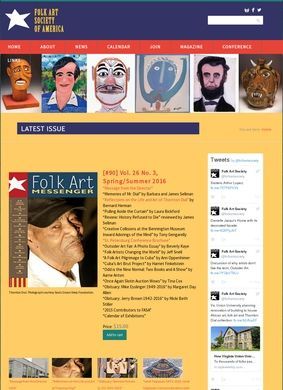
Someone who has just inherited a box of unsigned carvings, or stumbled on a roadside yard packed with painted concrete figures, usually hits the same wall: where do you even start learning whether any of it matters, who made it, and what the wider field thinks. Most general art references skim past self-taught and vernacular work, and academic databases tend to bury it under formal categories. The Folk Art Society of America aims squarely at that gap. It is a 501(c)(3) nonprofit out of Richmond, Virginia, running since 1987, and its whole reason for existing is the discovery, study, documentation, preservation, and exhibition of folk art, folk artists, and the often-overlooked environments those artists build.
The Folk Art Messenger journal
The center of gravity here is The Folk Art Messenger, the organization's journal. It comes out three times a year and, unusually, carries no advertising at all, which tells you something about how the publication sees its job. Members get it as part of joining; non-members can buy a single issue for fifteen dollars. Inside you get articles on self-taught artists, reviews of exhibitions and new books, field news, and an international calendar of folk art events. That last piece is more useful than it sounds, because tracking folk art shows across regions and countries is exactly the kind of legwork an individual researcher cannot easily do alone. The Folk Art Society of America has been compiling it for decades, and GuideStar credits the publication program with serving roughly 600 people.
Searching the article archive
The article archive is organized in a way that actually repays browsing. Articles are searchable by subject and by author, so you can chase a particular artist, a theme, or a writer whose eye you trust, instead of scrolling a flat archive and hoping. There are foreign-language articles in the mix too, which fits a field where important work and important scholarship are scattered well beyond the English-speaking world. The events calendar is split by region, Northeast, Southeast, Midwest, Southwest, West, and Europe, so a collector planning a trip can see what is happening near a destination without wading through irrelevant listings.
Annual conferences and National Folk Art Sites
Beyond publishing, the Folk Art Society of America does the connective work that holds a niche field together. It has held annual conferences for more than 34 years, which is a long run for any membership group and a sign that the gatherings deliver enough to keep people coming back. It hands out Awards of Distinction, and it designates National Folk Art Sites, a recognition that genuinely protects the artist-built environments, the painted houses, sculpture gardens, and obsessive yard installations, that are so easy to lose to weather, redevelopment, or simple neglect once their makers are gone. Naming and documenting those places is preservation in the most practical sense, and it is harder, slower work than mounting a gallery show.
The Folk Art Society of America has also put out at least one book, "A Half Century of Folk Art: My Recollections," which extends the same documentary impulse from the journal into longer form. None of this is flashy. The site is a working hub for a specific community, and it reads that way, which is a compliment.
Scope and audience
It is worth being clear-eyed about scope. The Folk Art Society of America serves a defined audience: collectors, researchers, dealers, and the segment of the general public that already cares about self-taught and vernacular art. If you are looking for a polished consumer marketplace or a slick visual gallery to browse for an afternoon, this is not built for that, and it does not pretend to be. The value sits in the depth of the writing and the durability of the record it keeps. A newcomer might find the density a little demanding at first, since the material assumes you came in with at least some curiosity about the subject. That trade-off is reasonable for an organization whose mission is documentation first.
The membership and subscription structure is straightforward, and the no-advertising stance on the journal is significant. A publication funded by its readers rather than by advertisers has more freedom to cover obscure artists and unfashionable corners of the field, and the Folk Art Society of America clearly leans into that freedom. Three issues a year is a modest cadence, but for a volunteer-driven nonprofit covering a specialized beat, steady and consistent output across decades is no small thing.
Building institutional memory
For anyone who wants a sense of where folk art sits in the broader cultural conversation, the Folk Art Society of America functions as a kind of standing institutional memory. The combination of an indexed article archive, an event calendar with international reach, and decades of conference history means the knowledge does not vanish when individual experts retire or collections get dispersed. That continuity is the quiet strength of the Folk Art Society of America, and it is the reason a serious inquiry into a particular artist or environment is likely to turn up something here that a broad search engine misses.
If you are a collector trying to authenticate or contextualize a piece, a graduate student researching self-taught artists, or simply someone who keeps photographing strange handmade roadside monuments and wants to know whether others have studied them, the Folk Art Society of America is a sound place to dig in. The most concrete first move is to read a single issue of The Folk Art Messenger, or pull up the article archive and browse by the artist or subject you care about. The depth of the record is what distinguishes it, and for most people who arrive with a genuine question about folk art, that depth is exactly what the search was missing.