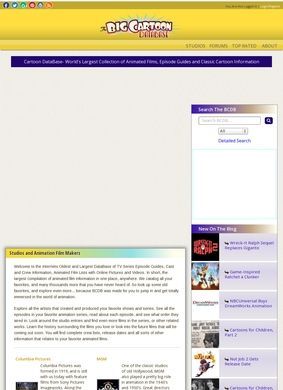
Where do you go when you need to know who directed a forgotten 1940s theatrical short, or which voice actor played a bit part in a Saturday morning cartoon nobody talks about anymore? For animation, the answer has often been The Big Cartoon DataBase. It sets out to catalog animated films, TV cartoons, and shorts on a scale that treats cartoons as a subject worth indexing properly, with something like the care a film reference gives to live action.
The pitch is simple to state and hard to execute: an IMDb-style reference built specifically for animation. The Big Cartoon DataBase reaches for that, and its scope is what makes it stand out.
What the database holds
Individual entries carry the kind of production detail that fans and researchers usually have to piece together from scattered sources. Directors, voice actors, writers, animators. Studio and production company information. Release dates, character listings, and plot summaries sit alongside those credits.
The coverage is broad. Theatrical shorts, feature-length animated films, television series episodes, and made-for-video animation all fall inside its net, and that net stretches across many decades and countries, American output included but hardly the whole of it. A person hunting down credits for an obscure short from a studio that folded generations ago is exactly who The Big Cartoon DataBase was built for.
What gives The Big Cartoon DataBase its value is that some of this information genuinely is hard to find anywhere else. Animation history has always been under-documented compared with feature film, and a specialized reference filling that gap earns attention on the strength of the gap alone.
Credits and production information
The credit data is the spine of the whole thing. When you can trace a single animator or writer across dozens of productions, the database stops being a lookup tool and starts being a research instrument.
Voice actor filmographies, studio rosters, the connective tissue between one cartoon and the next: this is the material that historians and industry people come back for, and it is a reason a reference like this outlasts casual fan sites that fade after a few years.
Indexes, characters, and community
Historically the site has organized its holdings through searchable indexes arranged alphabetically and by studio or series, which is a sensible way to let someone browse without knowing the exact title they want. Character databases and voice actor pages give a second route in, so a visitor can arrive through a performer or a character and work outward.
Beyond the raw data, the site has carried galleries, trivia, and forums where animation enthusiasts trade knowledge. Those community areas deserve a mention, because a reference of this kind lives partly on its contributors. The people who bother to correct a credit or fill a missing entry are what keep a catalog like this honest over the long haul.
Who it serves and why the depth matters
Animation historians and researchers are the obvious audience, but the reach is wider than that. Collectors chasing provenance, fans settling an argument about who made what, industry professionals checking a credit before they cite it in their own work, all need something slightly different, and a database organized this many ways can answer most of them.
The single-subject focus is more useful than a general film database precisely because animation gets flattened everywhere else. A giant catalog that covers everything tends to treat a hand-drawn short as an afterthought, light on credits and vague on studio history. Here the whole apparatus is pointed at cartoons, so the detail is there where a generalist reference gives up.
That depth is the argument for consulting it over a quick web search. Search engines surface the famous titles and go quiet on the rest. A dedicated catalog keeps going into the corners.
Outside reviews of the site itself are scarce. A search for independent write-ups or ratings of The Big Cartoon DataBase as a resource turned up little beyond forum mentions and passing references in animation-history articles, nothing resembling a structured review count on a review platform. That absence is not damning for a reference tool built by and for a niche community, but anyone weighing it purely on outside endorsement will not find much to weigh.
A note on reaching it and what that means
Honesty demands one caveat. During this review, attempts to load the live site returned only an empty directory listing with no rendered content, whether through a plain fetch or a scraper. That points to the site being down, misconfigured, or blocking automated access at the moment, and it is not a judgment on the catalog itself. The Big Cartoon DataBase has run for a long time, and a single failed request says nothing about the archive behind it.
The body of work The Big Cartoon DataBase represents is documented extensively elsewhere, and its standing as a reference for animation credits and history does not rest on whether one automated request got through on a given day. Treat the access hiccup as a technical footnote rather than a verdict.
Still, it is worth knowing before relying on it for something time-sensitive. Anyone chasing a credit for a deadline should have a backup source in mind. A reference is only as good as your ability to open it, and a long-running site can go through a rough patch with its hosting.
What The Big Cartoon DataBase set out to do, and mostly has done across its long run, is give animation the kind of detailed, credit-level record that other film forms have taken for granted for decades. The scope is broad, the audience is specific, and the material fills a documented gap. The current access trouble is worth watching before treating it as a first stop for something urgent, but the archive it points to remains, on the evidence, one of the more thorough animation references around.