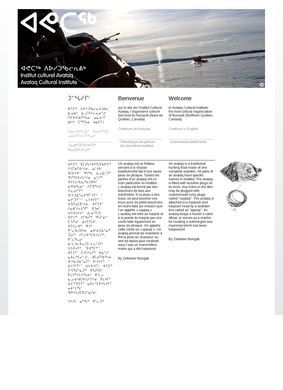
Avataq Cultural Institute is a non-profit organization based in Westmount, Quebec, that works to protect and promote the language and culture of the Nunavik Inuit of northern Quebec. It has been at this since 1980, when the biennial Inuit Elders Conference gave it that mandate, and the mandate still shapes what the site puts in front of you. This is not a general-interest culture page. It is the working home of a body that answers to Inuit communities and carries out heritage work on their behalf.
The name itself tells you something about the seriousness of the project. An avataq is a sealskin float used in hunting, and the Avataq Cultural Institute took that object as its emblem. There is a page describing it, and the choice reads as deliberate: a piece of everyday material culture, not an abstraction, standing in for the whole effort.
What the site actually holds is a spread of activity that most visitors will not have expected from a single institution. Language documentation in Inuktitut sits alongside the archiving of oral history and place names. There is museum and collection work. There is a publishing arm. And there is repatriation, the slow and often difficult business of bringing ancestral material home. Few organizations of this size attempt all of it at once, and the Avataq Cultural Institute does.
The range of heritage work on offer
Governance comes first here because it colours everything else. A board of five Inuit members, elected to two-year terms, runs the Avataq Cultural Institute. That structure is worth pausing on. It means the people setting priorities are the people whose culture is being documented, which is a different arrangement from the outside anthropologist model that dominated Inuit studies for a long time. The two-year cycle also keeps the leadership answerable, and that accountability shows up in how carefully the material is presented.
A search of the usual review platforms and business directory listings turns up nothing for the institute itself, which is not surprising: a mandated cultural body is not a shop or a clinic, and consumer review sites were never built to cover it. There is no public rating to weigh against the work, so the only real evidence is what the site documents: the archives, the publishing list, the repatriation record.
Language and archiving
The Inuktitut documentation work is the quiet backbone of the whole thing. Toponyms, the traditional place names that carry generations of geographic and practical knowledge, are collected and preserved before they fade as elders pass on. Oral history archiving runs on the same logic. I find the toponymy strand the most quietly consequential part of the site, because a place name lost is knowledge that no dictionary recovers.
None of this is flashy. It is the sort of patient recording that only makes sense over decades, and the Avataq Cultural Institute has had those decades. A reader who came expecting a gallery of pretty pictures will need to adjust; the value here is in the depth of the record, and the record is the point.
Publishing and the Sanaaq case
On the publishing side, the standout is "Sanaaq," a novel that the Avataq Cultural Institute helped bring into print. It has an independent life among general readers, with a solid average rating across several hundred ratings on Goodreads, which is unusual reach for a work tied to a small cultural body. That the book travels beyond the Nunavik audience says something about the editorial judgement behind the publishing program.
Publishing lets the institute do what archiving alone cannot: put Inuit voices into circulation as literature, on their own terms. It is a narrow output in volume, but a pointed one.
Repatriation with Dartmouth
The repatriation work is where the authority of the Avataq Cultural Institute becomes concrete. In 2018 it collaborated with Dartmouth College to return Inuit ancestral remains that had been excavated back in 1967. That kind of negotiation, between a community body and a major American college, only happens when the institution on the Inuit side is recognized as the legitimate voice for those communities. Half a century between the excavation and the return is a long wait, and closing it took an organization with standing on both sides of the border.
It is also the hardest work to do quietly and well, and the fact that it appears on the site as documented history rather than as a press release tells you how the institute carries itself. This entry sits in a visual arts category, but the substance runs well past art into questions of ancestry, ethics and law.
The site is bilingual, French and English, which matches the reality of Quebec and widens the audience to researchers and educational users outside Nunavik. An "Institute" section lays out the organizational history and the mandate, so a newcomer can understand who is doing this and under what authority before getting into the material culture content. The framing is careful throughout, and it reflects a body that expects to be read by scholars as well as by community members.
Who is the intended reader? Partly the Nunavik Inuit communities themselves, for whom the Avataq Cultural Institute keeps a record of their own language and history. Partly the wider public, researchers and students who want a grounded account of Inuit culture from the body mandated to keep it. Those two audiences pull in slightly different directions, and the bilingual, section-based structure is an honest attempt to serve both without watering either down. The material culture pages, like the one on the avataq float, do double duty here: plain enough for a curious visitor, precise enough for someone studying the objects.
Avataq Cultural Institute is easy to recommend to anyone with a real interest in Inuit culture, and worth the patience it asks of a casual browser. The work is dense, the mandate is genuine, and the institutional weight behind it is not manufactured. What is missing is a quick, decorative tour; what is there instead is the accumulated record of a people's language, names and objects, kept by a body those people elect.
Avataq Cultural Institute has spent more than four decades assembling that record, and the Dartmouth repatriation alone is enough to show the mandate is being carried out rather than merely stated on a homepage.