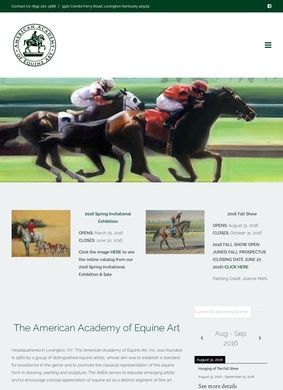
This group draws a hard line that tells you almost everything about it: no photographs, no giclees, no inkjet prints. Only paintings, drawings, and sculptures of horses make it onto the walls. That single rule, applied since the American Academy of Equine Art was founded in 1980 by ten artists, sets the tone for an organization built around a narrow and traditional definition of what counts as equine art. Joseph Rogers and Alexander Mackay-Smith pulled the founding group together, and the focus has stayed on classical, representational work ever since.
Behind the broken web address
A first complication is worth flagging early, because anyone arriving from this listing will hit it. The web address attached here, aaea.net, is a parked GoDaddy domain with nothing on it. The real activity of the American Academy of Equine Art lives at aaea.info. So the link a curious visitor follows from this entry leads to a dead end, and the actual portfolio, contact details, and membership information sit one search away on a different domain. For an organization whose whole purpose is visibility for a specific kind of art, that broken front door is an odd thing to leave standing.
The confusion is fixable. The active domain works, the GuideStar record is current, and the social accounts are live. None of that erases the fact that the entry point listed here goes nowhere, but the American Academy of Equine Art has not vanished; it has simply left the wrong domain out front.
Juried membership structure
Once you find the live site, the structure is clear enough. The American Academy of Equine Art runs on two membership tiers, Signature members and Juried members, indicating a selection process rather than an open sign-up. A juried system means someone is making judgments about quality and fit, and the no-prints policy reinforces that the bar is about original work in paint, pencil, and three dimensions. It is a deliberately small gate, and the American Academy of Equine Art does not seem interested in widening it.
Exhibitions, workshops and critiques
The activities back this up. The American Academy of Equine Art holds at least two juried exhibitions a year, historically at the Kentucky Horse Park in Lexington and at other venues around North America. It also runs workshops taught by working equine artists and offers critiques. An online gallery of member works is kept on the active site, which gives a prospective member or a buyer a way to see what the standard looks like before getting involved. Demonstrations and educational efforts round out a mission plainly aimed at both artists and the public, with neither side treated as an afterthought.
What I find genuinely useful here is the specificity. Plenty of arts groups describe themselves in soft, aspirational terms; this one tells you exactly what it will and will not show, where it shows it, and how you get in. That precision is rare, and it makes the group easier to size up than a vague mission statement ever could.
Confirmed nonprofit status
The organization is a non-profit, tax-exempt body, and that status is independently confirmed: the American Academy of Equine Art appears on GuideStar under EIN 52-0048344. For anyone deciding whether to donate, join, or lend work to an exhibition, that registration is a real anchor. It is verification that an individual artist or a small gallery cannot offer, and it lends weight to the claim of being a serious, long-running institution.
Contact details in Lexington
Lexington is the home base. External listings put a physical address at 3915 Jay Trump Road, with a P.O. box also in the city, and a contact page on the active site carries a cell number and an email. So the contact route exists and is reachable, though again the catch is that you have to be on aaea.info to find any of it. None of it surfaces from the domain printed on this listing. The information is solid once located; the path to it is the weak point.
The choice of Lexington is not incidental. Kentucky horse country is about as fitting a base for a horse-art academy as exists in the United States, and the recurring use of the Kentucky Horse Park as an exhibition venue ties the American Academy of Equine Art to a place that already draws people who care about the subject. The address and the subject matter line up in a way that feels considered, not accidental.
Public reviews and ratings
On outside opinion, there is not much to weigh, and it is fairer to say that plainly than to dress it up. A Yelp page exists for the Jay Trump Road address, filed under art schools, but the search snippet shows no visible rating or review count. The Facebook page sits at 489 likes, and there is an Instagram account as well. No Trustpilot, BBB, or Google star ratings turned up. For a niche non-profit that operates through exhibitions and a juried membership, the absence of a pile of consumer reviews is normal and not damning. Still, it means the case for the American Academy of Equine Art rests on its own record and its nonprofit registration, not on a chorus of public feedback.
The social following is modest but consistent with the size of the field. Classical equine painting and sculpture is a small world, and a few hundred Facebook likes plus an active Instagram is roughly what a working community of that scale looks like. The American Academy of Equine Art does not pretend to a larger public profile than it has.
Artists who work in traditional horse subjects and want a juried credential, a place to exhibit, and access to workshops and critiques will find a clearly defined home with the American Academy of Equine Art. Collectors and buyers interested in original equine work get a curated gallery and exhibitions to attend. People looking for prints, photography, or a more experimental take on the genre are openly not the audience, and the American Academy of Equine Art makes no apology for that. The demonstrations and public exhibitions also open a door for general visitors who simply want to see good horse art in person.
There is a lot to respect in how the American Academy of Equine Art defines itself. A 1980 founding, a documented nonprofit status, a juried two-tier membership, regular exhibitions at a venue that fits the subject, and a refusal to blur the line between original art and reproduction all point to an organization that knows what it is. The mission is coherent and the track record is long.
Weighing the domain gap
And yet the thing I keep circling back to is the one that opened this review. The domain listed for the American Academy of Equine Art does not work, and the entire substance of the operation lives somewhere else, reachable only by going around the listing. An organization that has spent more than four decades building recognition for equine art has, in effect, let its public signpost go blank. Whether that is a temporary lapse or a sign that nobody is minding the digital storefront, I cannot tell from here, but that gap is hard to ignore when the whole point of the group is to be found and seen.