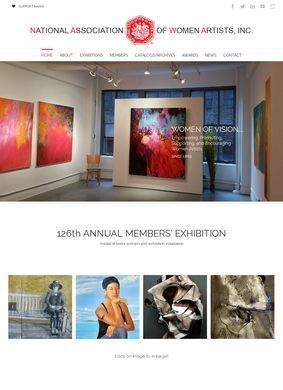
A painter finishes a body of work and wants to show it somewhere reputable, then hits the same wall most independent artists hit: open calls that charge a fee and vanish, galleries that never answer, no peers to compare notes with. The National Association of Women Artists has been closing that gap since 1889. The site is built around getting a working artist from painting alone to exhibiting, holding signature letters after her name, and knowing who else is in the room.
The National Association of Women Artists bills itself as the first professional fine arts women's group in the country. That claim shapes the whole site: the pages are arranged around credentialing and showing work, not around persuading a visitor to join on faith.
A membership structure built for real careers
The National Association of Women Artists lays out its entry points by stage of career. There is a New Member track, an Associate Member level, Signature Member status, and a Graduating Student Membership aimed at people just leaving art school. Each rung means something different in terms of what an artist can enter and how she signs her work, and the ladder gives a younger member a reason to keep coming back as her practice grows.
Behind a login sits a member portal and a member directory. A directory sounds like a small feature, but it turns a mailing list into a network a member can actually search. That is the part most independent artists never manage to build on their own.
Membership categories and the member portal
Sorting people into New, Associate, Signature, and Graduating Student tiers does two useful things at once. It tells a prospective member where they realistically stand, and it tells the public what a given credential is worth when they see it next to someone's name. The portal ties the practical side together: renewals, entries, and access to the directory all live in one gated space instead of scattered across email threads.
Exhibitions and awards that give the membership its point
Everything above would be filing paperwork if the shows were not there. They are, in quantity. The exhibition calendar runs both physical and online, with juried and themed formats side by side. Named shows on the site include "Contrast," "When Words are Not Enough," "HerStory250," "Summer Small Works," and "She the People," alongside the 137th Annual Exhibition. That annual count is worth pausing on, because the National Association of Women Artists does not reach a 137th edition of anything without an unbroken institutional spine underneath it.
Shows also land in outside venues, from the Aloft Hotel to Flushing Bank, which puts member work in front of foot traffic that never sets out to visit an art association. For a mid-career artist, that mix of a juried annual, rotating themed calls, and off-site placements is a genuinely deep menu.
Juried and themed exhibitions
The juried route is where the credibility comes from. Getting selected by a panel is the thing an artist can point to on a CV, and it is what separates this from a pay-to-hang arrangement.
The themed shows do a different job: a prompt like "When Words are Not Enough" gives members a reason to make new work instead of recycling the portfolio, and it keeps the calendar from feeling like the same open call twelve times a year. A themed slate is also how the National Association of Women Artists keeps its annual show from calcifying into routine.
The annual awards and the option to fund one
Selection is backed by an awards program attached to the annual exhibition, with named prizes such as the Hammerschlag Award. There is also a channel to fund an award outright, which is a smart bit of design.
It lets a donor or a family attach a name to a prize in perpetuity, and it converts the membership's own goodwill into recurring money that pays the next generation of members. A self-sustaining recognition engine comes out of it.
History, chapters, and how it stacks up
The National Association of Women Artists has real roots to point to. Its records are held at Rutgers University and at the Smithsonian, which is the kind of custody a hobby club never earns. The site leans on that history openly, under the banner of "136 Years of Women's Art," and backs it with press releases, programs and education initiatives, and the organization's own "NOW" magazine, which even sells ad space and ships a 2026 catalog.
Reach extends past New York through regional chapters in Florida, Massachusetts, Pennsylvania, and South Carolina, so a member of the National Association of Women Artists outside the city can enter shows and join a chapter close to home. A donation and support program rounds out the picture for people who want to back the work without being artists themselves.
Set it against the National Museum of Women in the Arts, the obvious point of comparison, and the difference in purpose is clear. That museum is somewhere you go to look at art. The National Association of Women Artists is something you join to make and show it, to earn a credential, and to land in a searchable community of peers. A woman with finished work and no professional foothold gets far more out of an active membership here than out of a museum ticket, and this site makes that membership legible from the first click.