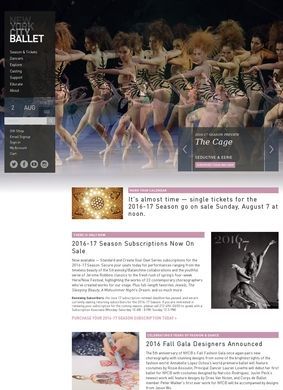
Five world premieres are scheduled for the 2026-27 season at New York City Ballet, alongside the company's debut staging of Alexei Ratmansky's Romeo and Juliet. That is a heavy commission load for any troupe, and it says something about how New York City Ballet thinks of itself: a place where new work is the point, not a once-a-decade novelty bolted onto a repertory of museum pieces. The classical and the contemporary have sat side by side here, season after season, since Balanchine shaped the company's DNA in the mid-twentieth century.
Performance seasons at Lincoln Center
New York City Ballet performs out of the David H. Koch Theater at Lincoln Center, splitting its year into Fall, Winter, and Spring runs. Each season carries a mix of signature productions and fresh material. The one fixture everyone already knows is George Balanchine's The Nutcracker, which New York City Ballet brings back every December and which functions, for a lot of New York families, as the entry point into ballet itself. If you have ever taken a child to their first full-length production, there is a fair chance it was this one.
Ticket options for different budgets
What is genuinely useful about the site is how seriously ticketing is broken out by who you are. Single performance tickets are the obvious route, but New York City Ballet also sells subscription packages that come with complimentary exchanges. When your calendar shifts and you would otherwise eat the cost of a missed night, that exchange policy is worth more than it sounds. Group bookings are handled separately for both repertory programs and Nutcracker runs. And then there is the "$30 for 30 and Under Rush Program," a deliberate price break aimed at younger audiences who would never otherwise sit in that theater at full freight. A company that wants the next generation in the seats has to make the math survivable, and this is a concrete attempt at it.
Education programs for schools and families
The education side is where the offering opens up further, and it is wider than a casual visitor would guess. Public programs cover a lot of ground: Family Saturdays, Children's Workshops, Ballet Essentials, In Motion Workshops, and Inside NYCB, which pull in everyone from total beginners to the merely curious. The school-facing programs are a separate track, built for teachers and classrooms and not designed for walk-up audiences. The Nutcracker Project, Ballet Tales, Project Ballet, Student Tours, and a discounted StudenTix scheme give schools several different doors in depending on budget and grade level. None of this is decorative. It is a structured pipeline from a child's first exposure to an actual seat at a performance, and the consistency across age groups is hard to put together by accident.
Autism-friendly and sensory-friendly performances
Access programming deserves a separate mention because organizations talk about it more than they deliver it. New York City Ballet runs autism-friendly performances and sensory-friendly shows, adjusting the theatrical environment so that families who would find a standard performance overwhelming can attend without strain. That is a real accommodation with real production work behind it, and it broadens who can plausibly walk into the Koch Theater.
Membership tiers and donor cultivation
On the giving side, the structure is layered the way you would expect from an institution of this scale. New York City Ballet offers individual membership tiers, a Patron Program, Major Giving initiatives, a Young Patrons Circle for donors earlier in their careers, and corporate partnerships, all with dedicated presence on the site. Galas and luncheons round out the calendar of special events. The Young Patrons Circle reads as part of the same long game as the rush tickets: cultivate people while they are young so that support compounds over decades instead of arriving only from established wealth.
Beyond the theater stage
Beyond performances and philanthropy, there is a scattering of offerings that fill in the picture. The Rose Studio is available for rentals, so the building works as a venue beyond its own programming. An official merchandise shop sells the usual branded goods. There is a podcast, "City Ballet The Podcast," for people who want the company in their ears between visits, and the NYCB Art Series brings visual artists into the theater experience itself. None of these are the headline, but they show an organization comfortable meeting audiences in formats outside the proscenium.
How does the company rank online?
New York City Ballet has a substantial presence across review platforms. On Google, the company carries thousands of reviews and holds a rating in the four-star range, which is high for a performing arts institution where the programming changes week to week and a single difficult seat or scheduling mismatch can pull a score down. Yelp reviews are numerous and broadly positive, with complaints concentrated on the practical side, mainly ticketing and front-of-house experience rather than the dancing itself. Press coverage is plentiful, and the reputation picture there has been complicated at times by the company's well-documented internal controversies in recent years, which are worth knowing about if you follow New York City Ballet closely.
The phone number and a contact form are on the site, and the Lincoln Center address is public. Practically speaking, New York City Ballet is not a company you need to chase down to find basic logistical information.
Pulling it together, the audience New York City Ballet is built to serve is unusually broad for a single arts body: general ticket buyers, families, school groups, students on a budget, donors at every level, and corporate partners. The site reflects that range clearly, with each constituency given its own path rather than being funneled through one generic funnel. A first-time visitor and a longtime patron are not asked to navigate the same way, and that design choice does a lot of quiet work.
The thing worth weighing is what kind of relationship you want with the company. New York City Ballet rewards the casual single-ticket visitor and the deeply invested subscriber differently, and both tracks are genuinely available. The Nutcracker will always be the easiest on-ramp, the rush program the cheapest, the subscription the most flexible over a full year, and the education programs the most substantial if you have children or a classroom in the mix. The premieres are the draw for anyone who cares about where the art form is heading. Going by the published programming alone, New York City Ballet has put together a more complete offer than you will find at most comparable institutions, and the site, at its best, manages to make that breadth legible.