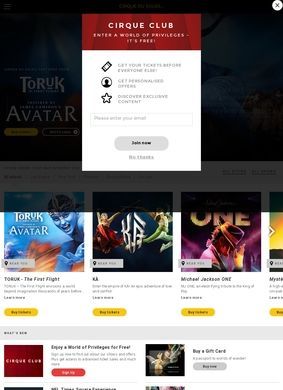
O has been running underwater at the Bellagio for long enough that an entire generation has grown up knowing Cirque du Soleil mainly as the thing you book when you visit Las Vegas. The website leans into exactly that. Type in a city or browse by show title, and within a click or two you are looking at a calendar, a seating map, and a checkout flow for a specific date. For a company juggling resident productions across MGM Grand, Bellagio, Mandalay Bay, and New York-New York alongside tents pitched in cities around the world, the decision to organize everything around two questions, what is playing near me and what is this particular show, keeps the whole sprawling catalog navigable.
Splitting resident shows from touring titles
The resident-versus-touring split is the spine of the site, and it reflects how the business actually works. The Vegas shows are fixed engagements: O, Mystere, Ka, The Beatles LOVE, Mad Apple. The touring titles move through one market and then pack up: Alegria, Corteo, Kooza, Luzia, Kurios, Totem, Echo, among others. A visitor planning a trip can pull up the Las Vegas lineup and compare half a dozen options in one sitting, while someone in a touring city sees a narrow window of dates before the show leaves. That distinction matters because the buying decision is genuinely different in each case, and the site does not pretend otherwise.
Show pages built around each production
Each show gets its own page with the elements that define a Cirque du Soleil production: acrobatics, original music composed for the piece, costume and set design that tends to be elaborate, and a loose narrative thread holding the acts together. The descriptions stay specific to the individual title, which is useful given how different the shows are from one another. O is built around a stage that transforms into water. The Beatles LOVE is a music-driven piece tied to a single catalog. Treating them as interchangeable acrobatic revues would do the company a disservice, and the site avoids that trap by giving each production room to explain itself.
Group sales and gift card options
Beyond the individual shows, the ticketing apparatus covers the practical cases. Group sales have their own path, which makes sense for a product where corporate outings, tour operators, and large parties are a real share of the audience. Gift cards are available, the obvious answer to the problem of buying a live-event ticket for someone whose schedule you do not control. I find the gift-card option more sensible here than at most attractions, since a Cirque show is the kind of splurge people put off booking for themselves.
Corporate structure behind the brand
The corporate layer sits behind the consumer-facing pages, and it is more substantial than a typical entertainment site. Cirque du Soleil operates under the Cirque du Soleil Entertainment Group, which also owns Blue Man Group and VStar Entertainment, so the portfolio extends past the brand most people recognize. Sections on global partnerships name SAP and Epson, the kind of technology relationships that make sense for a company running shows with heavy production demands. There are press resources for media, and a careers and casting area, which is worth noting given that casting for circus and acrobatic talent is a specialized pursuit few employers share much about.
One Drop foundation and Montreal roots
Two other pieces round out the picture and say something about how the company sees itself. One Drop, the water-access charitable foundation that Cirque du Soleil helped establish, has a presence on the site, tied to sustainability messaging. And there is material on the international headquarters in Montreal, the Canadian city where the company was founded and still runs its operations. The Montreal anchor is a real part of the story, a reminder that a brand synonymous with the Vegas Strip is run out of Quebec.
Limits of browsing a large catalog
If there is a limit to the site, it is the one inherent to any large catalog gathered under a single brand: the sheer number of shows can blur together for someone who arrives without a specific title in mind. Browsing by city helps, but a first-time visitor scrolling through a dozen unfamiliar one-word names may struggle to tell whether they want Kurios or Kooza, Totem or Echo. The pages explain each well enough once you commit to opening them, though the catalog rewards a visitor who already knows roughly what they are after.
What the ticketing site accomplishes
For most people the Cirque du Soleil site does the one job that matters, which is getting from curiosity to a confirmed seat for a real performance. The information is accurate to how the company operates, the productions are described on their own terms, and the practical extras, group sales and gift cards, address the situations that actually come up. It functions as the company's storefront, its press room, and its recruiting front door at the same time, and it manages those roles without any one of them crowding out the others.
Comparing a Cirque show to a concert residency
Anyone weighing a night out against, say, a headlining residency from a single musician on the Strip is making a different kind of choice. A concert residency is one performer and a fixed set; a Cirque du Soleil show is an ensemble spectacle where the staging is the star, and the website makes that proposition clear from the first show page you open. For a traveler trying to decide how to spend one evening of a Vegas trip, or a parent looking for something a touring date might bring to their city, it answers the questions that lead to a purchase and gets out of the way. That is most of what a ticketing site for live entertainment needs to do, and the Cirque du Soleil site handles it without fuss.