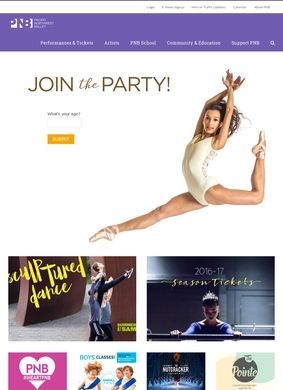
Seattle has been home to Pacific Northwest Ballet since 1972, and the organization has grown into one of the larger ballet companies on the West Coast, running both a professional performing company and a full training school. The website reflects that scale without apology: it handles season tickets, school enrollment, auditions, gift certificates, accessibility planning, and merchandise all in one place, which is either tidy or overwhelming depending on what you came looking for.
Season productions and ticket options
The performance season for 2026-27 runs September through June at McCaw Hall and covers four productions: Serenade, The Nutcracker, Swan Lake, and Ballet on Broadway. That is a deliberate mix. Serenade is the Balanchine piece that opens many a company's year; The Nutcracker is the December earner that funds much of what follows; Swan Lake is the full-length classic audiences buy on the title alone; Ballet on Broadway leans toward the lighter, show-tune end of the repertory. All four are listed with real dates rather than placeholders, which tells you the Pacific Northwest Ballet season is planned and bookable. Finding Pacific Northwest Ballet in any local arts or business directory will surface the same productions, but the company site is where the actual seat selection lives.
Four mainstage ballets for 2026-27
Ticketing is broken into more categories than a single buy-now button. Single tickets, season subscriptions, subscription renewals, gift certificates, and a mobile wallet for holding passes on a phone all have separate paths. The renewal track sitting apart from new subscriptions is the detail that stands out: you only build a dedicated renewal flow when a meaningful portion of your buyers came back last season and the one before. Gift certificates are timed to catch the holiday purchase that clusters around Nutcracker. The mobile wallet is just practical on the night itself, when nobody wants to hunt for a printout at the McCaw Hall doors.
Multiple paths to purchase or renew
Pacific Northwest Ballet runs a training program divided into children's, student, professional, and adult tracks. The school has operated alongside the company for decades, and the Pacific Northwest Ballet professional division in particular has produced dancers who have gone on to work at companies elsewhere in the country. That arc covers a first plie through pre-career conservatory work, with adult classes for people who took up ballet later or returned to it after years away.
Training school and professional pipeline
Auditions, summer intensives, and community education programs fill out the calendar. The professional division is the part that separates a serious academy from a neighborhood dance studio: it is the pipeline that feeds companies, and having one in-house means Pacific Northwest Ballet is not entirely dependent on poaching trained dancers from elsewhere. The children's and student tiers are the broad base that keeps the school financially sustainable, and the adult classes keep the building in use for people who will never perform but want to dance anyway.
Children, students, professionals, adults
Two named campuses appear on the Pacific Northwest Ballet site. The Phelps Center in Seattle and the Francia Russell Center in Bellevue serve as the rehearsal and teaching homes, while McCaw Hall is the public stage where the season plays out. The Bellevue campus makes practical sense for a metro area divided by water: families on the east side of Lake Washington get a location they can reach without crossing into the city for every class. Naming that center after Francia Russell, a figure tied to the company's own history, is the kind of quiet continuity these institutions carry without needing to explain it.
Two Seattle-area teaching locations
An online gift shop and accessibility information for McCaw Hall round out what the website covers. The merchandise arm catches the impulse purchase on the way out of a show and the gift-shopping parent during Nutcracker season. The accessibility section is less glamorous but more important for a chunk of the audience: wheelchair users, patrons with low vision, and people who need assistive listening devices have to plan a night out in advance, and a venue that puts that information where people can find it before they buy has done the actual work, and written a policy is a distant second to that.
Merchandise and accessibility information
As an organization, Pacific Northwest Ballet could coast on The Nutcracker alone, the way many regional companies effectively do, but the season pairs that earner with the Balanchine canon and a full-evening classic. That is a sign of artistic range rather than pure box-office calculation. The school is not a marketing add-on either. A professional division with real auditions and a summer intensive is the infrastructure of a company that grows talent in house and does not depend entirely on the open market.
The site is honest about the practical mechanics in a way that respects the reader's time. Season dates are concrete. Productions are named. The various ways to buy or gift a seat are spelled out separately. None of it asks you to dig. For an organization handling everything from a five-year-old's first class to a full Swan Lake, keeping the information legible is harder than it looks, and Pacific Northwest Ballet manages it.
One fair warning: the depth here rewards someone who already knows roughly what they want. A visitor arriving cold, curious about ballet but unsure whether they are shopping for a show, a class, or a gift, has a fair amount of territory to cover before the site narrows to their specific need. That is the natural cost of an institution this broad.
On outside reputation, a search for Pacific Northwest Ballet on Google and Yelp turns up a small number of audience reviews, enough to confirm the company has a real and loyal following in Seattle but not the volume that gives you a statistical picture. That absence reflects the nature of performing arts organizations more than anything else; most people who attend regularly do not leave written reviews. The published record on the site itself, a named season with dates, a professional training division with auditions, two physical campuses, and a full accessibility section, is the more meaningful evidence of what Pacific Northwest Ballet is and does as an institution. The Pacific Northwest Ballet site, taken as a whole, presents a large and active organization without overselling it.