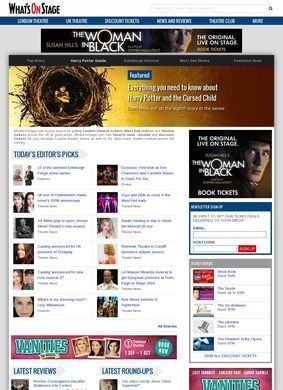
What's On Stage is a UK theatre platform that pulls show listings, news, reviews, and ticketing into one place, with its centre of gravity firmly on London's West End. The listings reach well beyond the capital, covering Off-West End houses and more than a dozen regional cities including Birmingham, Edinburgh, Manchester, and Stratford-upon-Avon. Someone trying to work out what is playing this week, and where, can browse by city or by production and land on a page that combines practical details with editorial context.
Ticketing options for different theatregoers
The ticketing side is the part most casual visitors will use first. On What's On Stage, productions are listed with the option to buy directly, and a separate special offers section gathers discounted seats for people who care more about price than about catching a specific opening. Sitting alongside that is a Theatre Club membership, which folds discounts and members-only offers into a recurring arrangement for regular theatregoers. The two routes serve different habits: the offers page for the opportunist, the club for someone who books a dozen shows a year.
Editorial content beyond ticket sales
Editorially, What's On Stage does more than a pure ticket reseller. Both critic and audience reviews appear against productions, which lets a reader weigh a four-star write-up against the crowd's own scoring. There is theatre news, production announcements, and performer interviews, plus podcasts and the occasional quiz for readers who treat theatre as a following rather than a one-off outing. Photo galleries and exclusive video content round out coverage of bigger openings, and a newsletter keeps regulars looped in on what is being announced. The mix of hard listings and softer feature content is the thing that separates it from a box office: a visitor can arrive for a ticket and leave having read an interview with the lead.
Annual awards voted by readers
The annual What's On Stage Awards give the brand a fixed point in the calendar. It is a reader-voted ceremony spanning the West End and UK theatre more broadly, and running its own awards puts the publication in a different position from a site that only sells access to other people's shows. Voting is open to the public, which ties the ceremony back to the same audience the listings serve and gives readers a reason to return at a set time each year.
Regional listings and venue information
A few extras fill out the offering: a Pride Theatre Guide, city-specific destination guides for planning a trip around a show, and aggregated venue information so a listing carries the where as well as the what. None of these are headline features, but together they point to a site built for people who plan around theatre as a regular habit.
Credibility through breadth and depth
On substance, What's On Stage leans toward credibility. The combination of a wide regional listings base, dual critic-and-audience reviewing, and a long-standing awards programme is the kind of footprint that bare aggregators simply do not have. The depth on the West End in particular is considerable, and the regional coverage stops it from feeling like a London-only product. A reader using it to decide what to see, and then to buy a seat, can stay inside the site from first research to checkout without bouncing out to three other tabs. That self-contained quality is the practical case for it: the same page that tells you a show exists also tells you what critics made of it and lets you book.
Contact information and accessibility
Contact transparency is the softer spot. There is a Site Feedback form and an About page, so What's On Stage is reachable in a basic sense, but the homepage shows no phone number and no physical address. For a media platform that is not unusual, and a feedback form covers most reasonable queries. A reader who simply wants listings and reviews will never notice; one who needs to chase up a specific query may find the information harder to locate than expected. It is a measured caveat against an otherwise solid presence, not a reason to distrust what the site publishes.
No notable third-party reviews of What's On Stage surfaced when looking for outside opinion, which means the assessment here rests on what the platform itself puts out rather than on a tally of stars from elsewhere. That is worth stating plainly. The internal evidence, the breadth of listings and the editorial machinery around them, does most of the work, and on that evidence the site performs well as a place to plan from.
How does it compare to official London Theatre?
Set against a reader's likeliest alternative, the official Society of London Theatre site at officiallondontheatre.com, the comparison is instructive. That body sells West End tickets and runs the TKTS booth with the authority of the industry trade association behind it, but its remit is essentially the capital. What's On Stage trades some of that institutional weight for far wider regional reach and a much heavier editorial layer of reviews, interviews, podcasts, and its own awards. For a Londoner chasing the cheapest West End seat, the official route may feel more authoritative. For someone planning theatre in Manchester or Edinburgh and wanting to read about it before booking, What's On Stage is the more complete tool, and that breadth is what makes it worth returning to.