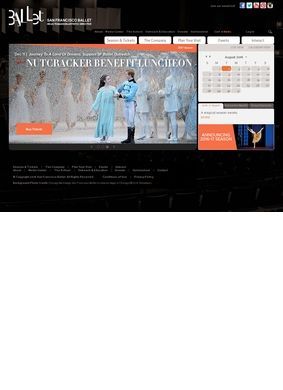
Ballet companies that start teaching two-year-olds are rare. The San Francisco Ballet School opens its Pre-Ballet track at age two and runs continuously up through teenagers and into a professional Trainee Program, which means the organization treats training as a decade-long arc, not a convenience offering. That breadth is the clearest indicator of what this site is built to do: it is the public face of both a touring company and a working school, and it holds the two roles side by side without letting either crowd the other out.
Performance and touring operations
The San Francisco Ballet performs at the War Memorial Opera House on Van Ness Avenue, presenting a repertory that mixes classical canon with newer contemporary work. It tours internationally, which places it among the handful of American companies whose programming travels beyond a home stage. On the site you get a sense of the full apparatus behind the curtain: a roster of dancers, a resident orchestra, and the artistic and administrative staff who keep a season running. There is also an Artist Development initiative, a detail that points to a company thinking about where its dancers go and grow beyond any given performance.
School structure by age
The teaching side is where the site has the most to say. The San Francisco Ballet School operates out of the Chris Hellman Center for Dance on Franklin Street, and the program structure is laid out by age and intent. Pre-Ballet covers ages two through eight, Ballet picks up the nine-to-thirteen group, and from there the path splits into a School Year Program, a Trainee Program for those aiming at a professional track, and Summer Programs for concentrated study.
What I find useful about this layout is that it does not pretend every child is a future principal dancer. Adult Classes sit in the same listing, which means a parent dropping off a nine-year-old could, in principle, take a class of their own. The school reads as a real ladder with a wide bottom rung, where most students will dance for the love of it and a few will keep climbing. That honesty about who the programs serve makes the offering easier to trust than a glossy pitch aimed only at the prodigies.
Summer and trainee tracks
The summer and trainee tracks deserve a separate mention because they change the stakes. A Summer Program is often how a serious student tests whether a school's method suits them before enrolling in a full year, and the Trainee Program is the bridge between schooling and a paid contract. Having both under one roof, attached to a company that actually hires its trainees, gives the training a destination that many standalone studios cannot offer. The San Francisco Ballet School is, in that sense, a closed loop: students who make it through the program can end up on the same Opera House stage they first saw as children.
A significant portion of what the organization describes has nothing to do with selling tickets. There are field trips and school programs that bring students in, family and community programs aimed at wider audiences, and audience engagement work that tries to make a night at the ballet less intimidating for newcomers. None of this is unusual for a large arts institution, but the specificity here carries through in ways the categories alone do not show.
Sensory friendly and adaptive programs
The Sensory Friendly and Adaptive Programs stand out. Performances and classes designed for people with sensory sensitivities or physical disabilities take real planning, and listing them as a distinct strand of the program points to ongoing work rather than a one-off gesture. Alongside the broader Bay Area impact initiatives, it paints a company that measures itself partly by who it reaches outside the paying subscriber base. For a family weighing whether ballet is accessible to a child who finds a dark, loud theater overwhelming, that single line on the page may be the most important thing the site says.
These programs also reframe how to read the rest of the operation. The orchestra, the international tours, the deep school structure: all of it sits within an organization that spends visible effort on getting people through the door who would not otherwise come. That combination of high-end performance and ground-level outreach is harder to pull off than either piece alone, and the San Francisco Ballet does not bury one to flatter the other.
Information architecture across functions
The information architecture keeps the many functions legible. The company, the school, and the community arm each get room to explain themselves in their own terms. Someone arriving to buy a single ticket and someone researching a year of training would both find a clear route. A site this multi-purpose could easily become a maze; this one mostly avoids that. The San Francisco Ballet has enough moving parts (a professional company, a conservatory-scale school, and an active outreach arm) that the site's structure is itself a form of editorial judgment, and the judgment here is mostly sound.
If there is a limit to what the page conveys, it is that the sheer scope can make the organization feel like several entities wearing one name. A first-time visitor may need a moment to work out which part applies to them. That is a function of ambition more than a flaw, and the layout does enough to keep the confusion brief. The San Francisco Ballet has made its scale public-facing in a way that rewards a thorough read over a quick skim.
Outside reputation is limited. No significant volume of third-party reviews for the San Francisco Ballet as an institution appears on the usual consumer platforms, which is typical for major performing arts organizations whose audiences tend not to leave star ratings. The company's standing in the dance world is documented through press coverage and peer recognition rather than aggregated scores, and that coverage is easy enough to find through an independent search. The site itself makes no claims about rankings, which is its own form of restraint.
How to evaluate enrollment options
Take the time to look at the full school structure, past the landing page, before deciding whether to enroll. The age-band breakdowns and program descriptions are detailed enough to answer most questions a prospective student or parent would have. If accessibility is a concern, the Sensory Friendly and Adaptive Programs listed on the site are a good place to start asking specific questions. The San Francisco Ballet is a serious institution with a serious school attached to it, and both are worth the time it takes to read past the season calendar.