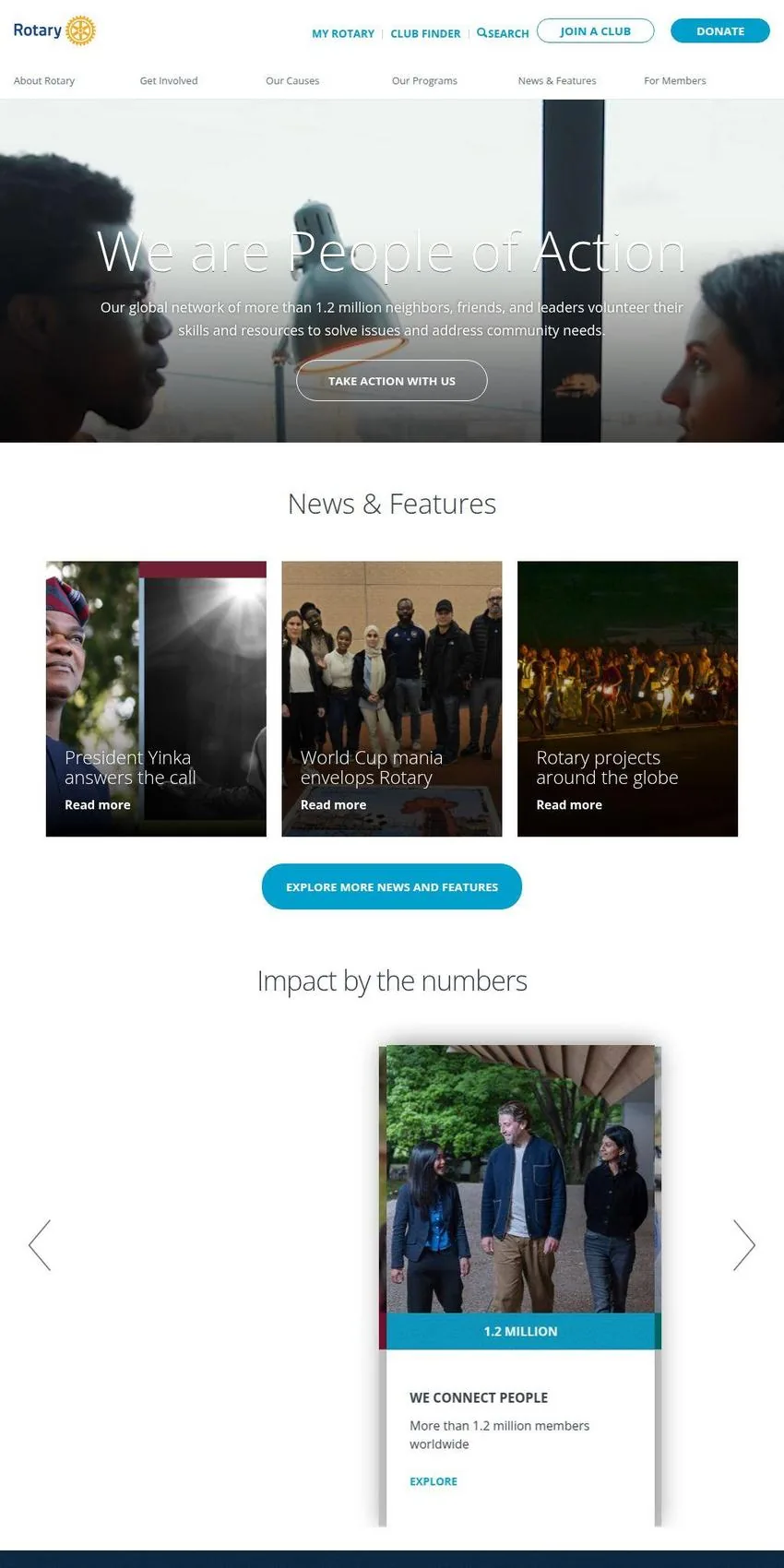
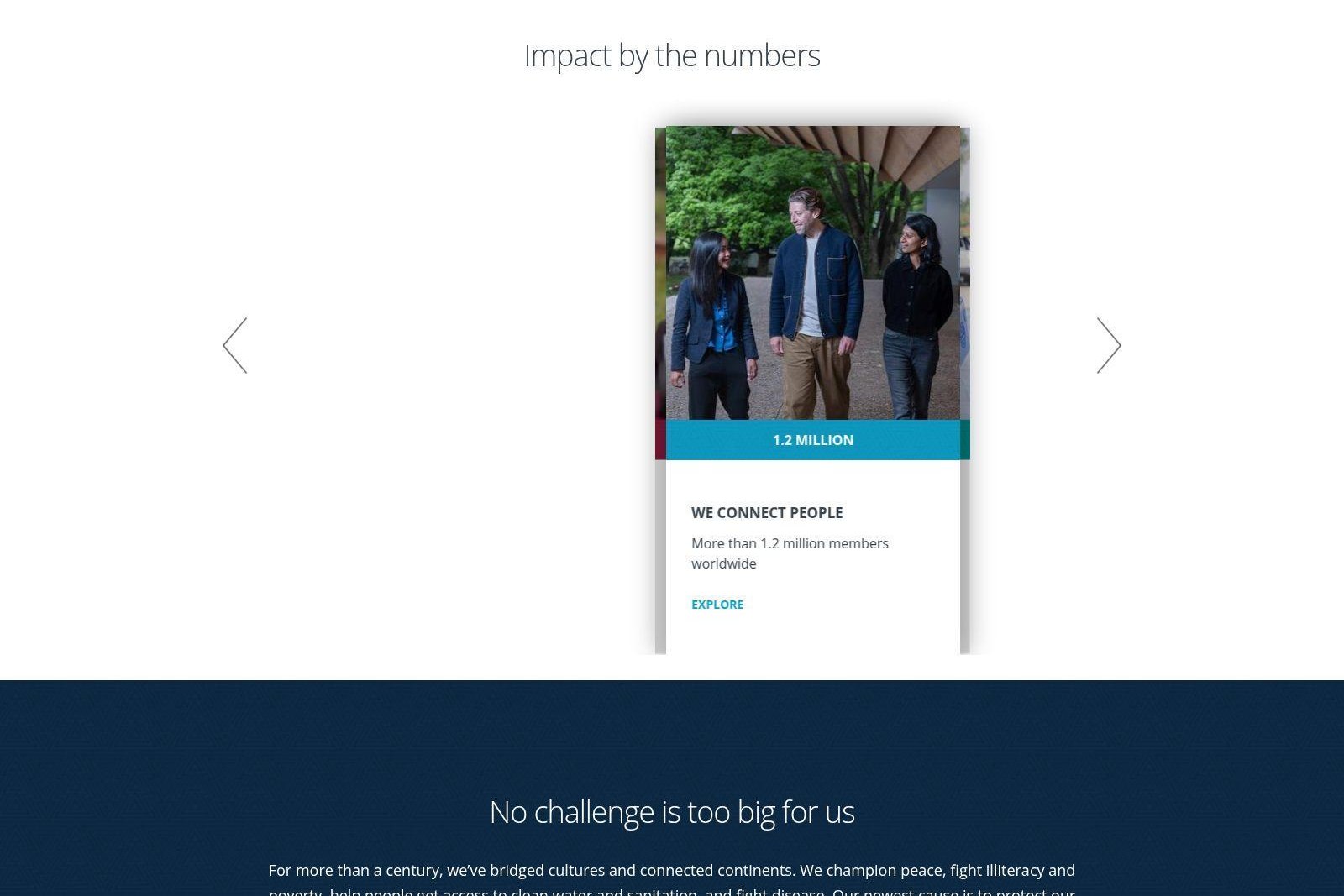
Rotary International is a global service organization that links more than 45,000 local clubs and over 1.2 million members worldwide into a single body. Membership works from the ground up: a person joins a club, and the clubs together form the international structure. The organization was founded in Chicago on February 23, 1905, by Paul Harris, a lawyer who wanted people from different trades to meet regularly and put their skills toward shared projects. The club model spread fast. Within fifteen years it had crossed into South America and chartered its first club on that continent, in Montevideo, in 1919.
The website presents this reach without inflating it; Rotary International lets the numbers carry the message, and there are plenty of them.
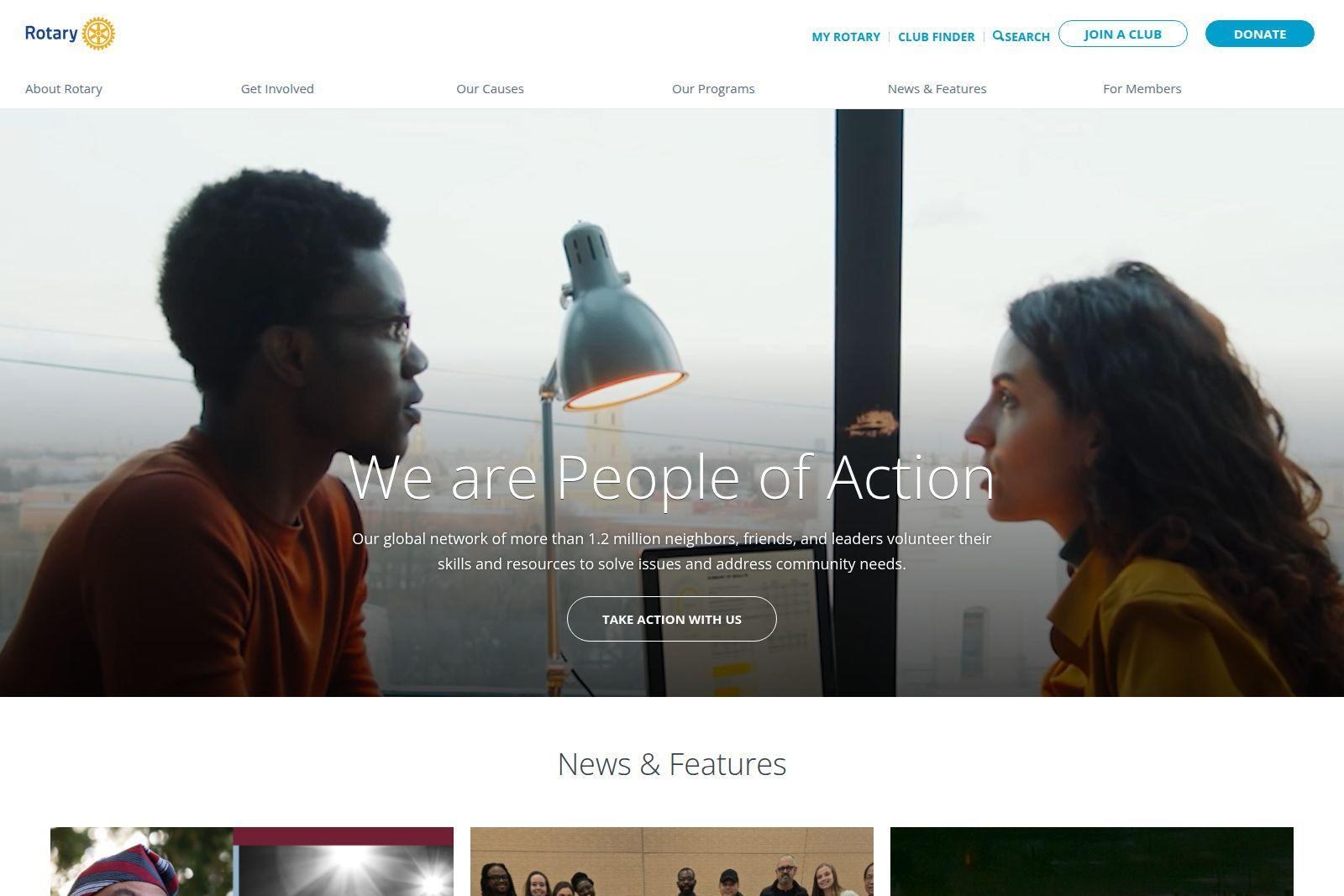
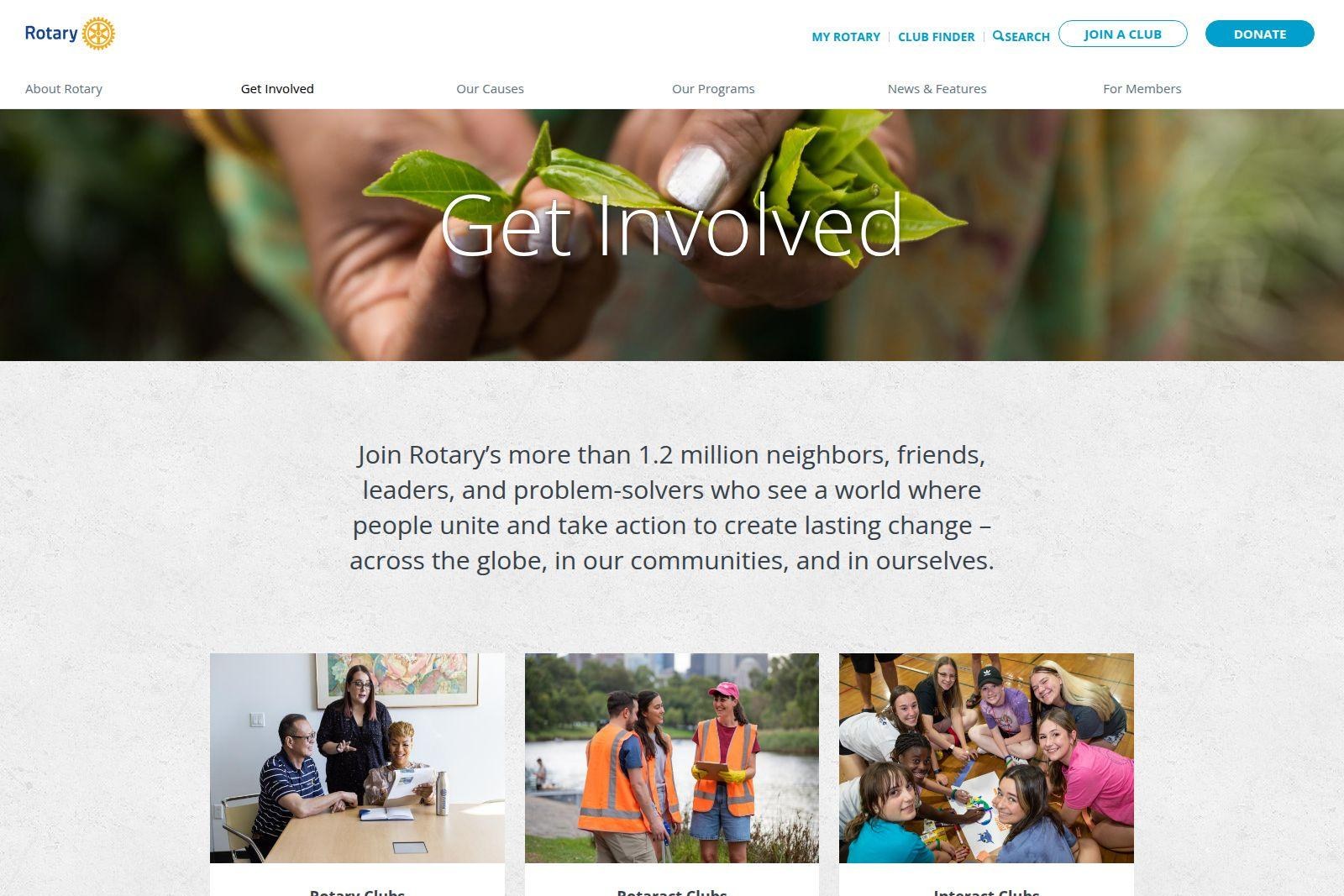
The content sits in a handful of top sections that Rotary International keeps in front of every visitor: About Rotary, Our Causes, Our Programs, Get Involved, and News and Features. Each is a real division of the work, and a reader can move from the founding history to a live grant program to a page explaining how to join a nearby club without hitting filler along the way. For an organization this large, the navigation stays surprisingly disciplined. A visitor who arrives by way of a business directory listing sees the same five sections as one who searches for the site directly, so the route in does not change what is on offer.
The Rotary Foundation and its causes
Money is where a group like this either proves itself or comes apart, and Rotary International channels most of its charitable work through The Rotary Foundation. The site reports that the Foundation awarded 273 million dollars in grants in 2024-25, split between humanitarian and educational programs. Those grants flow into the same causes the site catalogs, so the giving and the mission line up on the page instead of sitting in separate silos. For an organization moving that much money, printing the exact figure gives a reader something concrete to check against the annual report. The split between health work and education work is not broken out further on the same page, so a reader gets the total figure without the ratio underneath it.
Rotary International names nine areas of work in the Our Causes section: polio, peace and conflict resolution, disease prevention and treatment, clean water and sanitation, education and literacy, maternal and child health, community economic development, protecting the environment, and disaster response, and every one of them has its own page. The Our Causes landing lays the nine out as a grid of icons and photographs, so the range is legible at a glance before a reader opens any single page. The breadth is genuine, and it cuts both ways: nine priorities means the effort and the money are spread across a lot of ground at once. None of the nine reads like an afterthought squeezed in to round out the list; each has its own photographs and its own grant examples, not a shared template with the name swapped in.
Ending polio
The clearest and most convincing thread runs through polio. Rotary International began its eradication campaign in 1979 with a drive to immunize six million children in the Philippines, and the site puts the total the organization has contributed since then above 2.9 billion dollars. The result it points to is not abstract. Polio was endemic in 125 countries in 1988; it now persists in two. That arc, backed by a spending figure and a country count, is the strongest single case the site makes, and it needs no embellishment to land.
The polio pages also carry photography from the campaign, which grounds the statistics in something a reader can see. It is the part of the site that has clearly had the most sustained investment, and it shows. That level of visual investment does not carry over to every cause page, and the gap between polio and something like the environmental work is easy to spot side by side.
Peace, water, and health
Past polio, the causes with the most developed structure behind them are peacebuilding and public health. Rotary International organizes this work by problem: the peace pages connect straight to the Rotary Peace Fellowships, an academic program housed under Our Programs, while clean water, sanitation, disease prevention, and maternal and child health each get a dedicated cause page that feeds the grant pipeline the Foundation pays for. Someone who arrives caring about one issue, water, say, can follow that single thread from the cause overview into the programs and the giving pages without losing track of it. A reader who comes in with a specific concern is well served here.
Programs for younger members
The generational plan is laid out plainly in Our Programs. Rotaract and Interact bring in younger participants, the Peace Fellowships route selected people through graduate study, and grants, scholarships, and exchanges sit alongside them. The exchanges in particular give members a practical reason to keep participating across borders. This is the part of the site that meets a fair question about any membership body the size of Rotary International: who replaces the members it has now, and the pages answering that question exist and are detailed. Whether the pipeline holds, whether Rotaract members become lifelong Rotarians, is something no website can demonstrate, and the site does not pretend otherwise.
About Rotary and getting involved
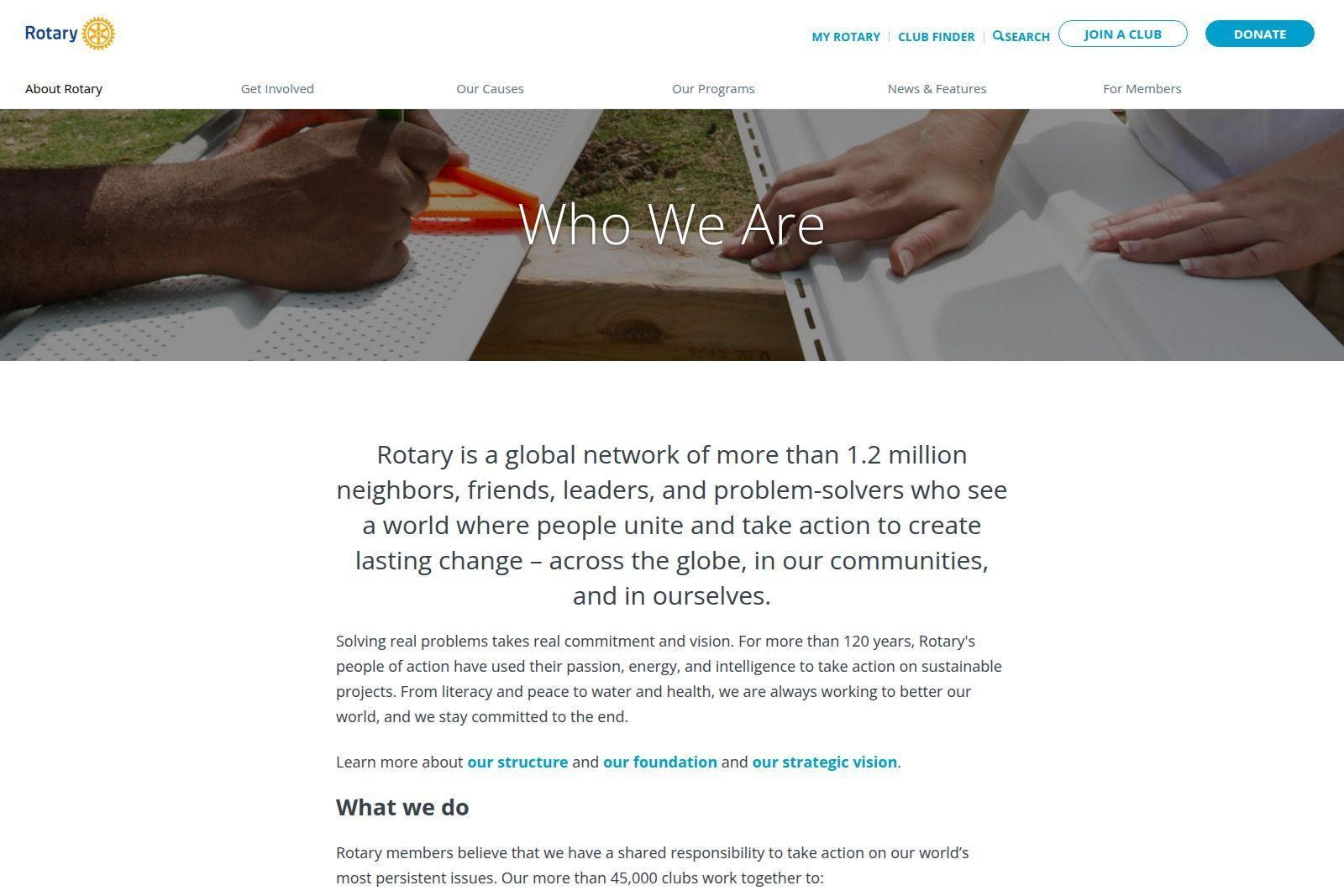
The About Rotary section is where Rotary International is most open about itself. It covers the organization's history, its governance structure, its leadership, the Foundation, financials, partnerships, and careers.
Putting financials and a governance chart in plain public view is the mark of an institution that expects to be examined and has chosen to make the examination easy. Leadership and the year-to-year governance structure are documented in the same place, which for a body spanning tens of thousands of clubs is no small thing to keep current. The history pages go deep as well, tracing the organization back to Harris and the first clubs with period photography, so the founding story is documented rather than merely asserted. The careers listings in the same section are a quiet reminder that behind the volunteer network sits a staffed institution that hires.
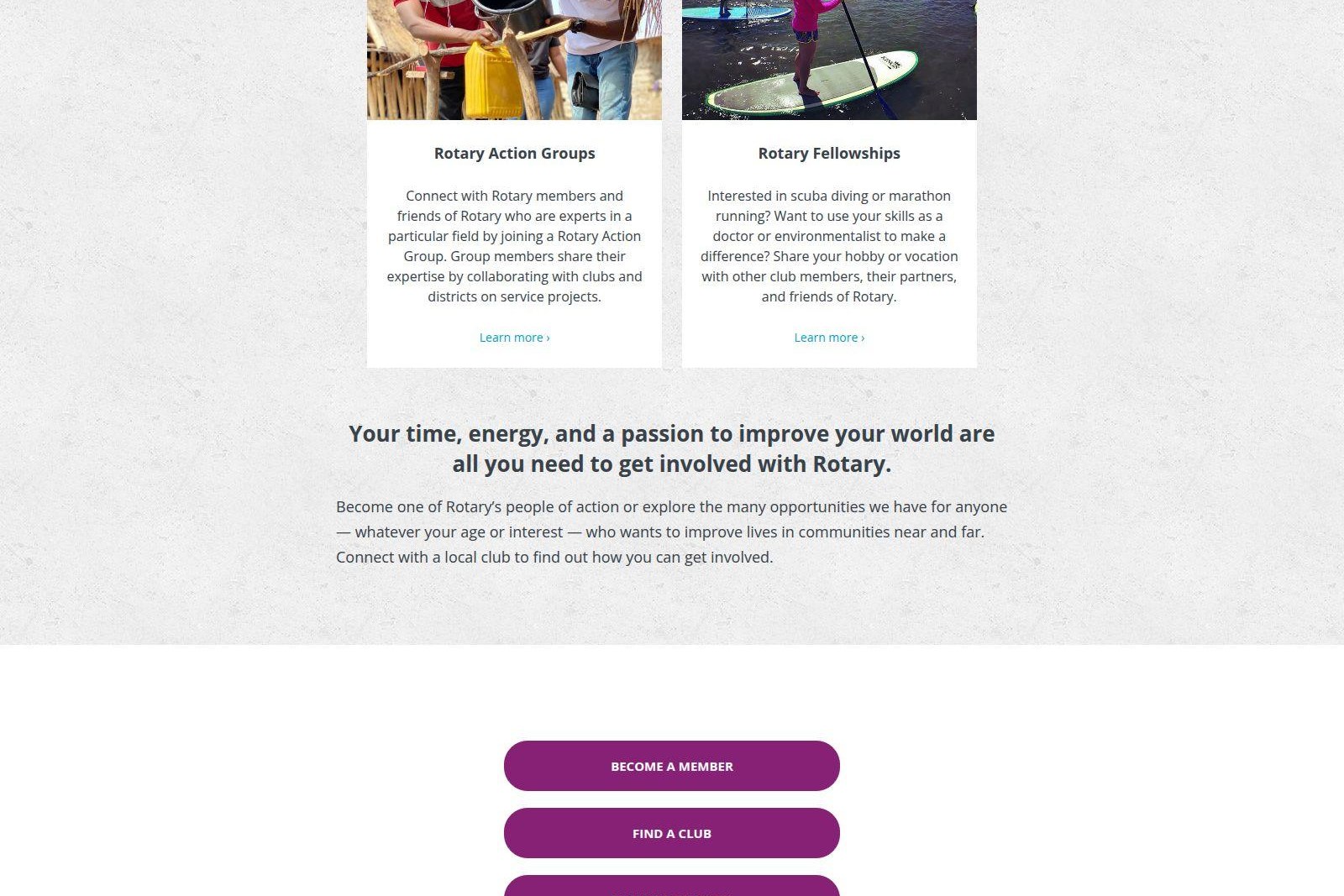
Joining is handled as a real process. Get Involved breaks into three routes: joining a club, volunteering on projects, and Ways to Give. Because membership in Rotary International runs through local clubs, the join path is essentially a matching step between a person and a nearby chapter, and the site treats it as exactly that, pointing a prospective member toward a club and the people already in it. Volunteering on projects covers the hands-on side, the community service that gives the organization its name and keeps clubs busy between fundraising pushes. Ways to Give lays out the donation routes and ties the ask for money back to the specific causes the rest of the site has already explained. None of the three routes overlaps with the others, and that clarity is not something every large membership organization manages when it lists the ways to take part.
For people already inside, there is My Rotary, a member portal that handles club administration and convention registration. With tens of thousands of clubs to coordinate, a member portal stops being optional and becomes basic infrastructure, and the site draws a clean line between what the public sees and what members log in to manage.
News and Features is fuller than a standard press page. It carries the Rotary magazine, a press center, a blog, and a podcast. The magazine holds its own section with cover art and feature stories, evidence of a standing editorial operation with real history behind it. Between those four, the section reads like a small newsroom. That steady cadence of magazine, blog, and podcast keeps the site from going quiet between the bigger announcements. The most recent item the feed surfaces is the 2026 Rotary International Convention, held in Taipei, which the site says drew more than 38,000 attendees.
The site runs in many languages, among them English, German, Spanish, French, Italian, Japanese, Korean, and Portuguese. For a body operating in scores of countries, offering the site in that many tongues is a baseline need, and Rotary International covers it across the sections a visitor is likely to use.
Not every inner page carries the same translation depth, but the sections a first-time visitor needs most, the causes, the join path, the giving page, all read cleanly in the languages checked for this review.
What the site cannot settle is the last stretch of its signature fight. Polio sits at two endemic countries, not zero, and the same pages that record decades of progress also quietly mark how long that final gap has stayed open. A campaign that has run since 1979 and fallen from 125 countries to two has plainly done the hard part; the distance from two to none has proved slower and more stubborn, and nothing Rotary International publishes here can tell a reader when, or whether, it closes.
Verified social profiles
Business address
Rotary International
1560 Sherman Avenue,
Evanston,
IL
60201-3698
United States
Contact details
Phone: 847-866-3000
Shaped by his native land, President Olayinka H. Babalola carries the dynamic spirit of Nigeria with him to Rotary leadership
Nigerian takes office as president of Rotary InternationalSecond African to lead the global membership organization will focus on…
From powerful performances and speakers to global service commitments, more than 38,000 people celebrate Rotary’s global spirit
Global gathering welcomes Rotary members from 140 countries and is expected to generate NT$1.578–1.735 billion in local economic…