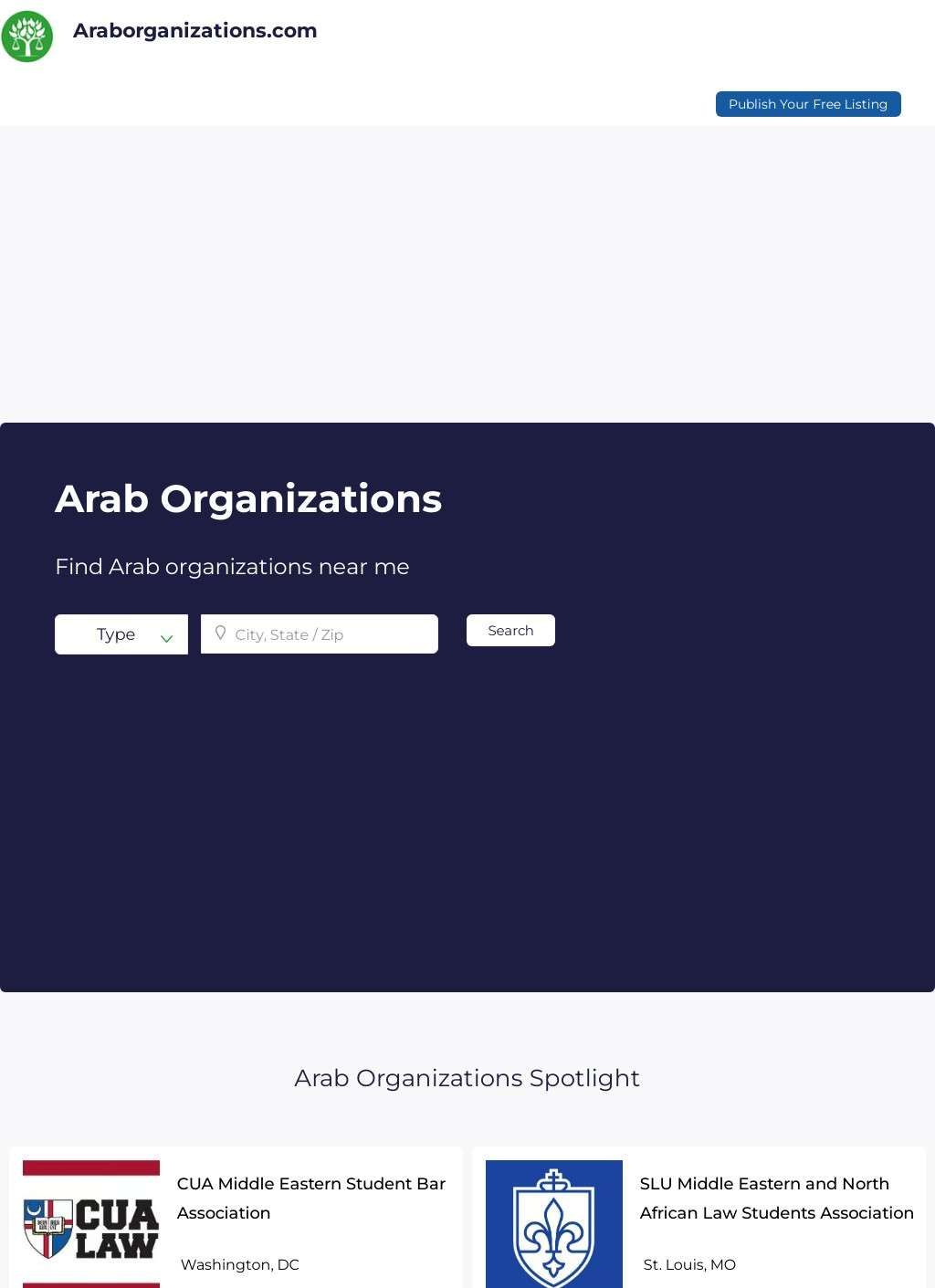
Arab Organizations is a search-and-browse index of Arab organizations and associations, concentrated in the United States with partial coverage of Canada, France, and Germany. What it does not do is generate content, publish news, or function as a community platform. It catalogs organizations, classifies them, and returns results. The usefulness of that proposition depends entirely on how well the catalog is built and maintained, and on that question the evidence runs in two directions.
Organization categories and structure
Arab Organizations divides charities alone into seven subcategories: animal, arts and culture, education, environmental, health, international aid, and religious. That is not boilerplate. A national catalog that refuses to collapse an Arab American environmental group into the same bucket as an international aid organization has made a genuine editorial choice about precision. The same logic runs through the student section, which is divided into academic, activism, Greek, and sports categories. Campus organizations occupy the same structural tier as embassies and regulatory agencies here. A directory that treats student clubs as an afterthought or leaves them out entirely is covering only the formally constituted end of community life, and Arab Organizations does not do that.
Government section for embassies
Government organizations get their own section for embassies and regulatory agencies, a practical addition for anyone navigating consular paperwork who does not want to filter through unrelated NGO results. Non-profits, NGOs, religious organizations spanning churches, mosques, and synagogues, and professional associations round out the main categories.
From community knowledge to verification gaps
Dearborn, Michigan appears as a highlighted location alongside the expected large metros. Dearborn holds one of the largest Arab American concentrations in the country. A generic metro-by-population list would never surface it. Its presence here reflects actual community knowledge rather than an algorithm defaulting to city-size rankings. That one decision is more informative about the site's editorial intent than any self-description on its About page.
Listings at Arab Organizations are marked as verified. The verification methodology is not described publicly, so what the flag enforces in practice is unknown. A built-in messaging system allows users to contact listed organizations without leaving the site. A monthly newsletter covers new additions, and affiliate participation options exist.
Arab Organizations operates under the HeritagWeb umbrella, with help links routing to that company's support center. That corporate parentage matters for a different reason than prestige: directories require continuous maintenance to stay accurate, and a site with no visible operator is more likely to go quietly stale. HeritagWeb's involvement is at minimum evidence of an ongoing operation. The index is not a side project running unattended.
No third-party review platform has accumulated user feedback on Arab Organizations. Google, Trustpilot, and comparable services return nothing for araborganizations.com. There is a passing mention on a USA directory page and nothing resembling independent user testimony beyond it. Note that differently-operated sites with similar names appear in search results; any ratings attached to those have no bearing on this listing.
The absence of outside feedback is not automatically damaging for a specialized index. Arab Organizations is not asking users to trust it with a purchase or a service engagement. People consult it to locate an organization and then interact with that organization directly. The relevant issue is listing accuracy and currency, and on that the site's unelaborated verification claim is the only available answer.
Verification methodology remains undisclosed
That unelaborated claim is the real problem. A directory covering thousands of entries across multiple countries, staking its value on a verification badge, and declining to explain what verification means, cannot be treated as a reliable source by anyone who needs the information to be accurate. Researchers building contact lists, grant officers vetting potential grantees, journalists confirming an organization exists and operates as described, all of them need more than a badge. Arab Organizations offers no methodology, no update cadence, and no track record of error correction that is publicly accessible.
No phone number, email, or physical location appears on the main Arab Organizations page. A footer Contact link leads to a form; the Help link routes externally to HeritagWeb's support center. For typical use, reaching a listed organization through the built-in messaging system, this is irrelevant. For someone trying to report a stale or inaccurate listing, the path to the Arab Organizations team is harder to find than it should be for a site whose credibility rests on accuracy.
Arab Organizations has a taxonomy that puts more thought into subcategories than niche indexes in this space typically manage, geographic awareness grounded in genuine community knowledge, and the institutional backing from HeritagWeb that a live directory needs to stay credible. Those qualities matter. They are also not enough on their own.
The limiting factor is the verification claim the site stakes its credibility on but will not explain. No methodology, no update cadence, no public record of corrections. Arab Organizations is a useful discovery tool when you need to find out that an organization exists and what type it is. It is not a reliable source for anyone who needs to confirm that an organization remains active, is accurately described, or is located where listed. Use Arab Organizations to generate a list of candidates; verify each one independently before acting on any of it.