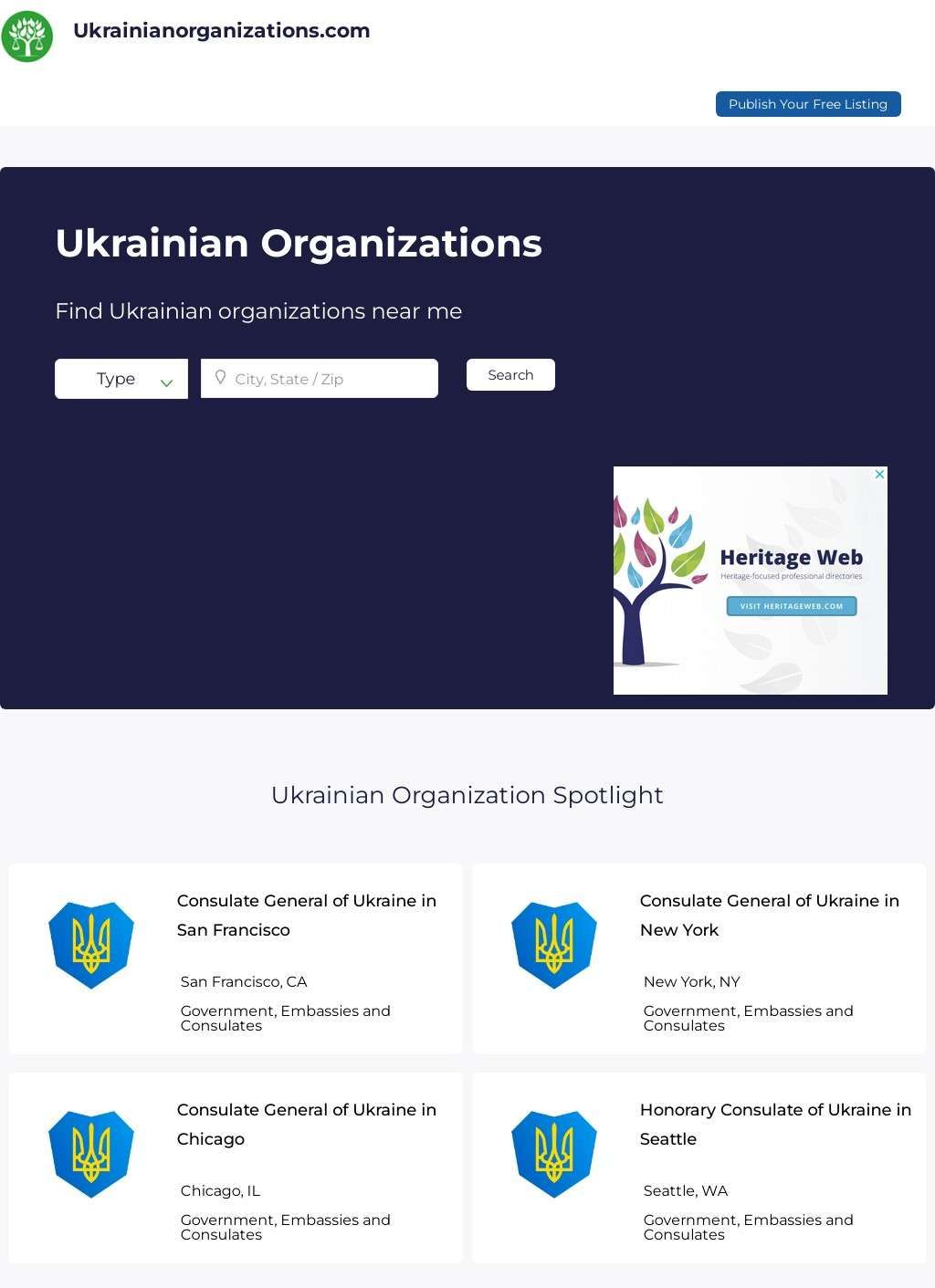
Ukrainian Organizations is a directory site that indexes Ukrainian community groups across North America, with some coverage reaching back to Ukraine itself. The premise behind Ukrainian Organizations is narrow and clear: one place to look up charities, cultural clubs, religious institutions, embassies and consulates, NGOs, student groups, and government agencies tied to the Ukrainian diaspora. You can search by an organization's name, by specialty, or by location, and the results are meant to point you to a real group rather than a blog post about one.
Browse by location and category
The location angle is where the site earns most of its usefulness. Instead of dumping everything into one long page, it lets you browse by city, so Boston, Chicago, New York and Seattle each get their own slice, with Canada and Ukraine sitting alongside the US entries. For anyone new to a city and trying to find a Ukrainian church, a heritage school, or a relief organization run by locals, that geographic cut does more work than a generic keyword search would. The category split holds up on its own terms too, since a consulate and a student society are things people usually look for in very different frames of mind.
Search and verified listings
Beyond browsing, Ukrainian Organizations runs as a platform on top of the listings. Groups can create and manage their own directory entries, and there is a notion of verified listings, useful in a space where a defunct club or a stale phone number can waste real time. Registered users get a dashboard that handles profile management and messaging, and the site mentions paid leads, pointing to a model that leans on organizations paying to be found rather than on the people doing the searching.
Internal messaging system for contact
That messaging system is the connective tissue that holds Ukrainian Organizations together. Instead of publishing a wall of phone numbers and email addresses, the platform routes contact through an internal inbox, so you reach a listed organization from inside your account. It is a reasonable design for a directory that wants to keep listings current and cut down on scraped contact data. The trade-off is that a quick, cold look-up (find the group, grab the number, call) is not quite the flow the site is built for.
Operated by Heritage Web LLC
Whoever set this up did not build it in isolation. Ukrainian Organizations is operated by Heritage Web LLC, with a copyright line running from 2011 to the present, and it sits inside a wider family of niche directories that share help documentation over at help.heritageweb.com. That shared backend explains why the account features feel more developed than a single volunteer-run community list usually manages. It also means the software is maintained by a company with a track record across similar sites, which counts for something when you are deciding whether a listing will still be live next year.
Limited public transparency
On transparency, the picture is mixed and worth stating plainly. The landing page shows no phone number and no street address, which is a fair thing to flag for a service whose whole job is connecting people to organizations. There is a Contact link in the footer, and the external help pages at help.heritageweb.com give you a route to the operator, but both require clicking away from the homepage. None of that is unusual for a platform that funnels communication through internal messaging, yet a first-time visitor does have to hunt a little to find a human at the company behind it.
No third-party reviews or ratings
A search for what other people say about the site comes up short. Searches for ukrainianorganizations.com surface plenty of material about Ukraine relief charities, the sort of rankings you see from Charity Navigator, CNBC, The Hill and Wikipedia, but none of it is about this directory. No third-party reviews, no star ratings, no user testimonials that I could tie to the site itself. That absence is not a mark against the content on the page, though it does mean you are judging Ukrainian Organizations on its own presentation and the reputation of its operator, without a chorus of outside voices to confirm or contradict.
Check whether your city has entries
What that leaves is a judgement about fit. If you want a fast, curated map of Ukrainian institutions in a specific American city, the browsing structure and the category system deliver that, and the verified-listing angle gives the data a fighting chance of being accurate. If you are the kind of person who wants to see a track record from previous users before trusting any lookup tool, there is simply nothing public to lean on yet, and you will be taking the entries at face value.
Index focused on serving organizations
The scope is honest about itself, which I appreciate. Ukrainian Organizations does not pretend to be a news site, a donation portal, or an advocacy arm; it is an index with a messaging layer bolted on, and it stays in that lane. The paid-lead and account machinery points to a long-term plan built around serving the listed groups as much as the searchers, and how well that balance works out will depend on how many organizations actually claim and update their pages over time.
For a searcher, the practical test is whether the city you care about has enough entries to be useful, and that varies by place. Boston or New York will likely carry more than a smaller metro. Ukrainian Organizations gives you the tools to check that in a couple of clicks, and the answer you get is the real measure of whether this particular listing is worth your time.