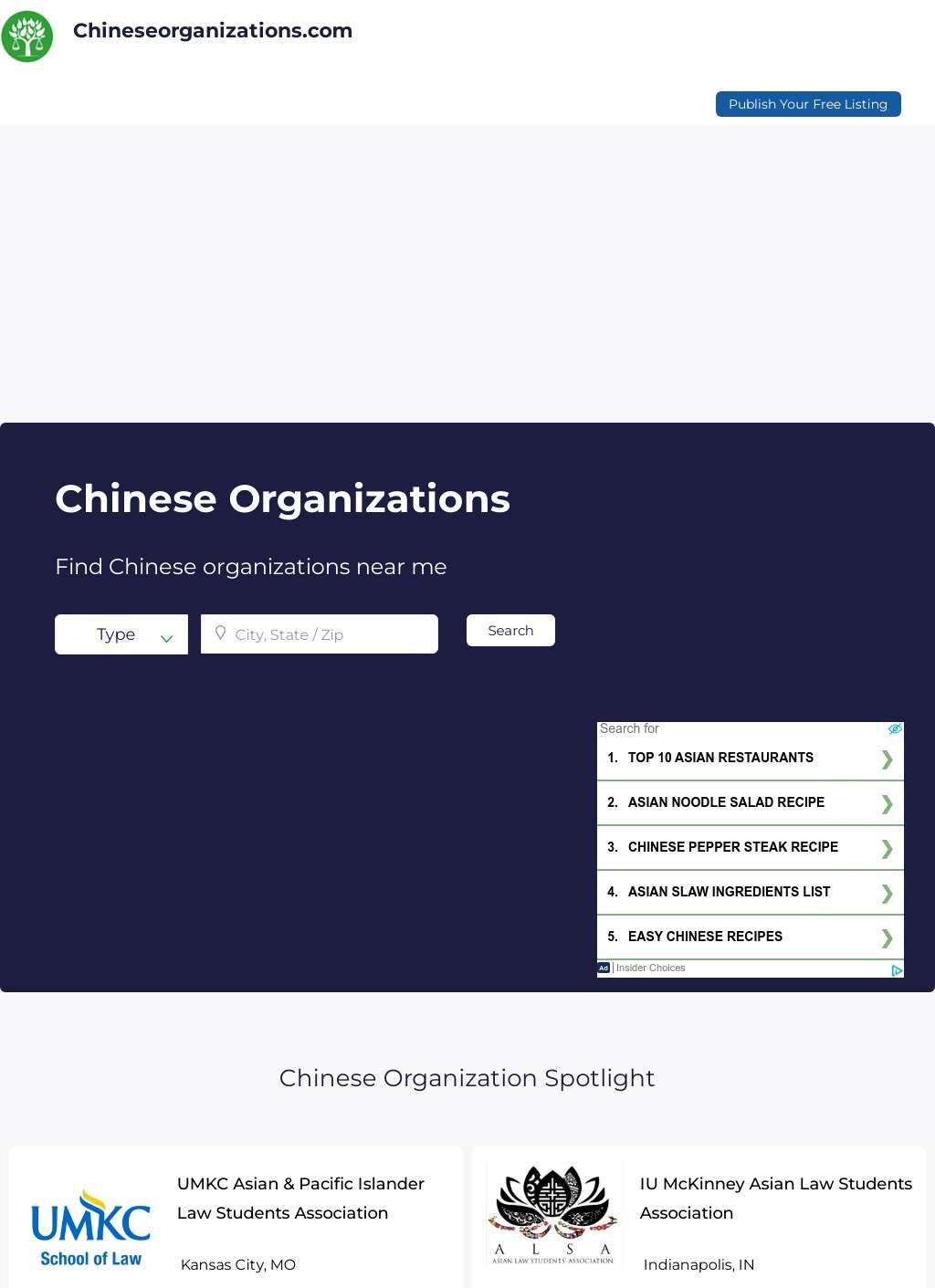
Search by organization name, practice area, city, state, or zip code is the first thing on offer at Chinese Organizations, and that search box is built to be used. You can narrow by specialty and by country, which signals from the start that this is built to be queried, not merely browsed. Type "New York" and the site is set up to hand back state and city-level pages; the same logic carries over to the United Kingdom and a handful of other countries. For a person trying to locate a specific Chinese charity, temple, or student group somewhere in the world, that filtering matters more than any homepage paragraph, and it is the feature Chinese Organizations leads with for a reason.
Search and filtering options
The category spread is wide. Charities alone are broken into animal, arts and culture, education, environmental, health, international aid, and religious branches. Beyond that, Chinese Organizations catalogs government bodies, cultural and human rights groups, religious institutions split into churches, mosques, synagogues, and temples, plus student groups and general non-profits. That is a lot of ground to claim, and the breadth cuts two ways: it promises a single place to look, but it also raises the obvious question of how thoroughly each of those buckets is actually populated. A directory that lists temples in one tab and human rights groups in another is reaching for scholars, donors, and people simply trying to find their community, all at once.
Organization categories
What lifts Chinese Organizations a notch above a plain link list is the claim it makes on its About page. The site says it compiles directories of top Chinese organizations worldwide and checks judiciary information in each organization's state of licensure for grievances, disciplinary actions, or civil lawsuits. If that vetting is applied consistently and kept current, it turns a directory into something closer to a screening tool, which is a genuinely useful thing for anyone deciding whether to donate to or join a group they do not already know.
Vetting claims and limitations
That same claim is also where the skepticism starts. Checking court and licensure records across many states, let alone across countries, is heavy ongoing work. The page asserts it; nothing on the public content shows the method, the date of the last check, or what a flagged record would even look like on a listing. A reader has no way to confirm that the vetting happens at the promised depth, or at all. The strength of the whole proposition rests on that one process, and it is the part a visitor cannot see. Chinese Organizations stakes its credibility on diligence that happens out of view.
Free submission and account features
The participation model is straightforward and free, which is in its favor. Organizations are invited to submit their own listings at no cost, and registered users get a real account area rather than a static profile. That dashboard covers profile management, notifications, messaging between users, listing management, and a referral program. Those are the bones of an active community platform, not a directory someone built once and abandoned, and they point to Chinese Organizations wanting groups to maintain their own entries over time.
Free submission has a known side effect, though, and it bears directly on the vetting promise. When listings are self-submitted and cost nothing, volume tends to arrive faster than verification. A directory that both invites open submissions and pledges to screen each entry against judiciary records is holding two goals that pull against each other. Whether Chinese Organizations keeps those two in balance is exactly the thing a visitor would want demonstrated, and exactly the thing the page leaves unstated.
The messaging and referral features are an interesting touch. Inter-user messaging implies the site wants people to connect through it, to do more than read and leave, and a referral program points to growth by word of mouth. Whether either feature has any real traffic behind it is impossible to judge from the outside. They could be a lively part of the experience or dormant plumbing that ships with the account system. The presence of the tools is documented; the life inside them is not.
Coverage depth remains unclear
Coverage is the other open variable. The category tree is impressively granular, and the geographic reach of Chinese Organizations spans the United States down to individual cities, the United Kingdom, and more. A directory like this is only as good as the density behind those labels. A category for, say, environmental charities or synagogues means little if it holds two entries. Nothing in front of a visitor confirms how deep any single branch runs, and that depth is the difference between a working reference and a tidy but empty filing cabinet.
Reaching anyone behind the project is not straightforward. The footer carries a Contact link and a Help link, which is a start, but the homepage and retrieved content show no phone number, no street address, and no published hours. A missing public email raises no red flag on its own, since a contact form handles that and spares the owner a flood of spam. The absence of a phone or address is more noticeable for a site whose pitch leans on diligence and record-checking, and Chinese Organizations makes exactly that pitch. An operation that asks you to trust its background screening invites the natural follow-up: who is doing the screening, and where are they based.
Reputation offers little to lean on either. A search for outside coverage of Chinese Organizations turns up no notable third-party reviews, no ratings on the usual platforms, nothing from users describing what the directory was like to use. That is not damning, since plenty of niche directories operate below the radar of review sites, but it does leave the site's own claims standing without any independent echo. There is no external voice confirming that the vetting works, that the listings are accurate, or that the messaging tools see use. For a project built around trust, the silence around Chinese Organizations is its own kind of data point, and not a reassuring one.
So the verdict sits on a fault line. Chinese Organizations is well structured, free to join, broad in scope, and built around an account system that points toward an active platform. Its central promise, screening organizations against judiciary records, would genuinely set it apart from the average aggregator. Yet that promise is unverified, the coverage depth is unknown, the contact details behind the project are sparse, and no outside party has weighed in. Everything that would make Chinese Organizations trustworthy is asserted by Chinese Organizations and confirmed by no one else. Until a visitor can see the screening applied to a real listing, or find a single independent account of using the site, the most appealing thing about Chinese Organizations is also the thing there is no way yet to believe.