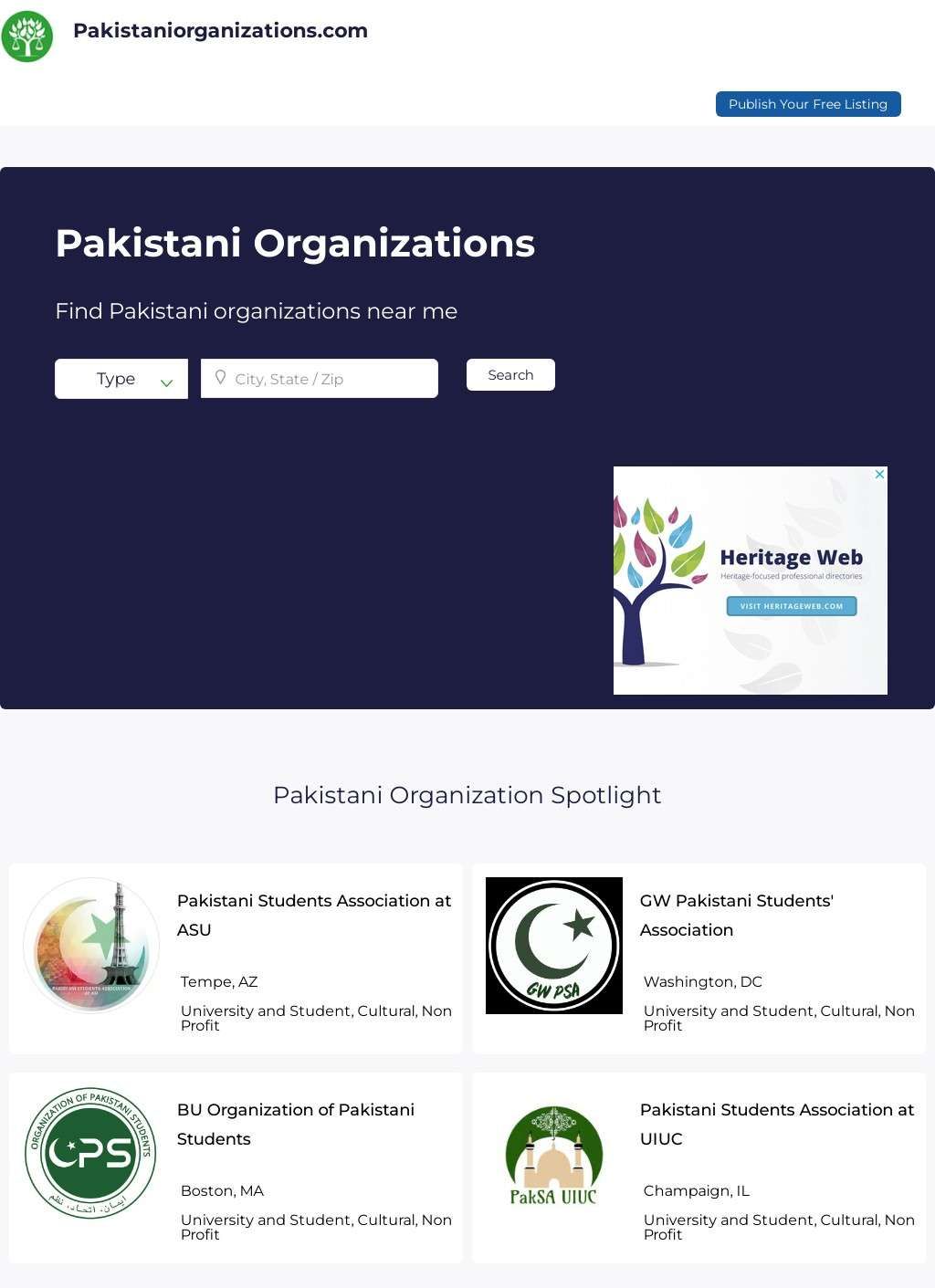
Tracking down a Pakistani mosque in Phoenix, a student association in Boston, or a consulate in Chicago, all in one place, is not something a general search handles well. That is the specific gap Pakistani Organizations sets out to fill. The site is a search-and-browse index of diaspora organizations spread across the United States, Canada, and Pakistan itself, and the premise is narrow enough to be useful. You either type in a city or pick a category and work down from there.
Categories from charities to embassies
The categories get more granular the further someone clicks in. Charities are not lumped into one bin; they split into animal welfare, arts and culture, education, environmental, health, international aid, and religious causes. Student organizations break down the same way, covering academic groups, activism, Greek life, international clubs, spiritual societies, and sports. Pakistani Organizations also lists non-profits and NGOs, cultural and human rights bodies, political organizations, and government entities such as embassies and consulates. Religious listings stretch past mosques to churches, temples, and synagogues, which is a wider net than the name might lead you to expect.
Searching by city and country
Geography is the other axis. Pakistani Organizations leans on major American cities, with New York, Los Angeles, Chicago, Boston, Phoenix, and San Diego among the named hubs, then extends to Canadian cities and to locations inside Pakistan. For a community that is scattered and often organized at the neighborhood or campus level, that city-first approach is the right instinct. Someone newly arrived in a metro area can plausibly find a religious center or an aid group near them without already knowing its name.
How deep do the listings run?
How deep the listings run in each of those cities is the part the homepage leaves unanswered. A directory like this lives or dies on density. The structure is sound and the taxonomy is thought through, but a visitor only learns whether their particular city is well stocked by running the search. The categories promise a lot of ground; the proof sits one click past the front page.
Submitting a free organization listing
Organizations can request a free listing on Pakistani Organizations, which is the usual engine behind community indexes of this kind. Free entry tends to grow coverage faster, though it also leaves quality control resting on whoever maintains the site. The homepage says nothing about how entries are vetted or kept current, so a user is trusting that the listings are live and accurate.
Membership dashboard for messaging
Beyond plain search, Pakistani Organizations carries a membership side. Registered users get a dashboard with messaging, so an organization and an interested visitor can reach each other inside the platform instead of hunting for an external contact. That is a reasonable feature for groups that may not run their own polished website. Layered on top are paid leads, a referral program, and a monthly newsletter you can sign up for.
The paid leads and referral pieces tell you the operators are trying to build something with a revenue model, not a static list. Whether that helps or distracts depends on execution that is impossible to judge from the outside. A messaging dashboard is genuinely handy here; small cultural or student groups often have no front desk and no staff watching an inbox, so an in-platform message may land better than a cold email to an address that no longer works.
Missing contact information on site
A persistent gap on Pakistani Organizations is the absence of clear operator identity. The site asks visitors to register, message, and in some cases pay, yet it keeps its own identity quiet. No phone number, email, or street address shows on the homepage. There is a Contact link tucked in the footer and a reference to a help documentation portal, so a route exists, but the direct details are not put in front of you the way they are on sites that want to be reached.
Checking outside reviews for trust
On outside opinion, the cupboard is bare. A search turned up only Pakistani Organizations' own internal pages, with nothing on Google, Trustpilot, Yelp, the Better Business Bureau, or anywhere else carrying user reviews for this domain. That is not damning on its own; niche community directories rarely attract the review volume that restaurants or shops do. It does mean a first-time visitor has no third-party track record to lean on and has to judge Pakistani Organizations on the merits of what they find when they search.
For a platform that handles messaging and money, the combination of no external review record and muted contact details is worth weighing carefully. None of it points to anything being wrong. It simply means the trust has to be earned listing by listing, since there is no outside chorus vouching for the operation and no obvious person to call if something goes sideways.
Taken on its own terms, Pakistani Organizations does the core job a diaspora index should: it organizes a hard-to-find community by both place and type, and it does so with categories specific enough to narrow a search. The free-listing model and the city focus give it room to grow. Whether Pakistani Organizations becomes a real first stop for the community will come down to how full those city pages are and how fresh the entries stay, and those are things a visitor can check in a few minutes by searching the cities they care about and seeing what comes back.