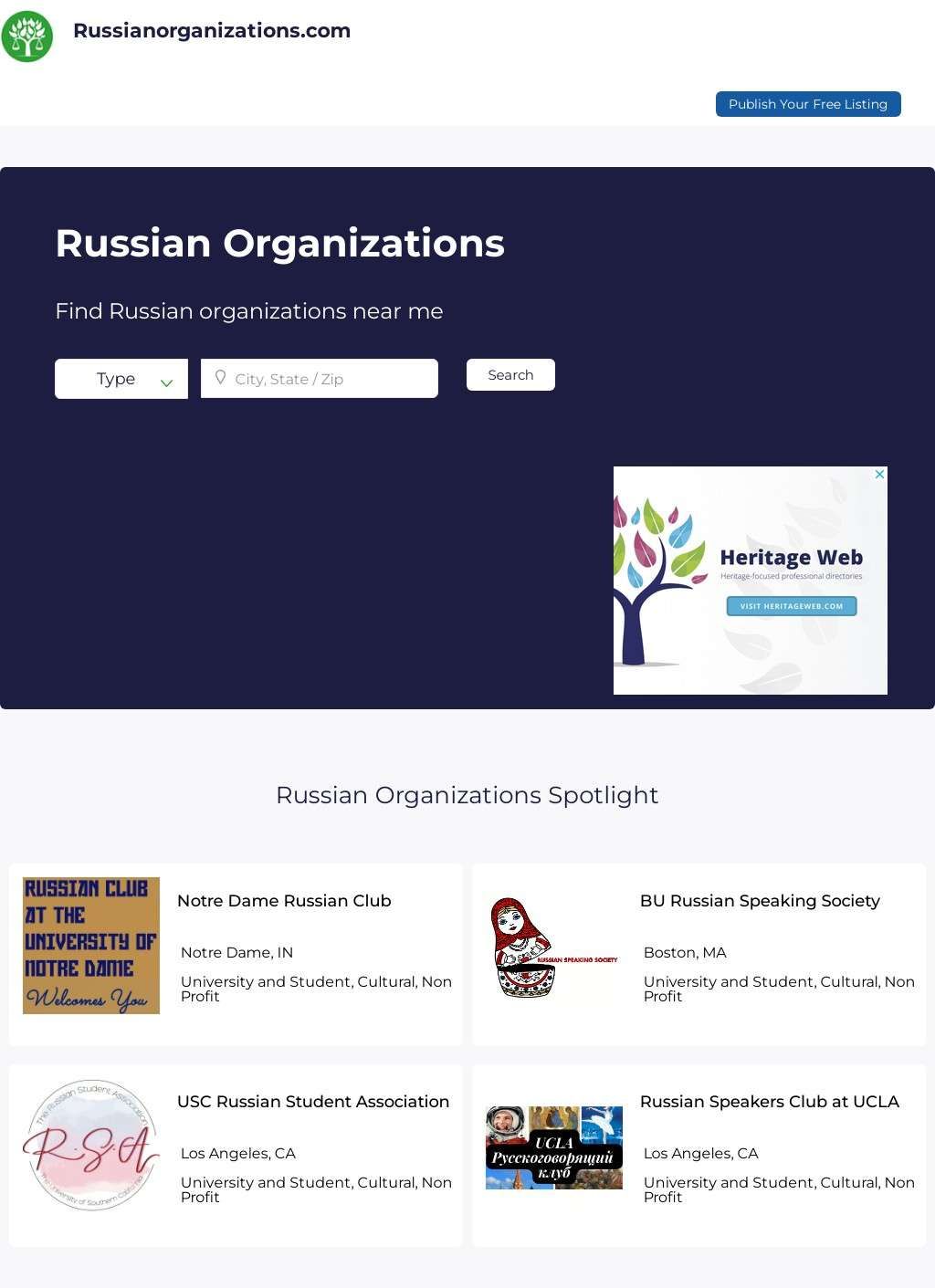
Russian Organizations is an online directory of Russian-affiliated nonprofits, charities, associations, and community groups, concentrated in the United States, Canada, and Russia. The scope is wider than the name might suggest at first glance. It pulls together charities sorted by cause (animal welfare, arts and culture, education, environmental work, health, international aid, and religious causes), government bodies, embassies and consulates, cultural organizations, human rights groups, political organizations, general nonprofits, religious institutions across churches, mosques, synagogues, and temples, and student organizations broken out into academic, activism, Greek life, international, sports, and spiritual subgroups. That is a lot of ground for one site to cover, and the category tree is the first thing that tells you whether the people behind it thought carefully about how someone would actually look for a group instead of just dumping a flat list.
Search and profile features
Search on Russian Organizations runs by city, state, or zip code, which fits the way most people approach this kind of lookup. Someone trying to find a Russian cultural society or a relevant church near them is thinking geographically before anything else, and the site leans into that. Each listed group gets a profile page, and Russian Organizations layers a modest set of account features on top: a member dashboard with notifications and an inbox, and a messaging system that lets users and organizations reach each other directly through the platform. There is a newsletter, and there is a paid leads service aimed at businesses, which is the clearest indication of how the operation intends to make money.
Verification through judiciary records
One detail stands apart from the usual directory pattern and is worth dwelling on. Russian Organizations says it verifies a nonprofit's standing by checking judiciary information in the organization's state of licensure, looking for grievances or formal disciplinary actions.
If that check runs consistently and stays current, it raises the floor on what gets listed, since a plain aggregator just scrapes names and never asks whether the group is in good legal standing. Vetting is the hard, unglamorous part of running a directory and most skip it entirely, so the claim is genuinely interesting. The catch is that the description tells you the check happens but not how often, who performs it, or what a failed check does to a listing. A verification process you cannot inspect is only as good as the trust you are willing to extend on faith, and Russian Organizations does not give you much to anchor that trust to.
LinkedIn profiles paired with nonprofit listings
There is also a separate page that lists verified Russian nonprofits alongside their LinkedIn profiles. A LinkedIn presence gives a visitor an outside anchor to confirm an organization is staffed by real people and currently active, and pairing that with the verification claim is the right instinct. It positions Russian Organizations as a place where listings have been looked at instead of imported in bulk. Whether the LinkedIn links stay accurate over time is the open question, since profiles move and organizations fold, but the intent behind that page points in the right direction. Russian Organizations is clearly trying to be more than a static name dump, and the combination of geographic search, profile pages, account features, and cross-referenced LinkedIn data gives it a layered feel that most directories at this scale do not bother with.
Credibility gaps in operator transparency
This is where Russian Organizations creates a real problem for itself. For a platform whose entire pitch rests on having checked the legitimacy of the groups it lists, it is notably quiet about its own. The only contact route from the homepage is a generic link tucked into the footer. There is no phone number, no physical address, and no direct email shown anywhere prominent. A contact form is a normal and acceptable way to handle inbound messages, since a posted email address invites spam and a form does the same job. The bigger issue is the absence of any stated location or named operator.
That gap lands harder here than it would for a shop or a blog. A directory asking visitors to believe it audits other organizations' judiciary records is making a credibility claim. Credibility claims are easier to take seriously when the people making them are identifiable. Russian Organizations verifies others while staying anonymous itself, and that sets up a tension a careful visitor will notice. None of this means the operation is careless or insincere. It means that trust has to be extended without much to anchor it to, and the site does little to close that distance.
Absence of outside reviews or ratings
Independent reputation is just as scarce. A search for outside reviews of Russian Organizations turns up nothing notable: no ratings on common platforms, no third-party write-ups, no discussion threads weighing in on whether the listings are reliable. For a directory, that absence is harder to read than it would be for a restaurant or a contractor, because people rarely think to rate a reference site even when they use it regularly. The empty result is not damning, but it leaves no outside voice confirming that the verification works as described or that the messaging and account features function smoothly.
As a structured place to find Russian-affiliated nonprofits, charities, embassies, religious institutions, and student groups across North America and Russia, Russian Organizations is organized sensibly. The geographic search is the right approach, and the category breakdown is detailed enough to be genuinely useful for someone who knows roughly what they are after. The account layer (dashboard, inbox, messaging) pushes Russian Organizations past a static list toward something interactive, and the verification and LinkedIn pages point toward an intent to be taken seriously as a curated resource rather than an aggregator.
In practice, Russian Organizations is most likely to be useful to someone researching a Russian cultural association, a community church, or a student group in a specific city; to a journalist or grant-maker trying to map the landscape of Russian-affiliated nonprofits in North America; or to a business hoping to reach these organizations through the paid leads service. For the first group, the search and the profiles should do real work. For the business audience, the leads offering exists but, like the verification, sits behind claims that cannot be tested from the outside.
The verification promise is what Russian Organizations keeps coming back to across its own pages, and rightly so, because so much of what makes it worth choosing over a plain list depends on it. The site has built the right scaffolding: profiles, geographic search, an account system, LinkedIn cross-references, and a stated judiciary check. But the promise is described rather than demonstrated, and the organization standing behind Russian Organizations will not say plainly who it is or where it operates from. A directory that audits everyone else yet keeps its own details in a footer link is asking for a kind of trust it has not quite earned. Until an independent source can confirm the checks are current and consistent, that is the doubt any careful visitor is left holding.