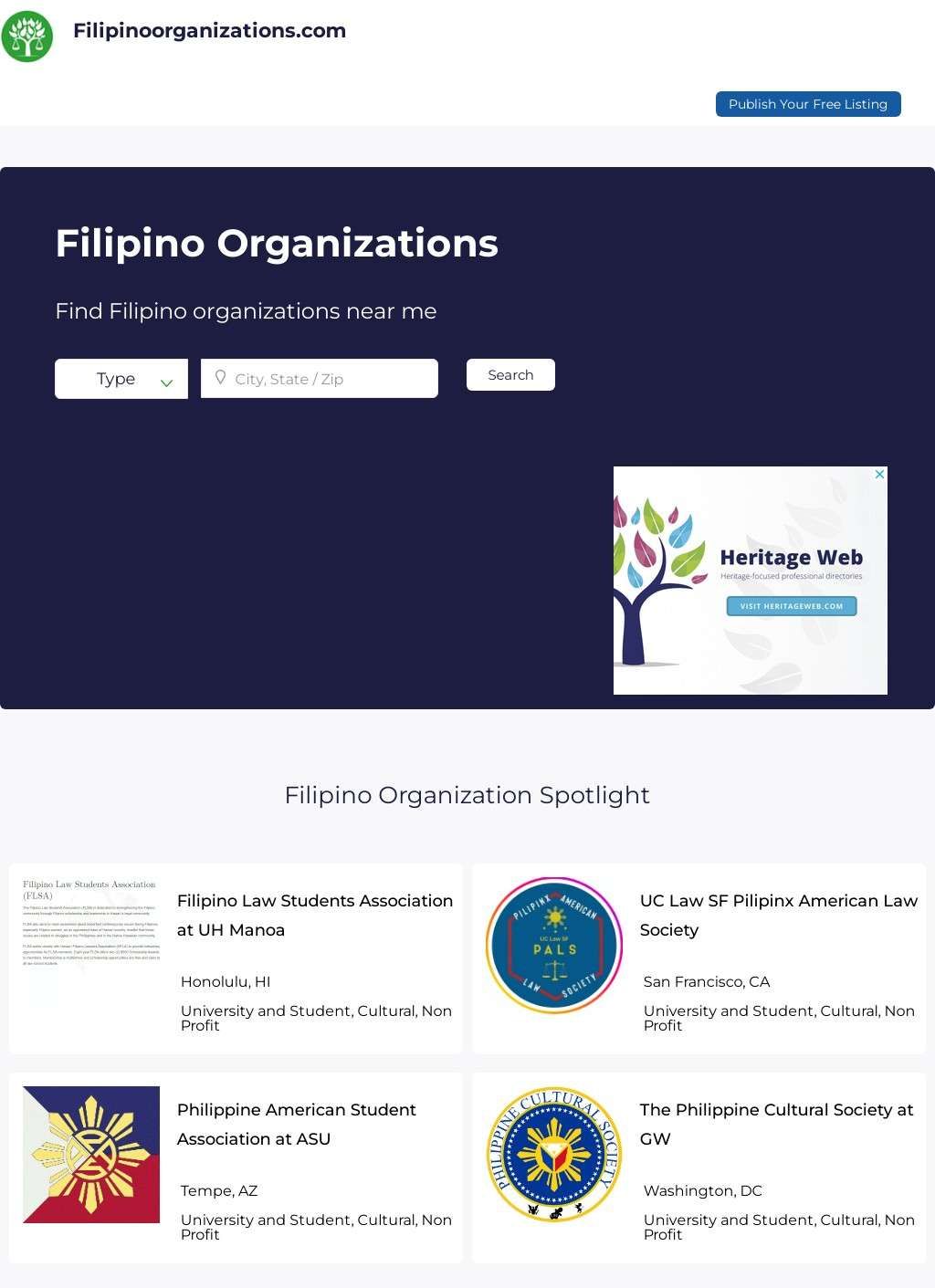
Finding the cultural, charitable, or religious groups near them is a real problem for Filipino-American families in Spokane or student clubs in Los Angeles. Filipino Organizations sets out to answer that question by gathering listings for Filipino cultural, charitable, educational, religious, and social groups across the United States and Canada, with a handful of entries reaching back to the Philippines. The search is the center of it: type a name, or filter by practice area, city, state, or zip code, and you narrow a wide field down to the groups within reach.
Search and filtering by location
The categories Filipino Organizations lists give a fair sense of who this is built for. There are charities, cultural groups, nonprofits, student organizations, and religious institutions, which together cover most of the ways a diaspora community tends to organize itself. Two of the sample verified listings spell out the intent well. One is Search to Involve Pilipino Americans in Los Angeles, the other the Filipino-American Northwest Association in Spokane Valley, Washington. Both are verifiable, geographically specific entries, and seeing actual named groups instead of placeholder filler is good evidence that the catalogue has substance behind the search box.
Zip code proximity for community resources
The filtering is the part most casual visitors will touch. Searching by zip code fits how people look for community resources, since proximity is what counts when you want to attend a meeting or drop off a donation. The practice-area filter sits alongside location, so someone hunting specifically for a student group rather than a parish can get there without scrolling past everything else.
Practice area categories for specific groups
For people who register, there is a second layer. A logged-in account opens a dashboard covering profile management, messaging between users and organizations, referral tracking, and tools for managing your own listing. That last piece points to a platform that expects organizations to claim and maintain their own pages, which is the model that tends to keep directory data from going stale. Whether enough Filipino groups have done so to make the messaging and referral features lively is the open question, and the site offers no easy way to gauge that from outside.
Account features for organizations
One thing worth flagging plainly: Filipino Organizations runs on HeritageWeb, a white-label directory product, and support routes through help.heritageweb.com. That is not a mark against it, since plenty of solid niche directories are built on shared infrastructure, but it does mean the experience and back-end belong to a wider template instead of something built uniquely for this community. Anyone who has used another HeritageWeb site will recognize the layout immediately.
Dashboard tools for registered users
On reputation, there is little to report. No third-party reviews or ratings tied to filipinoorganizations.com turned up in a search, so the usual external markers (Google stars, Trustpilot scores, that sort of thing) are not there. That absence is common for community directories that serve a specific audience and never chase mainstream attention, which leaves a visitor to judge the site on the listings themselves and the names it has managed to verify.
Platform infrastructure and contact options
Reaching the people behind the site is harder than it should be. A contact page exists, which is the baseline, but the landing page shows no phone number, no email, and no physical address, with support routing back to the HeritageWeb help center instead of to anyone running the Filipino-specific side. The footer covers About, Privacy, and Terms pages, and Filipino Organizations maintains a presence on Facebook, X, LinkedIn, and Instagram, so channels do exist even without a direct line. For a directory whose purpose is connecting people to organizations, a clearer route to the people behind the site would strengthen the trust it asks for.
HeritageWeb white-label directory system
What Filipino Organizations gets right is scope and specificity. It is narrow in a useful way, built for one community across two countries, pairing a genuine search tool with verified named entries instead of a splash page with a search box and nothing behind it. The dashboard features point to a platform that wants organizations to participate rather than just be indexed, which is the right ambition for a resource like this.
Contact methods and social media presence
Compared to a plain Google search for "Filipino organizations near me," Google surfaces more raw results faster but mixes news, social posts, and dead pages into the pile with no structured filter for sorting a cultural group from a charity or a parish. Filipino Organizations trades breadth for that structure, and for someone who specifically wants community groups sorted by type and zip code, the focused catalogue is the more useful starting point, assuming the listings in their corner of the map have kept up. Its value rises and falls with how many local groups have actually claimed a page.