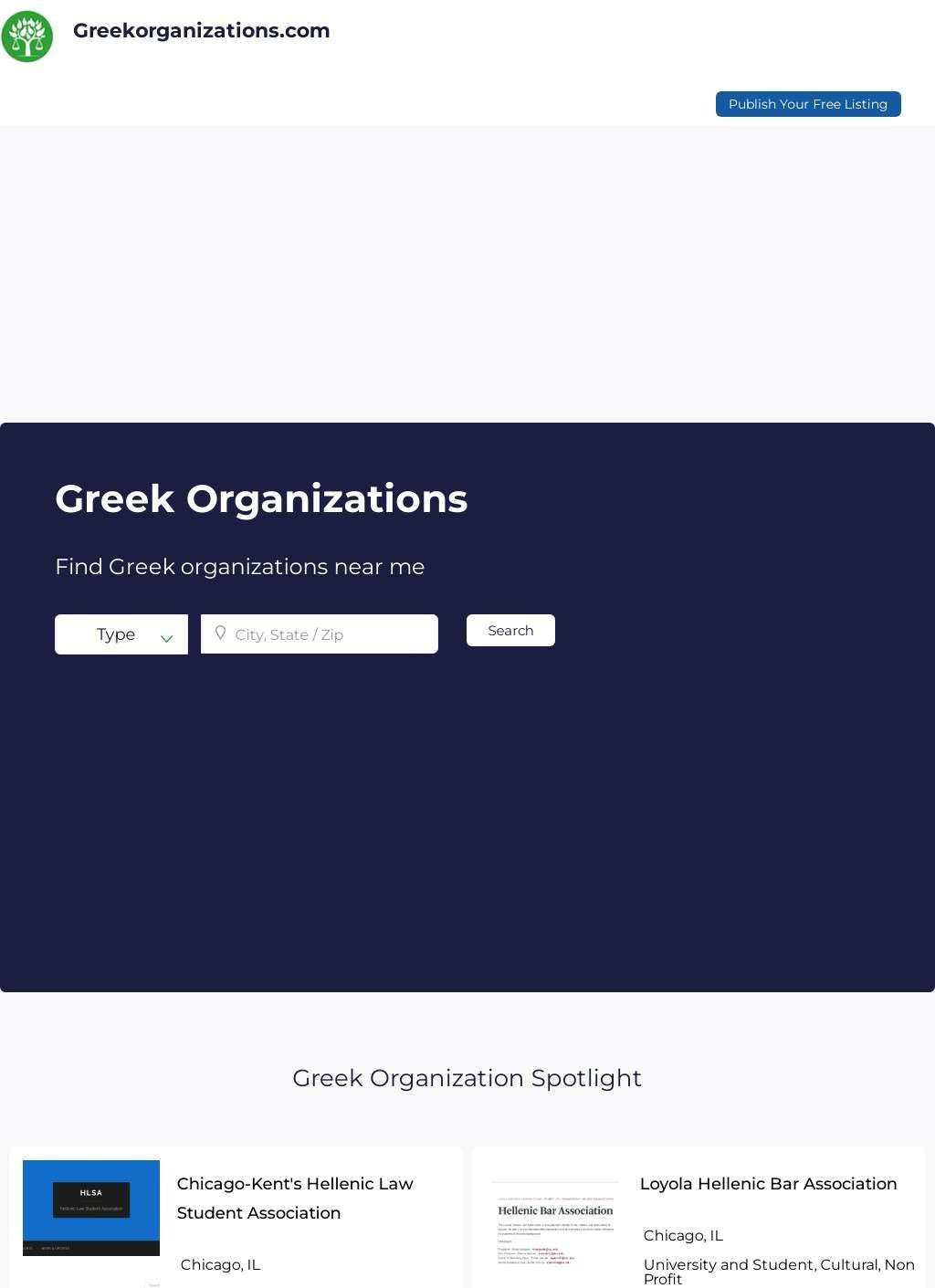
Despite its name, Greek Organizations indexes far more than fraternities and sororities. Heritage Web LLC runs the platform, and the category list sweeps in student groups across academic, activism, international, spiritual and sports lines, plus cultural, religious, non-profit, charity and government organizations. In practice it is a general community-group registry that happens to carry a Greek-letter brand. First-time visitors expecting only chapter houses and pledge classes will land in a much wider directory than the homepage implies.
Search and geographic filtering
Search sits at the center of what Greek Organizations does. You can look up an entry by name or filter by city, state or ZIP code, and the geographic browsing covers major U.S. cities including Boston, Chicago and New York. Two foreign entries also appear, Cyprus and Greece, which fits a literal reading of the name even though the rest of the platform is firmly American. That split is a minor oddity, but it at least confirms Greek Organizations does not quietly redefine itself without telling anyone.
Free submission model for organizations
Listings are free to submit, and organizations are openly invited to add themselves. A no-fee model expands coverage fast, but accuracy then depends on whoever filled in the form and whether they ever came back to update it. The depth of any given city category is something a visitor has to test by searching, not something Greek Organizations makes easy to gauge upfront. Whether the free-submission pipeline has kept the platform populated with current data or left pockets of stale entries is the practical question anyone using it for real research will hit quickly.
Dashboard tools for registered users
Registered users get more than a read-only lookup. The dashboard handles profile management and listing submission, and an internal messaging system lets you contact organizations directly through Greek Organizations without hunting for an email elsewhere. A referrals feature rounds out the account tools. The messaging layer is the most practically useful piece here, because the friction in finding a small club or charity usually lives in the contact step, and routing it through the platform sidesteps dead phone numbers and stale addresses that are common in this kind of listing.
Account requirements and feature access
The problem is that the better features stay hidden behind registration. A casual visitor who wants to confirm a group exists and where it meets gets the search and the filters; the contact and management tools require an account. For people willing to sign up that is a reasonable arrangement. For someone who lands once without that intent, the site delivers less than the dashboard suggests. The help center is not on the site itself but hosted on help.heritageweb.com, quietly confirming that Greek Organizations is one property in a larger Heritage Web stable rather than a standalone project.
Operator contact information
Reaching the operator is not straightforward. A contact link sits in the footer, but the listing page shows no phone number and no physical address, with support pushed to that external subdomain. For a directory whose pitch is connecting people with organizations, keeping the operator's own contact details low-key is an awkward position. A footer link and a hosted help center do count as real channels, so Greek Organizations is not entirely opaque, but the setup asks for trust the page does little to build proactively.
Third-party reviews and public feedback
A search for third-party opinion on Greek Organizations turns up almost nothing: results are the site's own directory pages, and no ratings or reviews appeared on Google, Trustpilot, Yelp, or BBB. The copyright line runs back to 2011, so Greek Organizations has been live for over a decade. A long-running platform with no external reviews has either operated well below the radar or has not given users a reason to weigh in publicly. No count of reviews, no platform scores.
Search functionality and listing accuracy
None of that makes Greek Organizations useless. The search works on the terms it sets out, the category spread is genuinely wide, and in-platform messaging is a smart answer to a real problem. The free listing model and the long-running copyright point to a maintained property. If you want to locate a student club, a local charity or a community group in a U.S. city, a name or ZIP search here costs nothing and may save some steps.
Data freshness over a decade of operation
What is harder to set aside is that decade-plus of operation has left no public record of whether Greek Organizations actually delivers fresh, accurate listings. No external scores, no operator address, and the most useful tools locked behind a sign-up you have to complete before you can judge whether the data inside is worth the account. On the published evidence alone, Greek Organizations is a functional directory with a reasonable feature set and an unusually quiet footprint for its age.