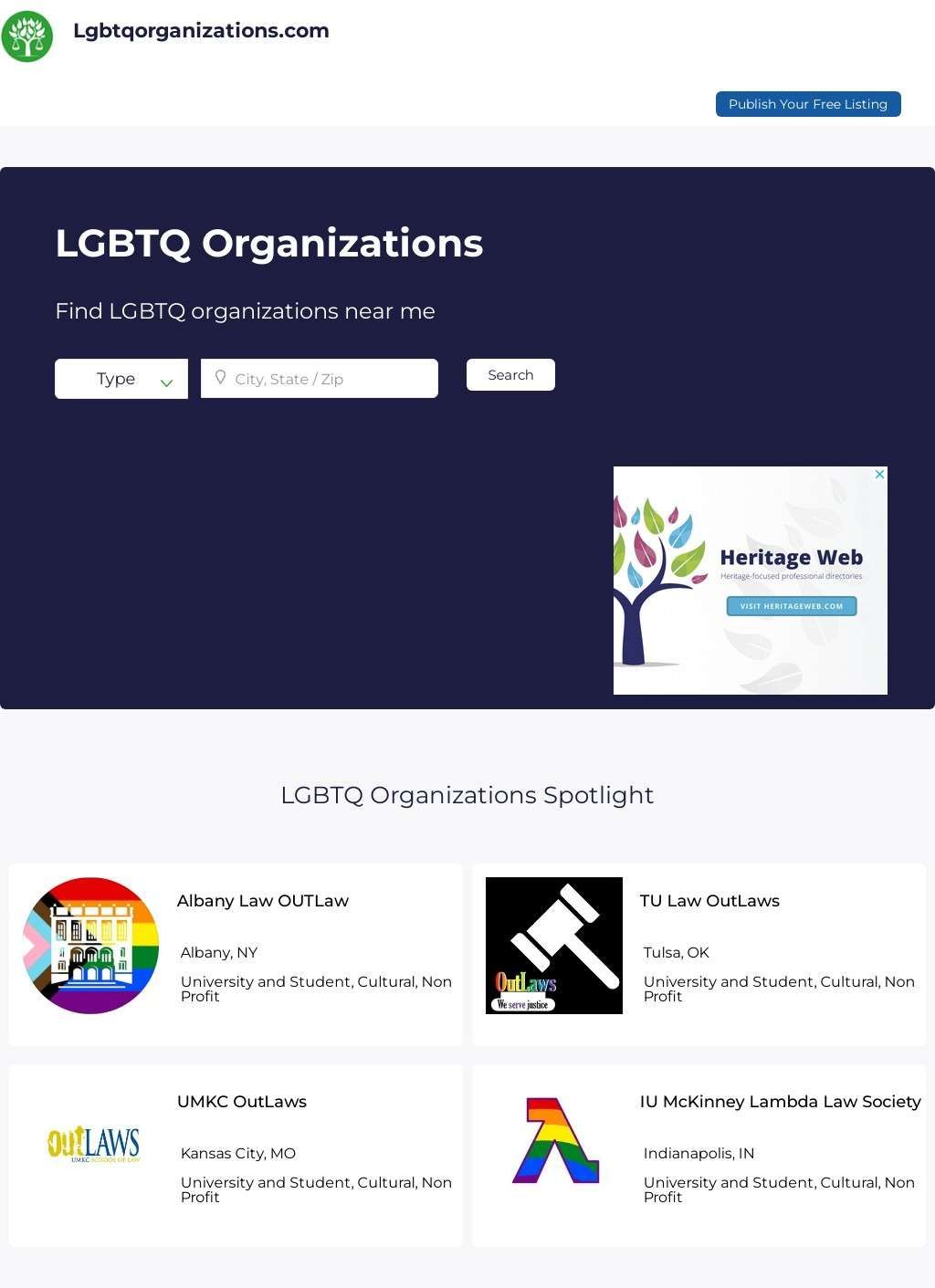
Search by city, state, or zip code, then filter the results by type of group: that is the core mechanic of LGBTQ Organizations, a worldwide index that sorts charities, nonprofits, cultural groups, political organizations, religious institutions, and human rights bodies into one place. LGBTQ Organizations is run by Heritage Web, a publisher that has been operating since 2009, and it carries dedicated browse pages for individual US cities including Austin, Chicago, Denver, and Los Angeles, plus a national roll-up at /us. So a visitor in one of those metros can land straight on a local slice instead of wading through entries from the other side of the planet.
How the directory filters results by location
The depth of the catalogue is the main draw, and it is reasonably honest about how it is built. Organizations listed on LGBTQ Organizations have their licenses checked once a year, a detail that separates this from the kind of link dump that never gets touched after launch. Whether annual verification is enough to keep a fast-moving nonprofit sector current is a fair thing to wonder about, but the site at least states the cadence openly instead of implying that everything is constantly audited.
Annual verification of organization licenses
Registration adds a layer beyond plain browsing. Account holders on LGBTQ Organizations get a dashboard for managing their profile and an internal messaging system that routes contact to the groups they find, keeping the conversation inside the platform. Organizations themselves can request a free listing, while paid lead and referral options sit alongside that for groups that want more visibility. The free-plus-paid split is common for catalogues of this kind, and the no-cost route matters for the small volunteer-run outfits that make up a lot of this space.
Account features and listing options
This is where LGBTQ Organizations deserves credit for not hiding the commercial machinery. The legal disclaimer page states plainly that the operator may receive monetary compensation or free products in exchange for reviews or endorsements of the companies it lists. That disclosure is the kind of thing many directories bury or skip entirely, so seeing it spelled out lets a reader weigh any praise on a listing accordingly.
Paid placements and editorial transparency
The flip side is that paid placement and editorial endorsement can blur together once money changes hands. A user looking for a genuinely well-regarded local nonprofit has to keep in mind that prominence on the page may reflect a referral arrangement and not independent merit. The disclosure does not erase that tension; it just means nobody can claim they were not warned. For a tool people might use to find a charity to support or a support group to lean on, that distinction is real and worth keeping in mind.
Contact methods and operator visibility
On finding the people behind LGBTQ Organizations, the picture is limited. A contact page exists, but it redirects to a Heritage Web FAQ and support page, and no phone number or street address appears on the homepage or the city landing pages. Everything funnels through the internal form. That is workable for routine account questions, yet the absence of any direct phone line or postal address makes the operator feel a step removed from the listings it curates.
Absence of third-party reviews or ratings
As for outside reputation, there is not much to go on. No third-party reviews or ratings for the site itself turn up on Google, Trustpilot, Yelp, the BBB, or comparable platforms. Searches mostly return the directory's own pages, alongside unrelated nonprofit scores on Charity Navigator and GreatNonprofits that apply to the listed groups, not to LGBTQ Organizations as a service. That silence is neutral more than damning: a niche catalogue can run quietly for years without ever accumulating a public review trail. It does mean a newcomer has no independent voices to consult before trusting the entries.
What LGBTQ Organizations gets right is structure. The geographic filters work the way someone in a hurry would expect, the category split is sensible, and the city pages give a clear entry point for the metros that have them. Heritage Web's long run since 2009 also points to an operation that is not going to vanish next quarter. The cross-border scope is genuinely useful for anyone trying to find groups outside their own country, where local knowledge is hardest to come by.
The reservations stack up on the credibility axis. Compensated endorsements, even disclosed, ask the reader to do their own due diligence. The verification of listings is yearly and self-described. Contact runs through a form with no human-facing phone or address. And there is no body of outside feedback to confirm that the entries on LGBTQ Organizations are accurate or that the messaging system reaches the groups it points to.
Taken together, LGBTQ Organizations works best as a starting point: a way to surface candidates in a given city or category that you then check independently before donating, joining, or reaching out. The disclosure habit is a genuine plus and the catalogue is broad, but the limited contact route and the lack of any outside track record keep this short of a resource you would lean on without a second source.