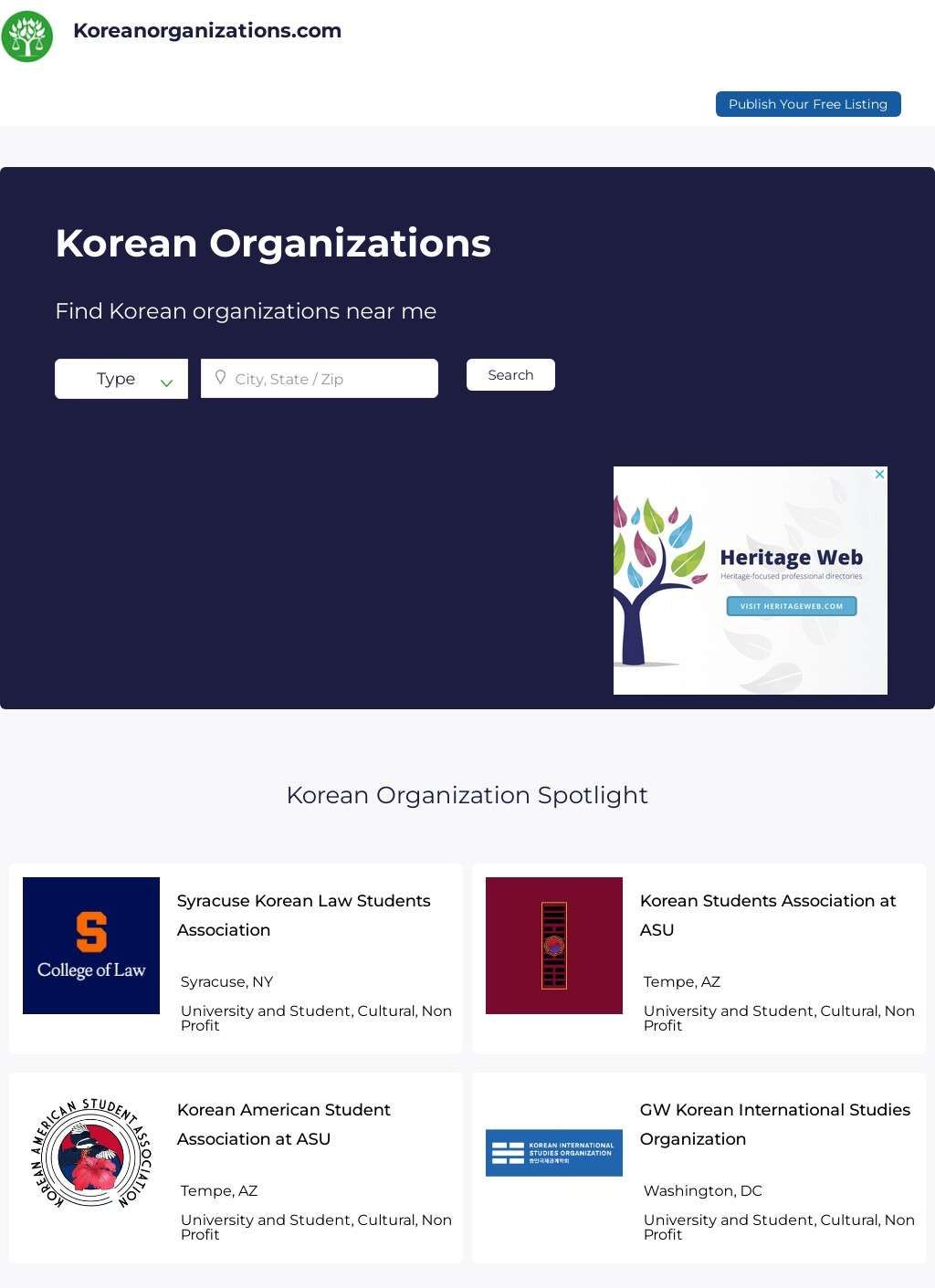
Search for a Korean cultural group, a North Korean human rights nonprofit, or a Korean American student association on koreanorganizations.com and the same machinery handles all three: type a name, narrow it down by location, and apply a specialty filter. The category list runs through charities (broken out into animal, arts, and general nonprofit subtypes), cultural groups, religious institutions, government bodies, human rights groups, business and political organizations, and student associations. That granularity is the most useful thing Korean Organizations puts forward. Plenty of community directories stop at a single bucket labelled "nonprofit," so the decision to split charities by cause and to keep cultural, religious, and student groups in separate lanes makes the filtering genuinely worth using.
Search and filtering by category
Geographically the site leans toward the United States, Canada, and Korea itself, with extra browse paths built around major US cities and individual US states. Someone hunting for a Korean association in a specific metro area can drill down that way instead of relying on the search box alone. Each organization listing carries contact details, phone numbers included, which is the payoff for anyone who lands on a profile after filtering: a name and a category are not much help without a way to reach the group, and Korean Organizations puts that information on the listing itself.
Geographic browse paths
Beyond plain browsing, the platform opens up once you sign in. Registered users can build a profile, manage listings they are responsible for, set up notifications, and send messages straight to organizations in the directory. That last feature has more utility for a community-focused index than it would on a generic commercial site, because the people searching here are often trying to connect with a group rather than simply confirming it exists. A messaging layer turns a static list of names into something closer to an introduction service, and on a site like Korean Organizations, where the audience is a specific diaspora looking for its institutions, the difference between a lookup and an actual introduction is substantial.
Messaging and profile features
Organizations themselves can claim a free listing, and there is a pricing section pointing to paid tiers on top of that. The free-entry route is the right call for a directory that wants coverage: a small Korean church or a volunteer-run cultural society is unlikely to pay before it sees value, so letting them in at no cost is how Korean Organizations fills out. What the paid tiers actually buy is left for the pricing page to explain, so it is fair to say only that a two-track model exists: a free door to get listed, and something more for groups willing to pay for it.
Free and paid listing options
The site runs under the HeritageWeb brand, whose help center sits at help.heritageweb.com. HeritageWeb operates a family of similar niche community and professional directories, and Korean Organizations reads as one instance of that shared template aimed at a specific diaspora and its institutions. That lineage cuts both ways. It suggests the search, filtering, and account features are tested across several sites and not improvised for this one. It also means the help and support experience is handled at the parent level instead of locally, so a question about the directory sends you off to a HeritageWeb help center rather than a desk that only knows Korean Organizations.
Support through HeritageWeb
On reaching the people behind the directory, the channels narrow to one. A contact form sits in the footer, and that is the route. No phone number and no physical address appear on the homepage, and the help link redirects to the HeritageWeb domain. The form covers the basic need, but a visitor has to scroll to the bottom of the page to find it, and the support handoff to a parent brand adds a step. For a directory whose entire premise is connecting people to organizations, the operator keeping its own contact details tucked away is a mild irony worth noting, though it does not stop the form from working.
No third-party reviews available
Reputation from outside the site is where the record runs empty. A search turns up no third-party reviews of koreanorganizations.com as a platform: no ratings, no user feedback, nothing on the usual sites that would tell you how others have found it. The reviews that do surface belong to organizations listed inside the directory and not to the directory itself, groups such as Liberty in North Korea on Charity Navigator and the Korean Association of Rhode Island on GreatNonprofits. Those are endorsements of the listed entities, not of Korean Organizations, and it would be a mistake to read them as a verdict on the index that catalogs them. So there is no external read here either way, positive or negative, and that absence is just a fact to weigh.
The assessment lands on the structure of the page itself. The specialty categories are specific enough to do real work, the geographic browse paths give a second route in, and the listings include phone numbers that make an entry actionable instead of decorative. The account features add a messaging channel that fits the community use case. Against that sit the buried contact form, the support experience that lives on another domain, and the complete absence of outside reviews to corroborate anything. Korean Organizations gives the filters enough resolution to be genuinely useful, and the free listing option for organizations should push coverage wider over time. The depth of any given category will track how many groups take that offer up, and right now the index is workable without being comprehensive.