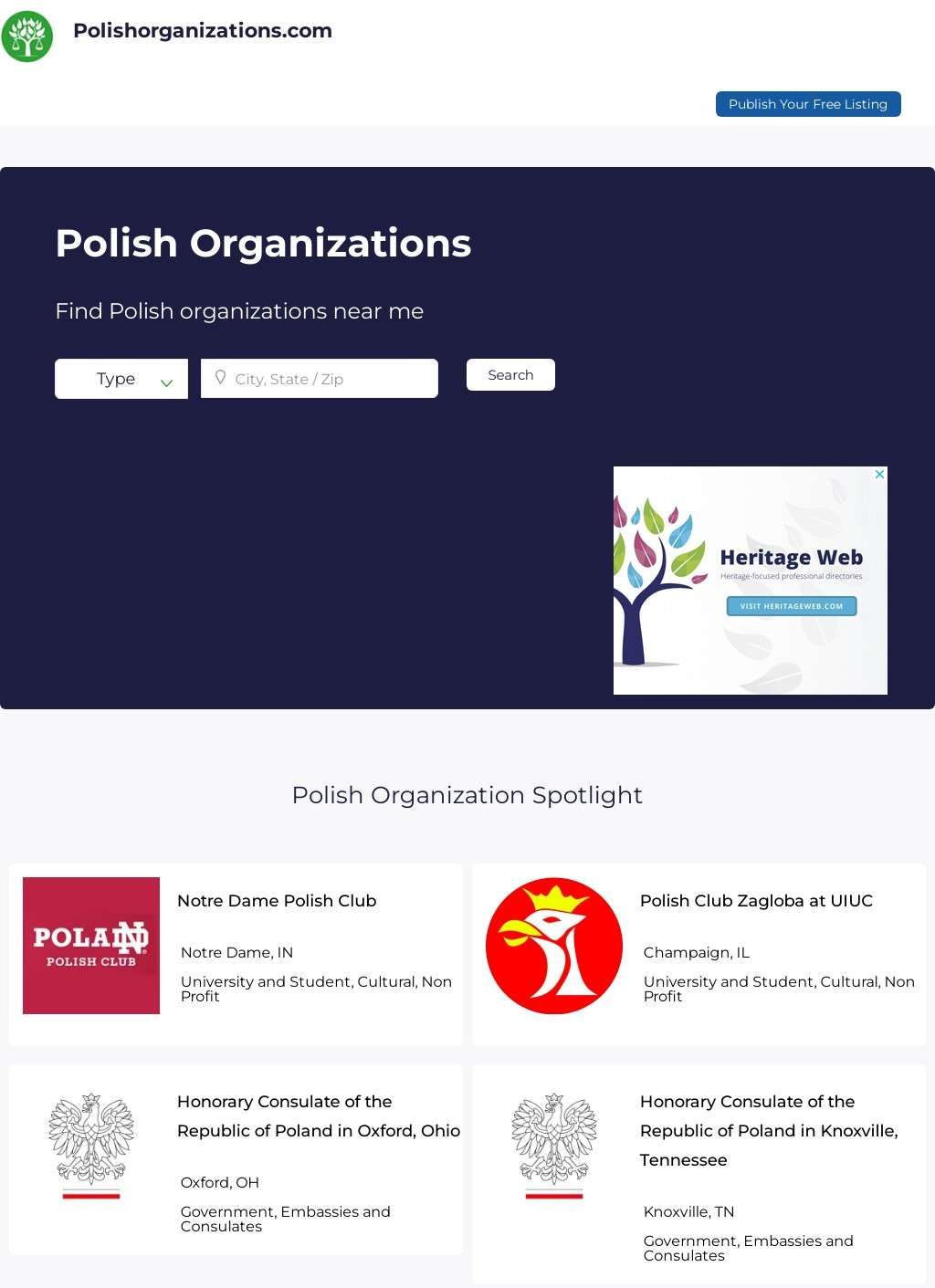
Search for a Polish cultural society in Chicago, a student club in New York, or a consulate listing in Detroit, and Polish Organizations is built to put all three on the same screen. The site is a directory for finding and listing Polish organizations across the United States, Canada, and Poland, with a search box that takes an organization name, a specialty, a city, a state, or a zip code. That spread of entry points is the practical core of it: someone who knows only the name of a group can find it, and someone who knows only that they want a Polish charity near Milwaukee can also get there.
Search and browsing across three countries
The browsable categories on Polish Organizations do a lot to explain who this is for. There are cultural organizations and religious groups, student associations and academic clubs, government bodies and consulates, charities and non-profits, human rights groups, and hobby clubs. That last category sits next to consulates in the same taxonomy, which tells you the site is trying to be a wide net for the Polish diaspora and not a narrow registry of official institutions. Featured US cities point the same way, with Chicago, New York, Pittsburgh, Milwaukee, and Detroit getting their own front-page presence, a list that lines up closely with where Polish-American communities have historically concentrated.
Categories for the Polish diaspora
The reach beyond the US is part of the pitch too. Polish Organizations covers groups in Canada and in Poland itself, which makes it more than a domestic listing service for one country's diaspora. A student in Toronto and an academic club in Krakow can both appear in the same system as a charity in Pittsburgh, and the search filters treat them the same way. For a community defined as much by emigration and return as by any single border, that wider footprint is a reasonable design choice, not a cosmetic addition.
Membership features and profile management
For a member who registers, Polish Organizations adds a layer beyond plain browsing. There is a dashboard carrying notifications and an inbox, tools for managing an organization profile, and a referral program. A monthly newsletter signup sits alongside those features. The split is clear enough: casual visitors get search and category lists, while groups that want to be found get an account and the ability to maintain their own entry. An organization keeping its own profile current is usually the difference between a directory that ages well and one that quietly fills with dead listings, so it is a sensible thing to have built in.
Heritage Web platform foundation
One detail worth pausing on is the infrastructure. Help links on Polish Organizations redirect to help.heritageweb.com, which means the site runs on the Heritage Web platform and is almost certainly one of a family of ethnic and community directories sharing the same code. That is not a knock. A shared platform tends to mean the listing tools, member dashboard, and messaging are tested across more sites than a single niche project could manage on its own, and it explains why the feature set looks more polished than the subject matter alone would predict.
The flip side is that the platform shapes how much of the experience feels specific to the Polish community versus generic to whatever vertical Heritage Web has pointed it at. The categories and city features are clearly tailored to the Polish diaspora, but a visitor who pokes at the help section will land on a general support domain rather than anything Polish-specific. How much weight you put on that depends on what you came for. For finding a group, it is irrelevant; for judging how invested the operator is in this particular community, it is a small data point.
What Polish Organizations does well is keep the path from question to answer short. The combination of free-text search and a structured category tree covers both the user who knows exactly which organization they want and the one who is browsing by interest or location. For Polish students looking for an academic club, or a family newly arrived who wants to find a church or a cultural society, that dual approach is genuinely useful, and it is the kind of thing a directory either gets right or fails at entirely.
Contact and support visibility
On contact, the Polish Organizations landing page is sparser than ideal. No phone number, email, or physical address appears up front. There is a Contact link pointing to /contact and a Help link, so a route exists, but reaching it means clicking away from the homepage instead of seeing a clear point of contact at a glance. For a platform whose whole job is connecting people to organizations, a more visible contact route on the front page would reinforce trust, though the presence of a dedicated page means nobody is left without any way to reach the operator. The Help link landing on a shared support domain rather than a Polish Organizations page reinforces the platform's group-site nature, which is fine for getting answers but does soften the sense of a single accountable operator behind this one directory.
The reputation side has no real outside record. A search for reviews of the Polish Organizations platform turns up nothing notable. What surfaces instead are reviews of unrelated groups that share Polish-community keywords, such as Better Business Bureau entries for the Polish National Alliance and employee feedback for the Polish American Association on Indeed, none of which actually speak to this site. So there is no independent verdict to lean on here, positive or negative. That is common for a niche directory that lives in a corner of the web most review aggregators never index, and it means Polish Organizations has to be judged on what it shows, not on a crowd of voices vouching for it.
Taken together, Polish Organizations reads as a competently built, community-specific directory doing a clear job: helping people find Polish groups by name, type, or place, and giving those groups a way to be found and to manage how they appear. The Heritage Web foundation gives it a more capable member system than a one-off site would likely have, the category structure is sensibly drawn for the diaspora it serves, and the featured cities match the geography. The gaps are modest and honest ones, a front page light on contact detail and an absence of third-party reviews, neither of which contradicts the basic usefulness of the thing.
Testing the directory with local searches
The real test of a directory like Polish Organizations is not its feature list but its filled-in pages. A few searches on a city you know will tell you whether the listings are current and populated enough to be useful. Based on what the site shows, the structure is set up for the job and the member tools give organizations a practical reason to keep their entries accurate. That combination is enough to make Polish Organizations worth trying before dismissing it, even in the absence of any crowd-sourced track record to confirm the obvious is actually happening.