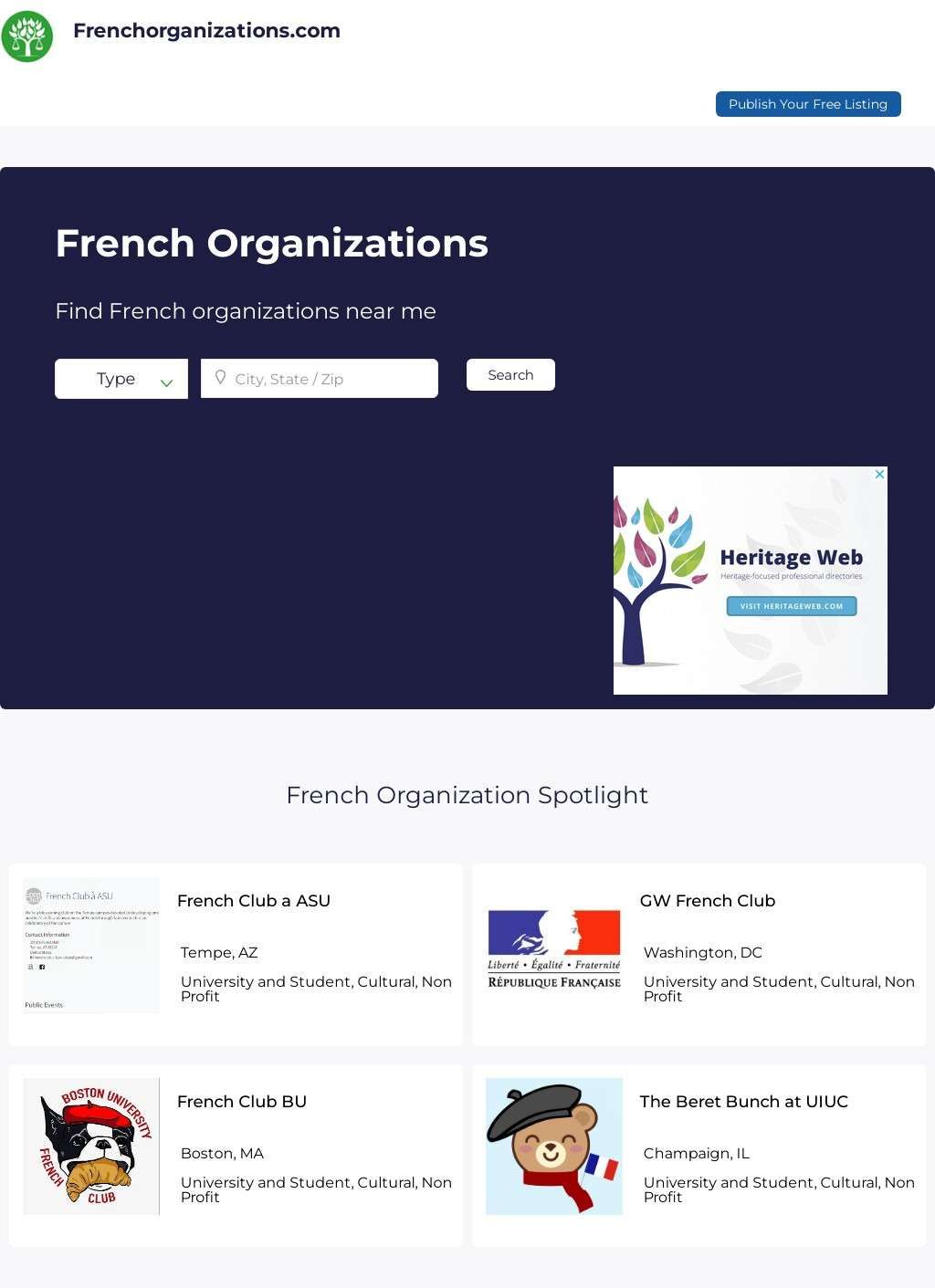
Where does someone turn to find a French cultural association, a Francophone student club, or a French embassy contact without sifting through a hundred unrelated search results? French Organizations sets itself up to answer exactly that. It is a directory built around French-language and French-cultural groups across the US, Canada, and France, and it lets a visitor search three ways: by specialty or practice area, by location down to a city, state, or zip, or simply by the name of a group they already have in mind. The premise is narrow on purpose, and that focus is the most useful thing about it.
How the directory organizes groups
The category coverage is wider than the simple pitch suggests. More than forty headings sit under the surface, and they spread across charities of several stripes (animal causes, arts and culture, education, environmental work, health, international aid, and religious groups), plus cultural organizations, student associations, government bodies such as embassies and consulates, healthcare, housing, and human rights work. A person looking for a French Catholic mission has very different needs from someone tracking down a consulate or a university club, and the taxonomy at least tries to keep those worlds in separate lanes instead of dumping everything into one undifferentiated list. The breadth here is the quiet strength of French Organizations: a single query can reach into corners that would normally take a dozen separate searches across charity registries, embassy pages, and campus sites.
University French societies
French Organizations also gives visible billing to university French societies. Groups at Arizona State University, George Washington University, and Boston University get named entries, among others. This is a small touch with real value: campus Francophone clubs are notoriously hard to find online because they live on student union pages that get rebuilt every academic year and vanish from search. Pulling a few of them into a stable, searchable place is genuinely handy for a student transferring schools or a parent trying to help a freshman plug into something. It also hints at the editorial effort behind French Organizations, since named placements like these do not populate themselves.
Member tools and registration
Two audiences share the space, and it is worth being clear about both. On one side sit the people doing the searching, who pay nothing and just want to locate a group. On the other sit the organizations themselves, who can register with French Organizations and then manage their own entries through a member dashboard. For those registered groups, French Organizations layers on a set of tools that go past a static listing: paid leads, a referral program, and a built-in messaging system so an interested visitor can reach out without the group having to publish a personal inbox.
Heritage Web infrastructure
That second feature set tells you what kind of operation this is. The directory runs on Heritage Web infrastructure, with its help and support funneled through help.heritageweb.com. Heritage Web operates a family of these niche directories, and the shared backbone explains why the member-side tooling feels more developed than a hobby project would manage. A French choral society or a regional alliance francaise can claim a page, field inquiries, and track leads from one login. For a small volunteer-run group with no web budget, that is a low-effort way to stay reachable.
Contact and support limitations
The flip side of leaning on a third-party platform shows up in how you reach the operation behind it. The site lists no phone number, no email, and no street address anywhere on its pages, and the main site carries no contact page either. Support gets routed entirely to the Heritage Web help portal. For a directory this is less alarming than it would be for, say, a shop taking payments, since the product is connecting you to other organizations and those organizations carry their own contact details. Still, a person who hits a problem with a listing has to leave the site to get help, and that extra hop is a mild friction worth flagging.
Public reviews and feedback
On outside opinion, there is little to report. A search for independent reviews of French Organizations turned up nothing specific; the results that surfaced pointed at other things entirely. No ratings, no platform tally, no scattered complaints to weigh. That absence is not a mark against the directory so much as a sign that it sits in a quiet corner of the web where few people stop to write up their experience. A reader should weigh it for what it is: untested by public feedback, neither praised nor panned.
The structure is sound and the niche holds a clear purpose. Someone hunting for a Francophone group in North America or France gets a focused starting point with sensible filters and a category tree that respects how different these organizations are from one another. The student-club spotlight is a thoughtful inclusion. The limited contact setup and the silence from reviewers keep me from calling it a destination you can lean on with full confidence, but neither flaw undercuts the core usefulness for the person doing a search.
Set it next to the obvious alternative, the federation of Alliance Francaise chapters and their own site, and the trade-off becomes clear. Alliance Francaise gives you depth and institutional weight, but only for its own network of language-and-culture centers. French Organizations casts a far wider net, catching charities, consulates, student groups, and human rights bodies that the Alliance directory would never list. That spread is where French Organizations does something its narrower rivals cannot. If a person knows they want a formal French cultural center, the Alliance route is more direct. For anyone whose target is fuzzier, or who needs the embassy alongside the choir alongside the campus club, French Organizations is the broader and more practical place to begin.