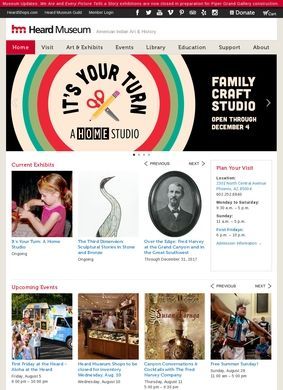
Eleven distinct collection categories sit under one roof here, and they go well beyond the usual painting-and-sculpture pairing. The Heard Museum holds baskets, jewelry, pottery, textiles, paintings, photography, sculpture, fashion, and Hopi Katsina dolls, all built around American Indian art and culture. That breadth is the first thing that registers when you read through what the Phoenix institution has on hand across its departments. It is a private nonprofit, and its entire subject is Indigenous and contemporary Native American work, which sets the Heard Museum apart from a general art museum with a diffuse collecting mandate.
Rotating exhibitions and permanent displays
The exhibition calendar moves. At the time of writing there are three rotating shows running on staggered end dates: "Wisdom from the Future" stays up through December 2026, "October Art: The Collection of Delores Browne Abelson" runs through October 2026, and "Blue Bird" closes in March 2027. Those overlapping windows mean a return visit a few months apart will not show the same walls twice, which is more than many museums of this size manage. Around the rotating work sit permanent displays covering Native American history and photography, so even a visitor who arrives between exhibition changes has substantial ground to cover.
Research library and digital archives
Underneath the public galleries the Heard Museum runs a research library and archives with a digital collection. That detail tends to separate a serious cultural holding from a venue whose purpose stops at hanging objects on a wall. Researchers and students who need primary material, with access to archival sources beyond what a wall label can carry, have somewhere to go. The Heard Museum treats its holdings as a record to be studied and an attraction to be toured, and for anyone working on Indigenous art or history that dual function has real practical consequences. The digital collection extends access further, which is useful for anyone who cannot visit Phoenix in person but still needs to consult the archive.
On-site shopping and dining options
The practical side of a day spent at the Heard Museum is worth spelling out. On site there is a Museum Shop that sells authentic pieces sourced directly from Native American artists, which puts buyers closer to the makers than a generic gift counter would. A Courtyard Cafe handles food, so a longer visit does not require leaving and coming back. Those two amenities sound minor on paper, but they change how much time a family or a group can comfortably spend before fatigue sets in. The Heard Museum also runs an annual Indian Fair and Market, a ticketed outdoor event that draws artists from across the country and adds another reason to plan a visit around the calendar.
School programs for educators
The educational programming runs deeper than a printed schedule suggests. School visits are supported, and there are teacher resources prepared for classroom use, which points to a real institutional commitment to working with educators and giving school groups structured content with clear learning objectives. The Heard Museum is also available for private event hire, so the building does double duty beyond public opening hours. Membership grants free admission across the year plus discounts, which makes repeat visits and the rotating exhibition schedule add up to genuine value for anyone local.
Who visits the Heard Museum?
Who is this for, practically speaking? Families, students, researchers, and people drawn to Indigenous cultures and contemporary Native American art. That is a wide span, and the mix of permanent displays, scholarly archives, hands-on education, and a shop that channels money to artists means each of those groups finds something built for them. The hours follow the Arizona calendar sensibly: 10 a.m. to 4 p.m. daily from September through May, then a Tuesday-through-Sunday schedule from June through August when summer heat thins the crowds.
Visitor ratings on major review sites
The public verdict, where it can be checked, leans clearly positive. On Tripadvisor the Heard Museum carries more than 360 reviews and has been flagged with a Travelers' Choice award, which is a distinction that depends on sustained high ratings across a large pool of reviewers, not a one-off endorsement. Yelp shows a comparable picture, with around 360 reviews and over 1,500 visitor photos attached to the listing. That photo count is telling in its own quiet way: people do not bother uploading 1,575 pictures of a place that left them cold.
Donor reviews versus workplace ratings
There is also a presence on GreatNonprofits, where the Heard Museum is listed with donor and volunteer reviews, which speaks to the support side of a nonprofit rather than the ticket-buying side. The one note that runs against the grain is internal: Glassdoor carries 18 employee reviews and a 2.6 out of 5 score on work-life balance. That figure reflects the staff experience, not what a visitor walking through the galleries will encounter, and it would be unfair to let an employer rating color a judgement about the exhibitions. Still, it is on the record, so it belongs in an honest accounting.
Contact information for planning visits
Contact information is as visible as it gets. The phone number, the full street address on North Central Avenue, and the opening hours all sit on the homepage, and there is a contact-and-visit page on top of that. A visitor planning a trip can find the basics in one pass, which sounds trivial until you have wrestled with a museum site that buries its hours three clicks deep. The transparency here removes any friction from the planning stage.
Overall reputation of the institution
Pulling it together, the Heard Museum comes across as a focused, well-run cultural institution with real depth behind the public face: a narrow and serious subject, a collection spread across eleven categories, an exhibition program that keeps changing, and the library, education work, and artist-direct shop that mark out an organization doing more than turning stiles. The outside reputation backs that up, and the practical details for a visit are laid bare without effort.
The one caution worth registering is the soft employee-satisfaction score, which sits apart from the visitor experience but is the one flat note in an otherwise strong picture. Phoenix has no shortage of art venues competing for the same afternoon, and the Heard Museum performs well against them because the subject focus is genuine rather than decorative. The rotating schedule means the case for a second visit is built in from the start.