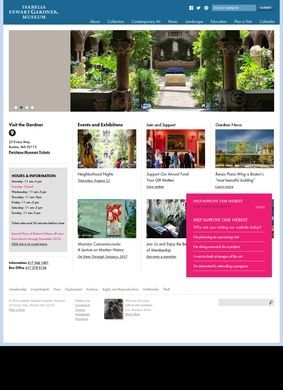
Built into the structure of a Venetian-style palace in Boston, the Isabella Stewart Gardner Museum asks something different from its visitors than the typical art institution does. Gardner assembled the collection herself over a lifetime, arranged every room personally, and stipulated that nothing be moved after her death. What that means in practice is that Italian Renaissance paintings hang beside seventeenth-century furniture, tapestries frame doorways, and the logic of the whole is one collector's eye, not a curator's argument. The Isabella Stewart Gardner Museum opened to the public in 1903 and still operates largely on those original terms.
The collection in context
The permanent collection is wide: European and American paintings, sculpture, ceramics, textiles, decorative objects, and archival material that documents Gardner's own life and the institution she founded. Because works sit in period rooms instead of on neutral gallery walls, the experience rewards attention. People who want a clean object-plus-label encounter may find the density unfamiliar. People drawn to how collections take shape, how taste becomes a space, tend to find it absorbing. The famous central courtyard, planted with seasonal flowers and ringed by the palace's interior facades, sits at the center of the arrangement and pulls the whole thing together.
How period rooms shape the experience
Programming keeps the Isabella Stewart Gardner Museum from becoming static. There are rotating special exhibitions, installations in the courtyard tied to the seasons, and community events including free admission days. An artists-in-residence program brings working artists into the building, giving the contemporary wing actual substance instead of a token gesture. The online collection database is genuinely useful for anyone planning ahead: you can search the holdings before traveling, and the archives extend that reach into the museum's institutional history. For researchers or teachers building curriculum, this is more than a homepage with a gallery map.
Programs and exhibitions
Education gets real treatment on the site. Guided tours are available and the museum recommends booking them in advance, which matters if a school group wants more than a self-directed walk. There is educator training and a set of curriculum resources for classroom use, so a teacher planning a visit has material to work with before the day. The Isabella Stewart Gardner Museum publishes more structured support for educators than many comparable institutions bother to offer.
What educators receive
The practical side of a visit is handled plainly. Cafe G covers dining on the premises and a gift shop handles books, prints and souvenirs. The museum also rents event spaces, so the palace doubles as a private venue for weddings and corporate evenings when it is not simply open to the public. None of this is dressed up; the site lays it out as the working reality of running a busy institution, which is what someone planning a function or just lunch after the galleries needs to confirm.
Visitor logistics and amenities
Support options run across a spectrum. Membership tiers serve regular visitors; patron and corporate partnership programs address deeper involvement; annual fund donations and planned giving round out the picture. That range is typical for a museum of this kind and reassuring to see laid out clearly in plain sight.
Support through membership and giving
One thing the website does well is set expectations before you arrive. Advance ticketing is recommended, and booking ahead is especially sensible around popular exhibitions or free admission days when demand climbs. The weekly schedule takes a moment to absorb: the Isabella Stewart Gardner Museum keeps different hours across the week and closes one weekday entirely, so checking ahead before traveling is worth the thirty seconds. The longer Thursday evening hours are a useful option for anyone who works during the day.
Why advance planning matters?
What gives the Isabella Stewart Gardner Museum its character is the refusal to separate the collection from the building and the person who assembled it. You are looking at Italian Renaissance painting and seventeenth-century furniture where a specific collector decided they belonged, with the courtyard as the green center of the whole arrangement. That makes it a different experience from a conventional encyclopedic museum. The trade-off is that the period-room approach asks a little more from the visitor, who has to read a room rather than scan a wall. Most people who engage with it on those terms find the Isabella Stewart Gardner Museum worth the adjustment.
What visitor reviews reveal
The museum carries a strong presence across travel platforms. Thousands of visitor reviews on major sites run consistently positive, with the courtyard and the overall atmosphere drawing the most comment. The volume and consistency of that record is about as clear a public signal as a cultural institution can produce. There is no shortage of independent commentary to draw on if you want it before booking.