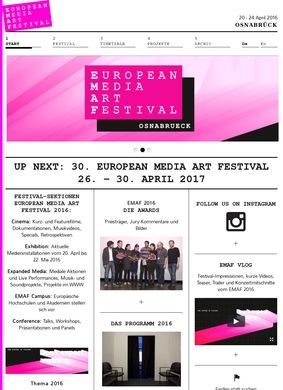
What does a festival have to do to call itself the largest of its kind in media art? In the case of the European Media Art Festival, the answer is four decades of continuous programming out of the University of Osnabrueck's Department of Media Studies, where it has run since 1981. Wikipedia describes it as the largest gathering of experimental short films, digital art, animation, and multimedia in the field, and the operating figures support that framing instead of merely asserting it: the 2018 edition drew roughly 14,000 attendees and processed around 2,500 submissions, feeding a program of more than 160 films, video installations, performances, and talks across multiple venues, among them the Kunsthalle Osnabrueck, the Lagerhalle, and the Cinema Arthouse.
Four decades of experimental media programming
The event runs each spring in Osnabrueck, Germany, but it does not end when the screenings do. Kunsthalle exhibitions continue for several weeks past the closing date, so the European Media Art Festival is partly a live event and partly an extended curatorial project. A 40th edition is set for April 2027, and a 2026 open call is already underway. On the basic question of whether this is a stable, going concern, there is little room for doubt.
Specialized strands for different art forms
Programming at the European Media Art Festival is structured rather than sprawling, and the shape of it tells you who it is for. An International Selection of more than 30 short films runs alongside a feature-film strand and Expanded Cinema programs that push past the conventional flat screen. An Artist in Focus retrospective gives one practitioner sustained attention across multiple works, while the Campus section reserves room for art-school submissions, keeping newer makers in the lineup next to established names. Thematic exhibitions at the Kunsthalle anchor the visual-art side. Each strand has real depth, and that depth is the product, not a bonus.
There is a cost to that focus, and the festival makes no effort to hide it. A visitor after mainstream cinema would find almost none of this familiar, and the selection is pitched to a specialist audience rather than to win a general visitor over. That specialist framing is deliberate. People who treat experimental film, video installation, and digital art as a discipline are the intended audience, and the festival is built around their expectations.
Professional infrastructure and international submissions
Wrapped around the screenings is a layer of professional activity that confirms as much. The European Media Art Festival awards the VdFk Media Art Prize at a dedicated ceremony, runs filmmaker Q and A sessions, and organizes workshops and panel discussions that take in practical topics around cultural work. An open call accepts submissions from media artists worldwide. A professional accreditation route gives film and art professionals free access to the whole program. That pairing, an international open call alongside a credentialed track for working practitioners, marks this out as a meeting point for the field as much as a public-facing event.
The European Media Art Festival's Facebook page lists 9,332 likes and 309 check-ins, a reasonable following for a regional art event. IMDb tracks it as an event, and there is a standalone Wikipedia article, which generally reflects some established notability within a domain. The consumer-review trail that follows a shop or a restaurant is absent here: a search turns up no Trustpilot, Google, or Yelp scores. For a cultural festival that is the expected pattern, not a warning. Events of this sort are judged by their programming and their standing among artists and curators, and a star aggregate would tell you almost nothing about either.
Tracking reputation through history and track record
The history does more analytical work here than any rating could. An event that has reached its fortieth edition without abandoning its experimental remit has clearly found firm ground, and the academic origins at Osnabrueck explain the studious character of the whole enterprise. Retrospectives, a campus strand, panel discussions on cultural practice: these read as priorities set by people inside the discipline. The claim to be the largest of its kind sits within a specialized field, so it should be read in that light, a leading position in a domain that never draws mass audiences. Within those limits, the published track record is enough to judge the European Media Art Festival on, and a prospective attendee or submitter does not need to wait on a brochure or an inquiry to size it up.
Contact details on the site are clear. A press email is published, edition details and announcements stay current in the news section, and accreditation information is laid out for professionals who want to apply. The weighting toward press and professional contacts matches the orientation of the European Media Art Festival itself. A general visitor can still find program dates and venue details without trouble, and the news section updates often enough to be a dependable first stop.
Pulled together, the picture is consistent and largely positive. The European Media Art Festival holds a clear position as the principal international fixture in its field, with forty years of programming behind it, credible attendance and submission figures, and a dual structure that serves both a curious public and the practitioners who submit, accredit, and compete. For anyone working in experimental film, video installation, or digital art, the open call and the free professional access turn it into a working venue as much as a spectator stop. The single qualification is the same as the strength: the framing is narrow on purpose, and a viewer whose tastes run to conventional cinema or a casual cultural outing will find most of the program pitched past them.
How does the festival compare to other European events?
Set it against Ars Electronica in Linz, the other heavyweight in this corner of European media art, and the difference is one of register. Ars Electronica sprawls toward technology, science, and society at large; the European Media Art Festival keeps a tighter grip on the experimental moving image and the gallery-based work around it. If the screen and the installation are where your interest sits, the narrower one is the better fit, and Osnabrueck rewards the trip.