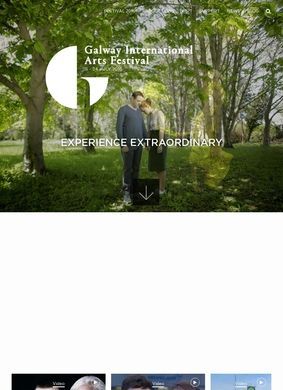
What does a two-week arts festival in the west of Ireland put in front of you between the 13th and 26th of July? A lot, as it turns out. Galway International Arts Festival runs theatre, music, visual art, opera, dance, circus, comedy, street spectacle and family shows across the city, and the 2026 calendar follows the same pattern it has held since Galway International Arts Festival began back in 1978. That is a long run for any event, and the breadth on offer is the first thing that registers when you read through the programme. Galway International Arts Festival is also a commissioning body that produces original work, which changes how the work lands.
Programming across theatre, music, dance, opera
The site sets out the year's strands clearly. There are headline music acts, contemporary dance pieces, opera commissions, large-scale street work that spills into public space, and children's theatre for families who want to bring younger audiences along. Galway International Arts Festival commissions and premieres new work, some of which goes on to tour internationally after Galway audiences see it first. That commissioning habit is what separates a festival that programmes from one that produces, and the difference shows in how the line-up reads year after year.
New productions premiere and tour internationally
The theatre side is where Galway International Arts Festival seems to put real weight. New productions premiere here and then travel, which means the work shown is often original to the festival rather than a stop on someone else's tour. That has earned Galway International Arts Festival press attention well beyond Ireland. The Stage, the UK trade paper, has published several critical reviews of individual productions, and Irish outlets including the Irish Examiner and the Sunday Independent regularly cover festival shows. Ireland.com goes as far as calling Galway International Arts Festival one of Europe's top arts festivals, which is a claim the programme backs up reasonably well.
Street spectacle reaches unticket audiences
Music, opera and dance fill out the rest of what Galway International Arts Festival puts on each year. The opera commissions in particular point to a festival willing to spend on ambitious work, leaving crowd-pleasers aside. Street spectacle is the part that tends to reach people who never bought a ticket, since it happens in the open and pulls in passers-by. This kind of programming is the truest test of an arts festival, because it has to win over an audience that did not choose to be there. Galway International Arts Festival has built a reputation for handling that scale of public work, and 2018 brought a record-attendance year that coincided with Galway's designation as European Capital of Culture.
Venues spread across the city
Performances run across several spaces. The Black Box Theatre on Dyke Road is a central venue, and the University of Galway's Bailey Allen Hall hosts other parts of the programme, with further locations across the city depending on the show. The spread of venues fits a festival that wants to occupy the city for a fortnight, with no single building as its anchor. Galway International Arts Festival treats the city itself as infrastructure, which is visible in how the street programme is mapped across public squares and unexpected corners.
Supporting the festival beyond attendance
Beyond the live events, Galway International Arts Festival keeps a talks platform with recorded talks and podcasts available on the site, so the ideas around the work outlast the run itself. There is a Friends membership scheme for people who want to support the festival and get closer to it, along with gift vouchers, merchandise and volunteer opportunities. Artist development initiatives sit alongside the public programme, pointing to a festival thinking about the makers as much as the audience. Accessibility accommodations are part of the offer too, which matters for an event that wants both local and international visitors to attend on equal footing.
Finding contact information and social presence
For anyone trying to plan a trip around it, the practical layer holds up. A contact section exists under the about pages, and the Black Box Theatre on Dyke Road is given as the main address. Social media handles are placed prominently on the homepage, which is sensible for an event that lives and dies by reach during its run. No phone number or email appears on the homepage itself, so a visitor has to click through to find a contact route, but the route is there and the physical venue address gives the festival a fixed point you can look up and find.
Press coverage signals serious programming
On Trustpilot, Galway International Arts Festival has only a single review, which tells you almost nothing on its own and is worth setting aside. Facebook is a different story, with more than 65,000 likes, a figure that fits an event with decades of local loyalty and a wide following. The more meaningful credibility comes from the press: a festival that draws repeated coverage from national papers and a foreign trade publication is being treated as serious by people whose job is to judge the work. That sort of attention is harder to come by than a pile of star ratings, and it is what puts Galway International Arts Festival in a different category from the many festivals that programme rather than produce.
If there is a caveat, it is the seasonal nature of the thing. Galway International Arts Festival is alive for two weeks a year, and the site is built around that calendar, so a visitor arriving in the off-season finds an archive and a programme-in-waiting more than a live event. That is the right design for what it is, and the talks and podcasts give the off-season some substance. The standing of Galway International Arts Festival rests on a long unbroken history, a commissioning model that produces original work, and a venue and city that have grown used to handing themselves over each July. On that record, the festival has earned its reputation from the output itself, not from the noise around it.