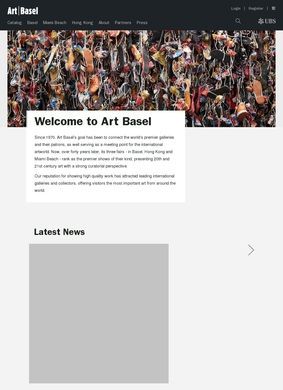
A gallery owner wondering where to find serious collectors, or a collector trying to figure out which fairs are worth flying to, runs into the same practical question: which event puts the most credible international work in one room. Art Basel answers that for a particular tier of the market, and the website is built to make the answer legible before anyone buys a plane ticket. It runs four annual fairs, in Basel, Miami Beach, Hong Kong and Paris, and the site treats each edition as its own section with exhibitor lists, sector overviews and previews you can read through well ahead of opening day.
Four annual fairs across global cities
What makes the Art Basel platform useful beyond ticketing is how it breaks a fair into named parts. Galleries is the main floor of established dealers. Unlimited carries the oversized installations and projects that do not fit a standard booth. Parcours pushes work into the surrounding city, Film handles screen-based pieces, and Kabinett, Nova, Positions, Statements and Feature each carve out space for solo presentations, younger galleries or focused historical showings. For someone planning a visit, that vocabulary is doing real work: it tells you in advance whether you are walking toward blue-chip painting, an emerging name, or a room-sized commission.
Named sections within each fair
The exhibitor side of Art Basel is documented with the same care as the visitor side. Galleries can read the application process and the partnership programs, which matters because a slot at one of these fairs is a competitive thing rather than an open booking. The site lays out what is on offer and who decides, so a dealer weighing the cost and effort of applying can see the terms first.
Gallery applications and partnership programs
Then there is the network layer. Art Basel's VIP Relations and Global Patrons program are the connective tissue between galleries looking to place work and the collectors and institutions who buy it. Hundreds of international galleries show across these fairs, presenting painting, sculpture, installation, photography, film and digital work, and the platform exists in large part to introduce the people holding inventory to the people who acquire it. That matchmaking function is the quiet engine under all the public-facing pages.
Connecting galleries with collectors and institutions
UBS is named as the global lead partner, and the relationship goes well beyond sponsorship. The two produce The Art Market, an annual report that has become one of the more cited references for sales figures, regional shifts and structural trends across the trade. For anyone trying to understand where money and attention are moving, that publication alone justifies a look at the site, fair ticket or not.
The Art Market report with UBS
The Stories section is more substantial than the usual event blog. It runs artist profiles, market news and fair previews, and it functions as a standing record of what the organization is paying attention to between editions. A reader who never sets foot in Basel can still follow the programming, the names being championed and the arguments about where contemporary work is heading.
Stories section and recognition programs
Recognition runs through the program too. The Art Basel Awards and the MGM Discoveries Art Prize give the organization a way to spotlight specific artists and galleries, which feeds back into the editorial coverage and gives newcomers a thread to pull on. There is also a retail shop and mobile apps for iOS and Android, the latter being the genuinely practical tool once a fair is underway: large halls, hundreds of booths, and a phone that knows the floor plan is the difference between a focused day and an exhausting one.
Art Basel GmbH is the operating entity behind all of it, and the structure shows in how cleanly the parts fit together. Press resources and an accreditation portal handle the media side without cluttering the collector and gallery paths. Each audience, the dealer, the buyer, the journalist, the curious visitor, has a route through the site that does not force them through everyone else's sections.
The one honest limitation worth naming is reach. Art Basel is a high-end, invitation-heavy ecosystem. A casual visitor can buy a day ticket and walk the halls, and the editorial and report content is open to anyone, but the deeper machinery, the patron network, the VIP programming, the gallery slots, is built for people already inside the trade. That is the nature of the thing rather than a flaw, and the site is transparent about who it serves.
For a collector or curator mapping the Art Basel fair calendar, the edition pages are the right starting point: the sector breakdowns tell you what kind of work dominates each show, and the exhibitor lists are detailed enough to decide whether the trip makes sense before you book anything. Galleries considering an application should read the partnership terms early, because the timelines are firm and the selection bar is genuinely high. Anyone who simply wants to understand the contemporary market can download The Art Market report and follow the Stories feed for free. Few organizations in this field document themselves this thoroughly, and Art Basel rewards the time spent reading it before you arrive.