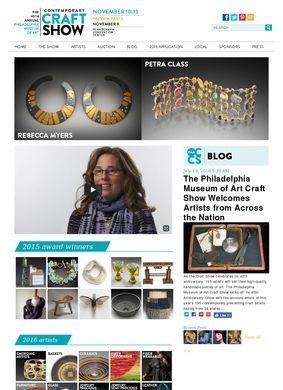
Every maker who sells a piece here keeps the full price. One hundred percent of each sale goes to the artist, an unusual arrangement for an event that also works as a fundraiser, and it is the first thing worth knowing about the Philadelphia Museum of Art Craft Show. The artists are paid in full, and the museum still comes out ahead: over its history the show has sent more than 15.3 million dollars back for exhibitions, programs, and acquisitions.
The Philadelphia Museum of Art Craft Show is a juried craft fair with a paying gate and a preview gala the evening before the public doors open, held each year at the Pennsylvania Convention Center. It is in its forty-ninth year. Collectors, craft enthusiasts, and people who simply back the museum all end up walking the same aisles, and the money side runs on ticket sales, the gala, and the crowd it pulls, not on a cut of what the makers earn.
That distinction sets a certain tone at the door: the people behind the tables are keeping what they sell, so the selling tends to be direct and personal.
What fills the convention center floor
Recent editions have juried in 195 artists, and their work is the whole reason to come. Everything on the floor is handmade, one of a kind, and for sale. There is no reproduction table and no print rack standing in for the real object, which is the practical meaning of a juried show: a panel has already thinned the field before anyone pays to walk in, so the average quality on the floor is higher than a general craft market.
A jury also sorts the accepted work into thirteen categories, and that sorting is the quiet strength of the Philadelphia Museum of Art Craft Show. It gives a visitor an actual map of the hall instead of an undifferentiated sprawl of booths. You can walk the room by medium, double back to the makers you liked, and know roughly what sits where before your feet give out.
Thirteen craft categories
The categories run across Basketry, Ceramics, Fiber in both its decorative and its wearable forms, Furniture, Glass, Jewelry, Leather, Metal, Mixed Media, Paper, and Wood. One more slot is held for Emerging Artists, which gives newer makers a way onto a floor they might otherwise wait years to reach. For a buyer at the Philadelphia Museum of Art Craft Show, that spread means a single ticket can cover a hand-thrown bowl, a carved chair, and a piece of studio jewelry in the same afternoon.
The breadth is the point. Someone shopping for one thing tends to leave having seen ten others they did not know were still made by hand.
Programs, talks, and award winners
The website does more than sell admission. It hosts digital show programs from several recent years as free downloads, runs artist talks and interviews, and highlights past award winners, so the Philadelphia Museum of Art Craft Show leaves a paper trail of who exhibited and whose work got singled out. Tickets are handled online.
For anyone weighing the trip, the archived programs are the most useful thing on the site, because they show the calibre of maker the jury tends to admit and let you scan names before you go. The interviews add context a booth visit alone rarely gives, since the makers explain the process behind the object, and the award highlights point a first-time visitor toward the strongest work in each category.
Credibility and getting in touch
Outside opinion of the Philadelphia Museum of Art Craft Show is limited but consistent. The listing on 10times carries a 4.3 out of 5 rating from seven people, and ArtShowReviews hosts its own page where an exhibiting artist scored it a clean five overall, with strong separate marks for facilities, location, and sales. A blog account on iambrownstyle gives a warm write-up of the artists and the craftsmanship, though that reads as a personal post, not a rating. No Google, Yelp, Trustpilot, or BBB scores turned up in a search.
Contact is the weaker spot. The page that fronts the Philadelphia Museum of Art Craft Show does not put a phone number, an email, or a mailing address where a first-time visitor can find them. There is an active Instagram account and a working online ticket path, so the show is reachable and clearly staffed, but no obvious contact tab surfaces in what the landing page presents. For a buyer with a logistics question, that is a small friction worth noting before the ticket gets bought.
What the ratings add up to
Seven scores on one platform and a single artist review on another add up to a modest sample for an event approaching its fiftieth year. The numbers lean positive, and nothing contradicts them, yet they are better read as a directional signal than as proof of anything. The stronger case for the Philadelphia Museum of Art Craft Show is structural: a jury that filters the work, a fixed set of thirteen categories, a long fundraising record, and makers who take home everything they sell.
That combination says more about what a visitor will find than a handful of stars ever could, and it explains why the show has held its place for decades while the ratings sites barely register it.
A weekend of juried, one-of-a-kind work, sold straight from the hands that made it, is what the ticket and the trip to the Convention Center actually buy.