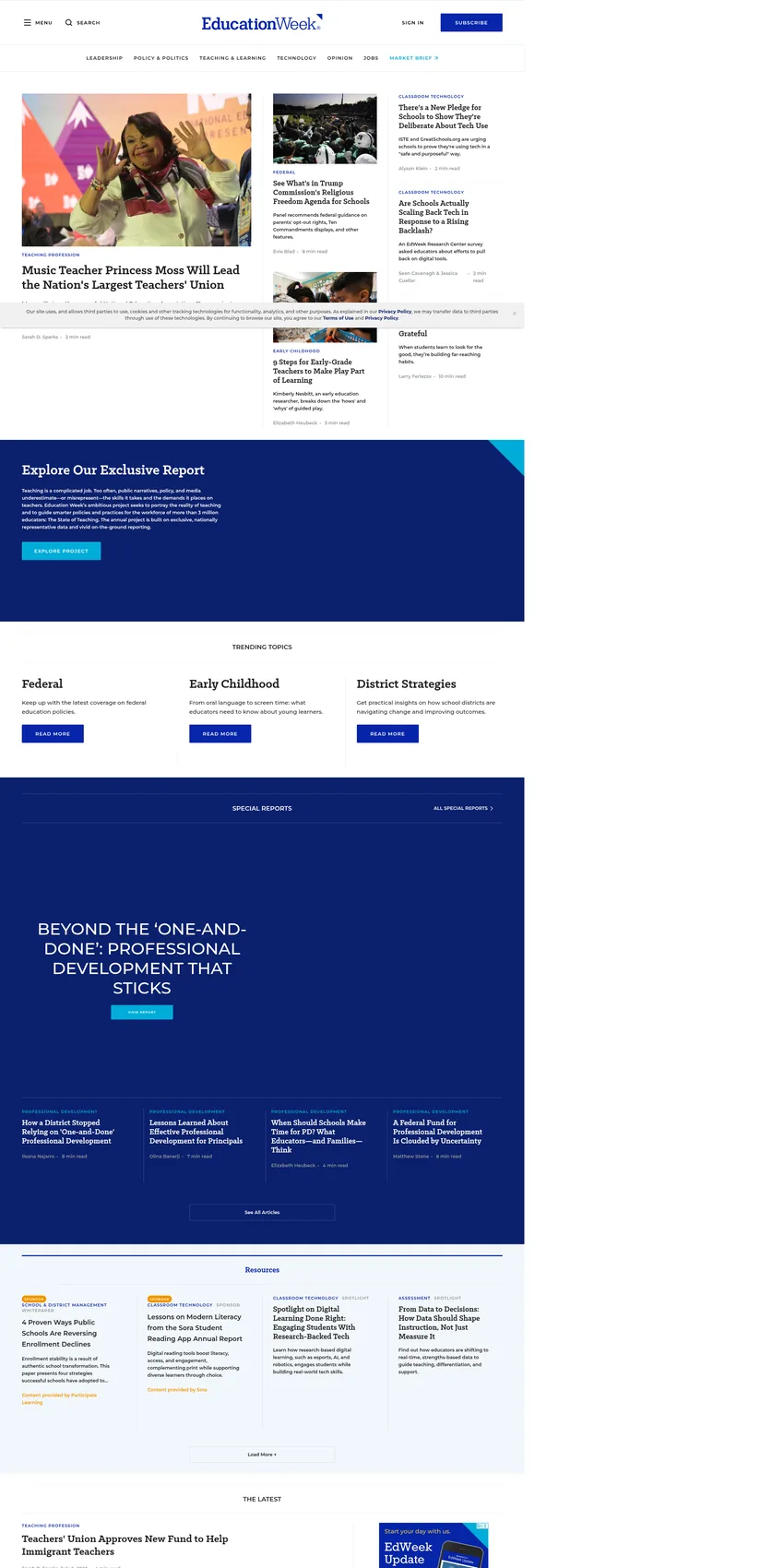
A curriculum director trying to work out what a change in federal education policy means for her district does not have many places to turn. General-interest outlets cover schools in bursts, usually when something goes wrong, and much of what circulates online arrives pre-sorted into political camps. Education Week approaches the subject from the opposite direction. K-12 schooling is the whole beat, covered continuously, and the coverage is organized the way the field itself is organized: the people who run schools, the rules they answer to, the classrooms they are responsible for, and the technology moving into all three each get attention from reporters assigned to nothing else. A first-year teacher arrives with different questions than a superintendent, and a company selling to schools with different questions again. The same site is built to answer all three.
Education Week comes out of Editorial Projects in Education, Inc., a nonprofit publisher, and frames its coverage as non-partisan news and analysis. That framing is easier to claim than to keep, but the claim here rests on a long track record: this is an established reference in K-12 journalism, the sort policymakers and researchers cite when they need a reliable account of what is happening in schools. By its own count, Education Week reaches more than 1.6 million readers. The figure is self-reported and should be read that way.
Five coverage sections and an opinion page
Nearly everything Education Week publishes hangs off five standing sections: Leadership, Policy & Politics, Teaching & Learning, Technology, and Opinion. The masthead splits along those lines, and the split maps onto the jobs its readers hold. A superintendent lives in Leadership, which follows the people who run schools and districts and pairs with Leaders To Learn From, a recurring feature profiling district leaders and the strategies they use, the closest thing Education Week has to a case-study library on running a school system. A statehouse watcher lives in Policy & Politics, the section that tracks the government side of schooling, where one decision can reach every classroom in a state. Teaching & Learning stays closest to daily instruction, and Technology gives the tools moving into classrooms a beat of their own.
Opinion rounds out the five. Its bylines come from inside the field, teachers, school leaders, and researchers writing about work they do themselves, and Education Week gives that commentary a full section of its own. The effect shows up across Education Week as a whole: a district official can read a news story about a policy in one section and a practitioner's argument about the same policy a click away, in the same visit, under the same masthead.
Survey work from the EdWeek Research Center
Behind the news report sits the EdWeek Research Center, an in-house unit that fields its own surveys and publishes research reports on education topics. Original data is expensive to produce, and having a unit that generates it in-house means the reporting can draw on findings of its own instead of depending entirely on whatever data other institutions happen to release. The practical use is plain enough. Administrators and teachers get numbers they can carry into a budget meeting or a curriculum argument, and readers of the news pages get the data and the stories that interpret it in one place.
Top School Jobs and the market brief
Two side operations extend the brand past journalism, and both aim at people who already read Education Week. EdWeek Top School Jobs is a job search and recruitment platform for education careers: teachers and administrators can hunt for the next position there, and districts use the same platform to fill openings. A jobs board attached to a news operation is an old newspaper pattern, and it fits this audience unusually well, since the readership and the labor market are close to the same set of people.
EdWeek Market Brief is the more specialized product. It runs on its own subdomain as a separate market-intelligence service for businesses that sell into the K-12 market. Education Week is plain about serving that commercial audience, and it sells advertising and marketing programs to education-sector companies as well. None of this is buried. A reader weighing the independence of the news pages should know the commercial arm exists, and the separation into distinct products keeps the boundary easy to see.
Subscriptions, webinars, and an open feed
Reading Education Week in full is a paid proposition. Digital subscriptions come in individual plans and in group or corporate plans, and the group tier says something about the audience: organizations buy access for their staff, which is the pattern of a publication read for work, on work time, to make work decisions. Around the paid core sits a real free layer. Virtual events such as the K-12 Essentials Forum webinars cost nothing to attend, and a public RSS feed carries Education Week headlines to anyone who points a feed reader at it.
The free layer holds less than the paid one, and that is by design. It gives a prospective subscriber enough contact with the coverage to judge the product before paying, and for that narrow purpose it works.
The verdict depends on who is asking. For anyone whose work touches K-12 schools, in a classroom, a district office, a research role, or a company selling to them, Education Week comes close to a default reference: continuous news, commentary from practitioners, original survey data, and a jobs platform under one nonprofit publisher. Single-field coverage at this depth is rare. So is the discipline of keeping news, opinion, research, and commerce in visibly separate compartments. The parts also fit together sensibly; the research arm gives the news report evidence of its own, and the opinion pages put working educators into the conversation the news started.
For a general reader, the calculus is different. The deepest material is paid, and someone with a passing interest in schooling can get most of what they want from the free webinars and the headline feed without ever subscribing. Education Week is priced and organized for people whose decisions depend on knowing this field well, and it does not pretend otherwise. Start with the free layer, and decide about the subscription only after seeing how much of it gets used.




Business address
Editorial Projects in Education, Inc.
6935 Arlington Road, Suite 100,
Bethesda,
MD
20814-5233
United States
Contact details
Phone: (800) 346-1834
In this panel discussion, district leaders and systems experts will examine the gap between the outcomes we want and the systems…
Join this webinar to hear recent findings from the EdWeek Research Center and discover practical strategies for improvement.
Explore the current trends around the use of AI in teacher preparation and continuing education with data from the EdWeek…
Learn how to recognize the early signs of disengagement and what the behavioral science reveals about which interventions…