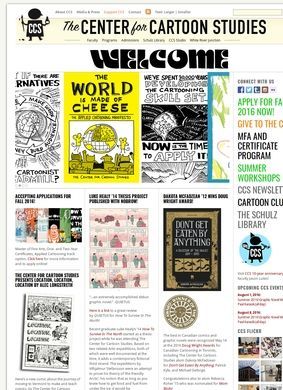
Someone who wants to draw comics for a living usually hits the same wall fast: the craft is demanding, the discipline is brutal, and almost no school treats it as a serious course of study. Drawing classes teach figure and composition. Writing programs teach narrative. Almost nobody puts the two together and treats sequential art as its own discipline with its own history, its own technical problems, and its own professional paths. That gap is exactly the space The Center for Cartoon Studies has built itself into, from a small town in Vermont, with a curriculum that assumes comics are worth a full education.
Degree and certificate tracks
The school sits in White River Junction, Vermont, and its whole reason for existing is cartooning and comics. As an elective inside a broader art degree, this would be unremarkable. As the entire point of the institution, it is unusual. That focus shows up in how the programs are arranged: a Master of Fine Arts degree with a low-residency option for people who cannot relocate to a small New England town for two straight years, a two-year certificate program, and a one-year certificate for students who want structured study without committing to the full MFA track. Three doors into the same building, each scaled to a different life situation.
Inside the low-residency MFA
The low-residency MFA deserves a closer look, because it answers a problem that quietly defeats a lot of would-be students. Cartooning takes years to get good at, and most people who want to learn it already have jobs, families, or geography working against them. A low-residency structure lets someone keep a life elsewhere while still doing the concentrated, in-person work that the craft genuinely needs. Talented people show up at all ages, and The Center for Cartoon Studies made a deliberate choice when it built this track.
Summer workshops and free eCourse
Beyond the degree and certificate tracks, the offerings spread out in ways that point to a place thinking about more than enrolled tuition-payers. There are summer workshops, run both in person and online, which give people a way to test the water without applying to anything long-term. There are fellowship programs and academic outreach initiatives. And there is a free one-week self-directed cartooning eCourse: a school that hands out a real starting point at no charge is one that takes its subject seriously enough to want more people drawing. For anyone unsure whether comics are a passing interest or a lasting calling, a free week of structured practice is a fair test.
The physical campus in Vermont
The physical campus matters in the picture too. The Schulz Library, named for a figure whose name alone tells you what this institution is about, anchors the place as a research and reading resource for the medium. The Center for Cartoon Studies also runs a gallery that hosts exhibitions, which is more significant than it sounds: a working gallery means students see comics treated as exhibited art, see other people's finished work on walls, and learn that the medium has a public life beyond a printed page or a screen. Student housing assistance rounds out the practical side, acknowledging that moving to a small Vermont town is its own logistical puzzle for many people.
What separates The Center for Cartoon Studies from a purely academic outfit is how directly it pushes toward the working world. The school runs a program that connects students and alumni with freelance and professional opportunities. This is the part most art education leaves vague, the bridge from finishing a program to earning from the skill, and building it into the institution says something about priorities. The Center for Cartoon Studies is trying to plug students into a market that pays for comics, and that is a different goal from simply training them.
The Applied Cartooning Lab
Then there is the Applied Cartooning Lab, which is where the place gets genuinely interesting. The Lab produces applied cartooning projects and free educational comics on subjects like mental health and civic governance. This is comics put to work as a tool for explaining hard things to ordinary people, and it points to a belief that runs through the whole institution: that drawing is a way of thinking and communicating, not purely a way of entertaining. A school that turns its craft toward public-interest topics and gives the results away freely is demonstrating what it teaches instead of just describing it. Students who pass through that Lab leave with a sense of what cartooning can do beyond filling a comic book, and The Center for Cartoon Studies treats that outcome as part of the education.
The student body is drawn from across the United States and internationally, which is a quiet measure of reach for a school this specialized. People do not move to White River Junction by accident; they go because The Center for Cartoon Studies has a reputation for being the thing it claims to be. For prospective students weighing the leap, financial aid guidance and one-on-one admissions video consultations mean the decision to apply does not have to be made in the dark. Talking through cost and fit with a real person is straightforward access that smooths a genuinely large life decision, and The Center for Cartoon Studies builds it in rather than leaving it to chance.
From classroom to profession
Put it all together and The Center for Cartoon Studies has a tight, coherent identity. Every piece, the degree, the certificates, the library, the gallery, the Lab, the professional placement program, points the same direction. There is no sense of a general art school that bolted on a comics elective to chase enrollment. The specialization is the foundation, and the supporting structures, housing help, financial aid guidance, free entry-level coursework, all serve the same narrow and ambitious mission: teaching people to make comics and helping them build a life around it.
That coherence is the strongest thing about The Center for Cartoon Studies. A school that does one thing and arranges everything else around it tends to do it well, because there is nowhere to hide a weak program inside a sprawling catalog. The risk of any specialized school is that the focus becomes a ceiling; here, the breadth of formats, online workshops, low-residency tracks, certificates of different lengths, free coursework, points to having thought hard about not letting the specialty narrow the audience. It wants the committed full-time MFA student and the curious person poking at a free eCourse to both find a place.
The Center for Cartoon Studies makes the most sense for a particular kind of person: someone who already suspects that comics are what they want to spend years getting good at, and who wants a place that will treat that ambition as legitimate rather than eccentric. The Applied Cartooning Lab and the public-facing educational comics widen the appeal toward people interested in using the medium for communication and advocacy, beyond storytelling and art alone. It is a school with a point of view, and that point of view is consistent enough that a prospective student can quickly tell whether it matches their own. The published evidence, the alumni it places, the Lab work it gives away, the gallery it runs, makes the case that The Center for Cartoon Studies is doing what it says.