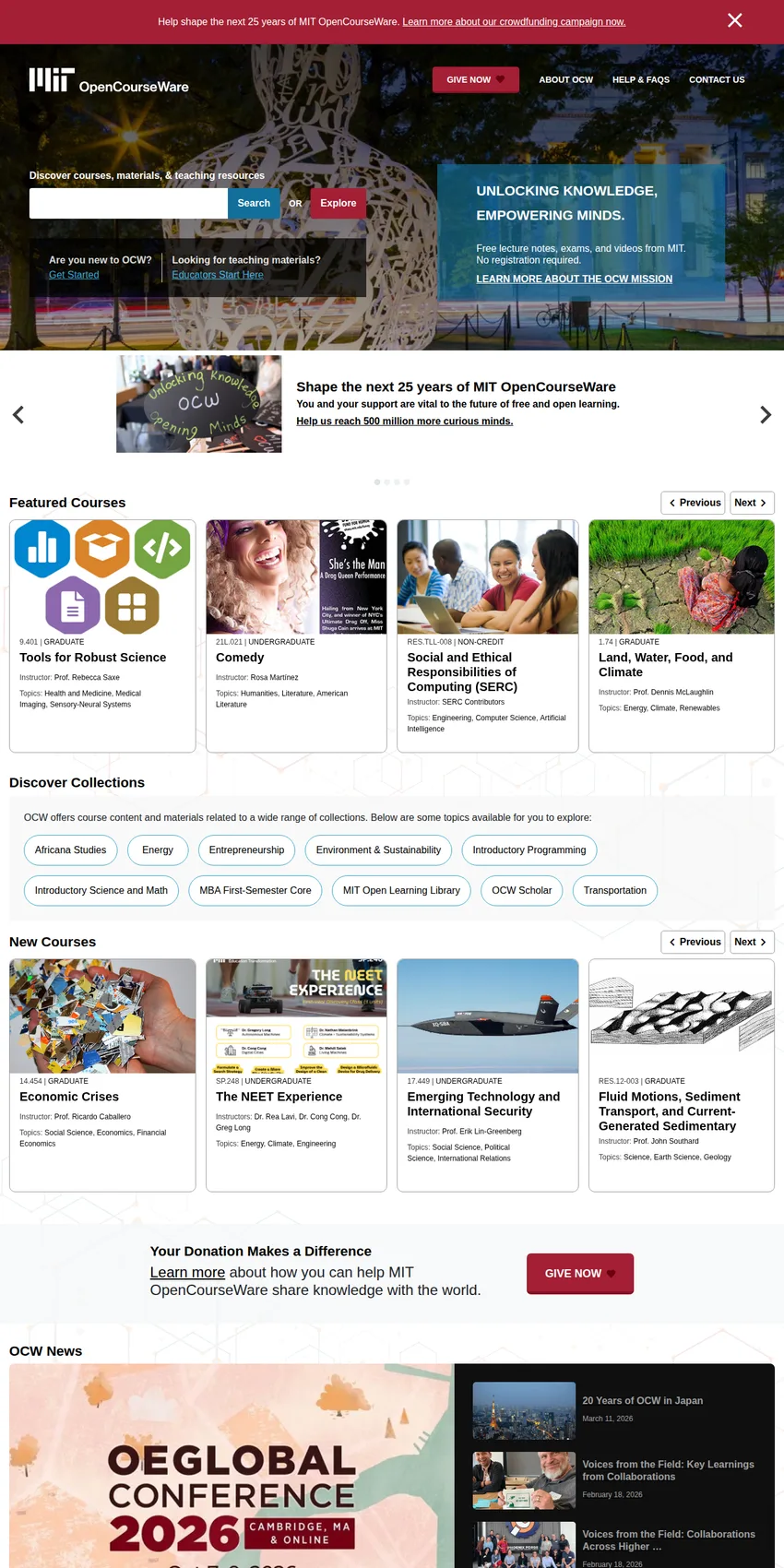
MIT coursework, given away for free
Anyone can sit in on an MIT class here without enrolling or paying tuition. MIT OpenCourseWare publishes the teaching materials from courses across the Massachusetts Institute of Technology and puts them online for anyone to read, download, adapt, and reuse at no cost. There is no sign-up, no account, and no login. You open a course page and the material is there.
The published materials come straight from what MIT students use. Depending on the class, a course page can include the syllabus, lecture notes, full sets of readings, problem sets with worked solutions, past exams, project assignments, and in many cases complete video recordings of the lectures. More than 2,500 courses are available, and together they cover the full MIT curriculum, from introductory calculus and physics to graduate work in engineering, economics, linguistics, and management.
How it started and how big it has become
The idea took shape in 2001, when an MIT faculty committee asked how the Institute should use the internet, and the answer that came back was to give the course materials away. A pilot site went live in 2002 with a first group of courses. Publication scaled up quickly, and within a few years the project had put nearly the whole catalog online. It has run continuously since, adding new classes and refreshing older ones as faculty revise what they teach.
Reach is easier to describe in traffic than in enrollment, because nobody enrolls. The website and its companion YouTube channel have together drawn more than 500 million visits over the life of the project. The YouTube channel alone has more than six million subscribers, which makes it the most subscribed channel of any university on the platform. A large share of the audience is outside the United States, and many are not students at all but self-directed learners, teachers borrowing material, and working professionals brushing up on a subject.
Who uses it, and for what
A few groups show up again and again. Independent learners work through a subject on their own schedule, often to fill a gap before a job or a degree program. Educators at other schools adapt MIT lecture notes and problem sets for their own classrooms, which the license expressly permits. Current and former students use it as a reference, going back to a course they took or looking ahead to one they have not. For a working adult, the practical value is plain: you can study a topic in the evening, at your own pace, without committing money or a fixed schedule before you know whether it fits.
The license, and what you are allowed to do
Nearly all of the material carries a Creative Commons Attribution-NonCommercial-ShareAlike license. In plain terms, you can copy it, translate it, remix it, and build on it, as long as you credit MIT, you do not sell it, and you release your version under the same open terms. This is why the content turns up in so many other places. Teachers in other countries have translated whole courses, and volunteer groups have mirrored the site for regions with slow or metered internet. An offline package has long been available so that material can travel to places where a steady connection cannot.
Programs built around the core collection
- OCW Educator organizes the material by teaching approach, so instructors can see not only what MIT teaches but how it is taught.
- A collaborations effort works with historically Black colleges and universities and with community colleges to adapt open materials for their students.
- Mirror sites, installed at universities in bandwidth-limited regions, keep the collection reachable where the main site loads slowly.
Where it sits within MIT, and how it is paid for
OpenCourseWare is part of MIT Open Learning, the Institute's unit for online and digital education, which also runs MITx courses and other programs. In recent years the material has been folded into a single MIT learning hub that brings the free course collection together with the Institute's other online offerings, so a visitor can move between open materials and structured courses from one place. The project has always been free to users and is paid for by MIT along with grants and donations, including early support from private foundations and continuing gifts from people who have used the site.
Because it is open teaching material rather than a school you apply to, OpenCourseWare fits the education section of this directory as a reference point for self-study, a place to send someone who wants real university coursework without cost or enrollment. It is run from the MIT Open Learning offices at 600 Technology Square, NE49, 2nd Floor, Cambridge, Massachusetts 02139. General questions go to the OpenCourseWare team by email at ocw@mit.edu or by phone at +1 617-253-0266, and the full collection is always at ocw.mit.edu.
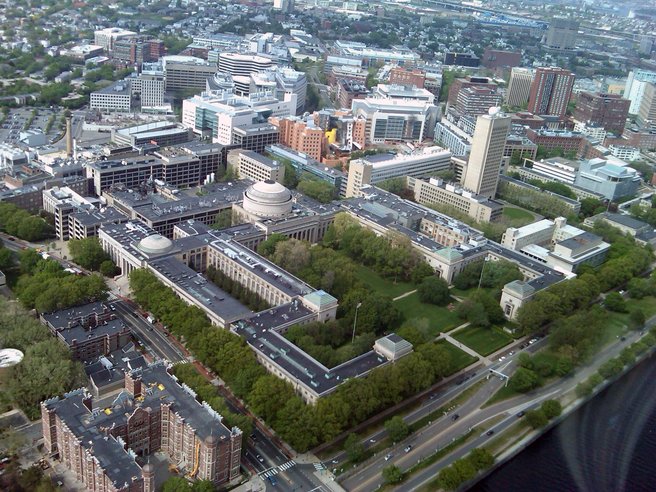
Business address
Massachusetts Institute of Technology
600 Technology Square, NE49, 2nd Floor,
Cambridge,
Massachusetts
02139
United States
Contact details
Phone: +1 617-253-0266