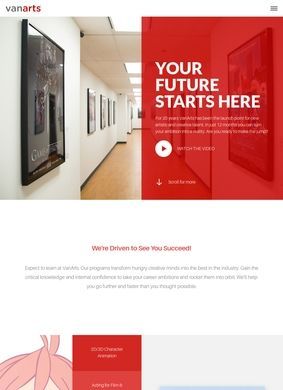
Anyone who lands on this page is usually chasing one thing: the diploma in 2D/3D Character Animation, which sits at the center of what the Vancouver Institute of Media Arts has built over more than two decades. VanArts is a private career college in downtown Vancouver, and its catalogue reads like a map of the local screen and games industry: Visual Effects for Film and TV, Game Art and Design, Acting for Film and Television, an Acting Foundations track, an Art Foundation year, Professional Photography, and Web Development and Digital Design. Part-time evening classes and summer courses sit alongside the full diplomas, a way in for someone testing the water without committing straight away.
Programs built around Vancouver's screen industry
What stands out is how specific the training tracks are. This is not a general arts school that dabbles in a bit of everything. The programs are named for jobs that exist in the studios a short drive away, and the school leans on that proximity openly, pointing to the roughly 40,000 digital entertainment jobs concentrated in the city. For a photographer or an aspiring VFX artist, geography is not a small detail. Being in the same metro area as the employers you hope to work for shortens the distance between a portfolio review and an actual interview, and the Vancouver Institute of Media Arts clearly designs around that fact.
Placement rates and program rankings
The claim the Vancouver Institute of Media Arts puts forward most prominently is placement: over 90 percent of graduates begin working in their chosen field within six months of finishing, and a number two ranking among top animation training programs in Canada for 2024. Those are strong figures, and it is fair to treat a self-published placement rate with caution, since schools define "working in their field" in ways that flatter the number. Still, the ranking is an outside marker, and the six-month framing is a concrete, checkable promise instead of vague talk about outcomes. A prospective student can ask, during a tour, exactly how that percentage is measured.
Access programs for underrepresented applicants
Access is another area where the Vancouver Institute of Media Arts has thought past the standard applicant. It serves domestic and international students, advertises pathways for Indigenous applicants and for Ukrainian refugees, and offers degree-pathway options for students who want their diploma to ladder into a further credential. Those routes say something about who the Vancouver Institute of Media Arts wants in its classrooms, and setting up dedicated support for particular communities takes effort a purely transactional college would skip.
Campus tours and info sessions
On the practical side, the Vancouver Institute of Media Arts makes it easy to check the place out first. It runs info sessions online and in person, and offers campus tours by appointment, which counts for more in a hands-on media program than in an academic degree, since a prospective student wants to see the labs, workstations, and studios before enrolling. A photography or game art student is buying access to equipment and space as much as instruction, and the Vancouver Institute of Media Arts seems comfortable being inspected up close.
Reaching the Vancouver Institute of Media Arts is easy, a low bar but one plenty of career colleges still trip over. There is a published phone line, a physical address at a suite on Terminal Avenue in Vancouver, and a working contact page. An email address surfaces through outside listings too. None of this is remarkable on its own, but together it points to a school that expects to be phoned, visited, and questioned, the posture expected from an institution asking for a year or more of tuition.
How do reviews rate the school?
Outside opinion on the Vancouver Institute of Media Arts is genuinely mixed, and it would be dishonest to smooth that over. On the positive end, CourseCompare lists the school at 4.35 out of 5 across six reviews, TrustAnalytica shows 4.3 stars, and the Vancouver Institute of Media Arts holds an A plus rating with the Better Business Bureau as an accredited business, which is not nothing when handing money to a private college. There is also a ProvenExpert profile carrying reviews, so the formal, verification-oriented sources land favourably.
Mixed feedback on campus experience
The picture gets more complicated once the open-ended comments about the school get factored in. Sites like Wanderlog and Wheree host mixed feedback on campus upkeep, administrative clarity, cohort consistency, and how transparent job-placement outcomes really are for animation graduates specifically. That last one is pointed, given how heavily the Vancouver Institute of Media Arts markets its placement figures. A Glassdoor employee rating of 3.4 out of 5, with 55 percent of staff saying they would recommend the place, hints that some of the internal friction students notice may have roots on the staffing side.
None of that reads as disqualifying for the Vancouver Institute of Media Arts, but it should not be waved away either. Campus upkeep and administrative wrinkles are common gripes at small private colleges running lean, and the negative comments come from two or three lesser-known sites against twenty-plus years of operation, a small sample next to that history. What they do is hand a candidate a concrete list of questions for the campus tour: which lab would you use, how is the placement rate calculated, does it count freelance work, and how did the term actually go for a current student rather than a staff member. The school invites that scrutiny by offering the tours, so a serious applicant should take it up.
Weighed as a whole, the Vancouver Institute of Media Arts comes across as a credible, industry-anchored option with a clear identity and a track record long enough to mean something. The programs are specialized in a useful way, the location is a real asset for anyone chasing studio work, and the school is transparent about how to reach it and easy to inspect in person. The honest caveats sit on the softer side: consistency between cohorts, the accuracy of the headline placement number, and the day-to-day condition of the facilities. Those shift from year to year and cannot be judged from a distance, which is why an in-person visit does so much here.
Someone who already knows they want to work in animation, VFX, games, photography, film acting, or web design, and who wants a focused diploma close to the employers, has a fairly strong case with the Vancouver Institute of Media Arts. Someone still unsure can use the part-time and summer courses to test whether the field and the school suit them without locking into a full program. It does not hide its pitch or its address, and both count in its favour when so much of the private-college market does the opposite.
The decision, in the end, turns on how much weight to give a placement claim that cannot be independently verified, set against specialized programs and a location that genuinely lowers the distance to real studio jobs. The Vancouver Institute of Media Arts gives you the tools to check its own story: an open phone line, a real campus, tours on request, and outside ratings that mostly hold up on the numbers, even where the open-ended comments are less flattering. Spending an afternoon on Terminal Avenue asking those questions is the sensible way to close that gap.