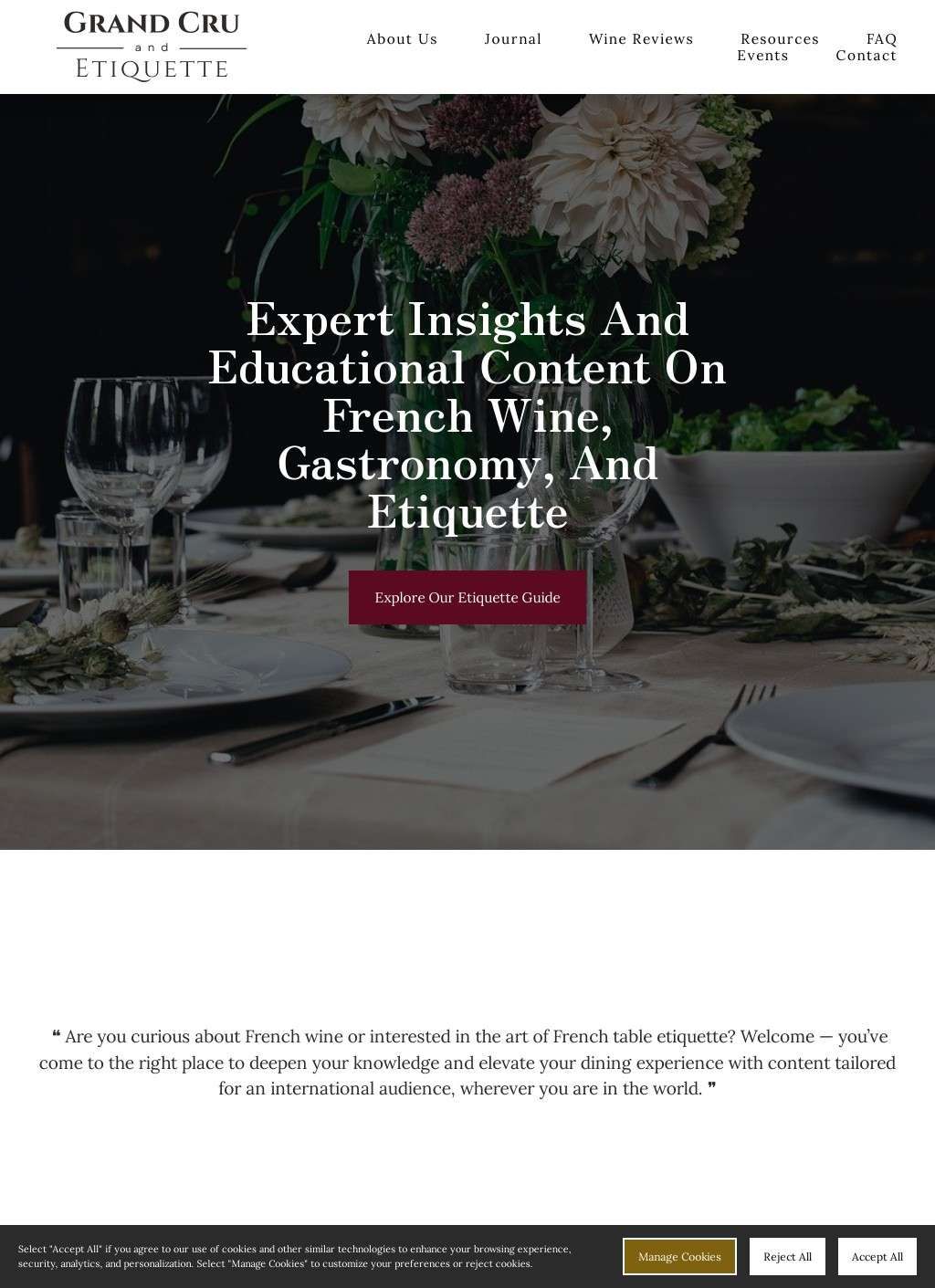
Someone has six bottles of Medoc cellaring in a closet, a dinner party in three weeks, and no real idea whether to decant, what to serve alongside, or how to talk about any of it without sounding either pretentious or lost. That gap, the space between owning French wine and actually understanding it, is what Grand Cru and Etiquette sets out to fill. The business is a consulting and education outfit built around French wine culture and the manners that surround it, started in France at the beginning of 2025 by a consultant named Maria and run out of Paris, with work done both in person and remotely for clients abroad.
The core of Grand Cru and Etiquette's offering is personal guidance. Maria consults on French wines and spirits for individuals, walks collectors through building or refining what they own, and trains hospitality staff on dining etiquette, wine service, and the small details that shape how a guest feels at the table. Workshops sit alongside the one-to-one work. It is a fairly specific menu of services for a young company, and the specificity reads as a strength: someone has picked French oenology and French table manners and stayed firmly inside that lane, with no pretense of covering everything.
Wine reviews with food pairings
What gives the site more weight than a typical consulting page is the wine review section. The tasting notes are written as personal impressions, each paired with food suggestions, and they cover real appellations: Sancerre from the Loire, the reds of Medoc, the firmer tannins of Madiran. Anyone who has tried to write honestly about a single bottle knows how much harder it is than listing services, so the presence of actual AOC-by-AOC notes tells you the wine knowledge behind Grand Cru and Etiquette is genuine and not borrowed. The pairing recommendations turn the notes into something a reader can use rather than just admire.
Affiliate retail model and incentives
There is also a boutique, though it works through affiliate links to partner retailers instead of direct sales. Click a recommended wine and you are sent to a shop that stocks it, with Grand Cru and Etiquette presumably taking a cut. This is worth understanding plainly, because affiliate income can quietly tilt which bottles get recommended. Nothing in what is visible suggests that is happening here, and tying recommendations to retailers a reader can actually buy from is a reasonable model, but the incentive exists and a careful visitor should keep it in mind while reading the praise.
Rounding out the public material is a blog, an FAQ, and a set of free resources for subscribers that includes curated wine selections. The free tier is a sensible move for a new name. It lets a curious reader sample the judgment before paying for consulting, and curated selections are exactly the kind of thing Grand Cru and Etiquette should be giving away to prove it knows what it is doing. Between the reviews, the blog, and the subscriber material, there is more substance on offer here than you find from most early-stage consultancies.
The audience is clear enough from the structure: private individuals who want to drink and serve better, collectors who need a steadier hand on what they buy, and hospitality professionals whose livelihoods depend on getting service right. Grand Cru and Etiquette speaks to all three without diluting itself, partly because French wine and French etiquette genuinely overlap in a restaurant or a well-run home. The etiquette training in particular is a less crowded niche than wine consulting alone, and pairing the two is a sharper idea than either would be on its own.
Building trust without outside reviews
Where reputation is concerned, a search turns up nothing for this specific business. The names that surface belong to unrelated places that happen to share the words Grand Cru: a restaurant in Columbia, Missouri, a wine bar in Arlington, Virginia, even a beer. No Google rating, no Trustpilot, no Yelp or Facebook presence that can be tied to grandcruandetiquette.com. For a company founded in early 2025 that is not damning, since reviews take time to gather, but it does mean a prospective client has only the site's own voice to go on, with no outside chorus confirming that the consulting delivers what the tasting notes promise.
Contact methods and accessibility
Getting in touch is the other soft spot. There is no phone number and no street address on the homepage, and reaching Maria runs through an email questionnaire that lives on the Services page, behind a click or two from where most people land. A questionnaire is a defensible filter for a consultant who wants to understand a prospect before replying, and the absence of a public email is no fault at all. Still, a visitor who wants to pick up the phone or confirm where in Paris the business operates will not find that here, and for higher-value collector work some buyers will want a faster, more direct line.
The offering itself is coherent and the wine knowledge, at least as the tasting notes show it, is the real article. What Grand Cru and Etiquette lacks is anyone other than the founder vouching for it. Whether the etiquette training and collector guidance match the standard of those polished notes is the one thing the site cannot answer, and until clients start saying so out loud, that doubt falls on each buyer to carry alone.

Business address
Grand Cru and Etiquette
France