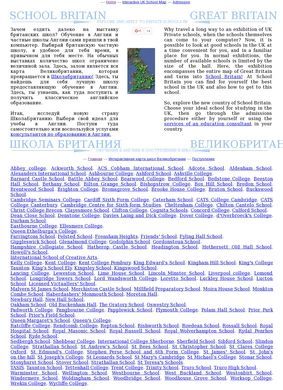
A family abroad who has settled on a British private education runs into the same wall almost immediately: there are hundreds of independent schools scattered across England, Scotland and Wales, the open days happen in person on the other side of the continent, and the official guides assume you already know the difference between a prep school and a sixth form. School Britain sets itself up as the answer to exactly that frustration, a way to walk through dozens of UK private schools from a desk instead of buying a plane ticket.
Virtual exhibition for international families
The premise is a virtual exhibition. Instead of standing in a hotel ballroom collecting glossy prospectuses, a parent browses school profiles online and pulls together the same picture from home. That framing is honest about what School Britain is replacing. The open-day circuit exists to let parents see a campus in person and put names to faces; a website catalogue cannot replicate that, and School Britain does not pretend it can. What it offers instead is a structured first pass, enough comparative information in one place to turn a hundred-school landscape into a manageable shortlist before anyone books a flight.
School catalogue and profiles
The substance behind that pitch is a catalogue of more than a hundred independent schools, laid out alphabetically from Abbey College through to Wycliffe College. Each one gets its own page on School Britain, and those pages carry information a parent needs at the research stage: admissions details, the basics of what the school is and where it sits in the UK system. A typical profile has enough to decide whether a given school is worth a closer look on its own official site, which is exactly the right level of depth for a catalogue built to filter rather than to replace the schools' own material.
Breadth matters in a project like this, and a hundred-plus profiles is a credible number. Large enough that an international parent will probably find several schools that fit the budget and region they have in mind, yet small enough that School Britain has clearly curated to private institutions rather than dumping every school in the country into one undifferentiated heap. For what it is doing, a business directory aimed at families starting from scratch with the UK independent sector, the alphabetical layout is plain but functional.
Interactive map of Britain
The feature that does the most work here is the interactive map. UK geography is genuinely confusing to an outsider, and a list of school names tells you nothing about whether two of them are an hour apart or on opposite ends of the island. Plotting the schools on a map of Britain turns an abstract roster into something a parent can reason about geographically. If proximity to a relative in Manchester or a direct flight from London matters, the map answers that in a glance in a way a sorted list simply cannot.
Admission guidance for applicants
Alongside the individual school pages, School Britain also gathers general admission guidance. The application process for British independent schools is opaque to anyone who did not grow up inside it. Entrance exams, registration deadlines, the rhythm of terms and the role of references are all things a first-time international applicant has to learn from scratch. Pulling that background into shared resources, kept separate from any one school's marketing, gives the site genuine utility beyond the catalogue itself. It is the kind of content that reduces the number of basic questions a family has to ask a consultant before they even know which questions matter.
Who is School Britain built for?
There is a clear international tilt to the whole thing. The site points to education consulting services, and at least one linked consultant resource carries content in Russian. That says a lot about who School Britain is really built for: families from Russia and other countries outside the English-speaking world who are seriously considering a UK private school place. It is a narrower audience than a generic "learn about British schools" resource, and the design seems to know it.
For the intended reader, a Russian-language consultant link and an English-language school catalogue under one roof is a genuine convenience, the kind of bridge that is hard to find elsewhere. A domestic British parent would find the same arrangement slightly off-target, since the well-trodden home-grown comparison sites already cover that group well. School Britain is not competing with those on volume; it is aiming at the family that needs a language border and a geographical one handled together.
Consultant resources and external links
The consulting angle deserves some scrutiny. School Britain leans on an external consultant resource, hosted on a separate domain, to carry part of the value. That is fine as a model, and plenty of education sites pair a catalogue with an advisory service, but it does mean the experience is not fully self-contained. A parent following the consultant link is stepping off School Britain and onto someone else's site, with its own terms and presumably its own fees. That is worth knowing before following the link, not after.
Credibility and transparency gaps
On the credibility side there is less to work with, and it would be dishonest to dress it up. School Britain shows no contact details on its homepage: no phone number, no address, no general enquiry route for the organisation behind the catalogue. The external consultant link is the only path toward a human, and that points at a different company on a different domain. For a site whose entire value rests on guiding nervous families through a high-stakes, expensive decision, the absence of any direct line back to whoever runs School Britain is a gap worth naming plainly.
A directory does not strictly need a phone bank the way a service business does. The school pages do most of the talking, and a parent's actual conversations will happen with the schools themselves or with the consultant. Even so, trust is the currency of any site asking a family to act on its recommendations, and an organisation that does not say who it is or how to reach it leaves the reader doing extra homework to verify it is what it claims to be.
A search for outside opinion on School Britain turns up nothing useful: no reviews, no ratings, no commentary from parents who used it. What does surface is the established UK school-comparison tier, WhichSchoolAdvisor and Good Schools Guide, neither of which mentions this platform. That silence is not proof of anything negative, but it does mean a prospective user cannot borrow confidence from anyone else's experience and has to judge the catalogue on what is directly in front of them.
The honest reading of School Britain lands in a middle place. The core idea is sound and the execution has real substance: a genuine catalogue of over a hundred schools, individual pages with admissions information, a map that solves a problem outsiders have, and guidance aimed squarely at international applicants. As a first stop for an overseas family building a shortlist, School Britain does a useful job that the bigger domestic sites are not structured to do. The catalogue is the asset, and it is a better starting point than scattered open-day calendars and country-specific forums that treat UK independent schooling as an afterthought.
What it cannot do is be the last stop. Verify each school's facts against its own official site, treat the consultant link as a separate relationship with its own terms, and recognise that School Britain offers no public identity or track record to fall back on. Used as a map and a first filter, it pays its way. Used as an authority on the schools it lists, it has not yet put the evidence forward to support that level of trust.
Business address
Science-T
55 Pushkinskaya Street,
Odessa,
65011
Ukraine
Contact details
Phone: +380482 496184
Fax: +380482 496184