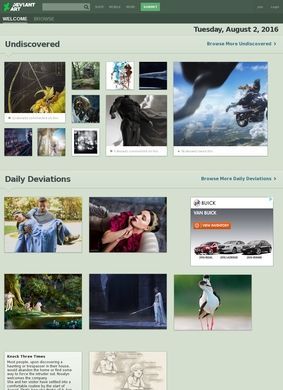
You have finished a drawing or a photo set and you want it in front of people who will actually look, comment, and tell you where it falls short. That is the precise problem DeviantART has been solving since 2000, and the scale of it is hard to ignore: more than 100 million creators and enthusiasts now pass through the platform, which means a piece posted there has a real chance of being seen instead of vanishing into a personal folder. Part gallery, part social network, DeviantART has held that hybrid shape long enough that the conventions feel settled, the culture no longer provisional.
Upload, browse, share across media types
The core loop is upload, browse, share. Where it gets interesting is the breadth of what counts as eligible work. Digital painting sits next to traditional media, photography, anime, fan art, cosplay documentation, and a long list of categories beyond those. A creator does not have to pick a lane to belong. Someone who shoots film, sketches in pencil, and dabbles in 3D can keep all of it under one profile, and the discovery feed adapts to what each person actually engages with, not to a single house style the platform prefers. I find that genuinely useful, because the worst thing a creative site can do is flatten everyone into the same trending aesthetic.
Built-in drawing and video tools
DeviantART ships a browser-based drawing tool, so a sketch can start and stay inside the same environment without a separate app. There are AI features too: DreamUp handles image generation, and a Video Creator opens the door to motion experiments. These additions read as practical rather than gimmicky, the sort of thing a curious artist might open on a slow afternoon to test an idea before moving on to a more demanding piece elsewhere.
Community feedback and group spaces
The community machinery is where the platform has built its long reputation among working artists. Comments, favorites, and watches are simple mechanisms, but together they form the feedback economy that lets someone post a study, get told what is wrong with the hands, and try again next week with an audience that remembers. Group and fandom communities give that activity a home, which helps an illustrator chasing a specific niche more than any amount of raw traffic ever could. Critique is the thing that makes a beginner improve, and the architecture here is built to deliver it consistently.
Selling prints and exclusive downloads
DeviantART folds monetization into the same profile a creator already maintains. Exclusive downloads and physical art prints can be sold through an integrated shop, so the leap from posting for praise to charging for work does not require migrating to a separate storefront. The Core Membership subscription sits alongside ordinary free accounts and adds perks such as five percent back on purchases, which is a modest but concrete reason for an active buyer or seller to upgrade rather than a vague promise of status.
Free accounts without paywalls
What the free tier offers is worth holding onto for a moment, because plenty of creative platforms have quietly gated the basics. On DeviantART a person can open an account, build a profile, upload, and join the conversation without paying. The subscription is positioned as an upgrade for people already invested in the ecosystem, not a tollgate at the front door. That distinction shapes the audience: someone testing the waters loses nothing by signing up, and someone with a serious output has a clear path to start earning.
Scale and cultural friction points
There are trade-offs that any honest look should name. A network this large and this old carries a dense back catalogue and a culture that took shape over more than two decades, so the experience can feel crowded. The AI generation tools have been a point of friction for parts of an artist community that values handmade work, and DeviantART has had to navigate that tension publicly. None of that erases the value of the place. It does mean a newcomer should expect to spend time learning the etiquette of a particular corner before the feedback loop starts paying off.
Connecting creators to audiences
Measured as a working tool, DeviantART does the central job well: it connects original work to an audience large enough to matter and gives creators the comments, communities, and selling options to turn attention into growth or income. The drawing tool and the experimental AI and video features are bonuses on top of a foundation refined through long use. The breadth of accepted media is the standout. Few platforms welcome a film photographer, a fan artist, and a traditional painter under one roof with equal seriousness, and DeviantART has maintained that openness across changing trends without narrowing its scope to whatever happens to be popular.
Starting with a free account
An emerging illustrator or photographer who wants honest critique and a built-in route to selling prints will find this one of the more complete destinations available. The practical move is to create a free account, post two or three of your strongest pieces, follow a handful of artists working in your medium, and watch how the feedback comes back before deciding whether the Core upgrade fits your actual usage.