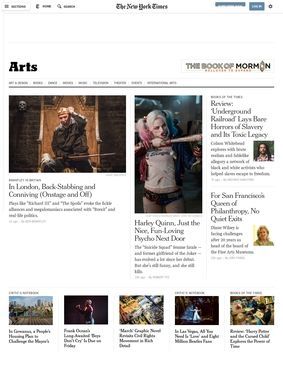
After watching a play or walking out of a film, the question of whether a reaction is well-founded tends to send people toward Arts - The New York Times. The section at nytimes.com/arts gathers reporting and criticism across theater, film, television, music, dance, visual art, and books, and it divides that work into clear sub-sections so a reader can go straight to Movies, Television, Theater, Music, Art and Design, or Books without wading through unrelated coverage. The newspaper behind it was founded in 1851 and the culture desk reflects that age in the form of a standing roster of staff critics and journalists rather than a rotating pool of freelance bylines.
Staff critics and industry reporting
That distinction shows up in the reading. A review carries a name and a track record, so a person who follows a particular critic can weigh new opinions against ones they already know. Reporting and criticism sit side by side: there are straight news pieces about the industry, longer features on artists and movements, interviews, and the verdicts Arts - The New York Times has always been associated with. The criticism is opinionated, which is the point.
How reviews build authority
A reader who wants a neutral summary of what released this week can find that anywhere; what the Times offers is a considered take from someone whose job is to hold a standard. That can mean a withering notice as easily as a rave, and the willingness to publish the harsh version is part of why the praise lands with force when it does.
Coverage across film, theater, music
The range is wide without being shapeless. Film and television coverage runs from individual reviews to broader features on how the medium is changing and who is making the work worth watching. Theater coverage leans on New York's stages but reaches beyond them, and the music writing spans genres rather than staying parked in one corner of the field. Visual art and design get their own dedicated space, and the books coverage connects to the paper's long history of literary criticism and bestseller tracking.
For a general reader, that breadth means one destination covers most of what counts as cultural life. For students and academics, the value is sharper. A critic's argument about a production or an exhibition becomes a primary text in its own right, something to cite, push against, or trace over time as a reputation forms and shifts. Cultural professionals read it for a different reason: Arts - The New York Times remains one of the places where a notice can move ticket sales or shape how a release lands in the wider conversation.
Coverage is not confined to American work. The culture desk follows international film, music, and visual art, so a reader looking past the United States will find festivals, foreign releases, and overseas exhibitions treated with the same seriousness as domestic ones. That reach is part of why Arts - The New York Times functions as a reference point well outside New York.
Subscription access and bundling
Access has a structure worth understanding. The Times runs a metered model: a number of articles are free, and full access sits behind a paid digital subscription, either the All Access bundle or a standalone product. A casual visitor can usually read enough to judge the writing. A heavy reader who returns daily will hit the paywall and need to subscribe, which is the trade the paper states plainly. The subscription also folds in NYT Cooking, Games, Wirecutter, and the Athletic. None of that is cultural coverage, but it explains why Arts - The New York Times rarely stands alone for a subscriber. The criticism arrives bundled with a much larger product, which changes the value calculation.
Inside the metered paywall model
What a subscription buys, on the cultural side, is editorial judgment built over a long span. Real limits exist. The metered access frustrates anyone who wants to read freely and only occasionally, and the bundling means the criticism cannot be subscribed to in isolation. The viewpoint is also unmistakably a particular one, centered on a certain slice of American and international high and popular culture, so a reader chasing niche scenes or coverage of regional work far from major cities will find gaps. None of that undercuts the core strength; it sets expectations for what the section is and is not.
Depth is the consistent payoff. A single Arts - The New York Times feature on a director or a composer often runs longer and reports harder than a quick wire item. The archive stretches back decades, so a search on an older work frequently turns up the original review alongside later reassessments. For anyone building an argument about how a piece of art was received over time, that continuity is useful and difficult to replicate from scattered sources. The desk publishes continuously, so the front of the section turns over with the cultural calendar: awards seasons, festival cycles, publishing rhythms, and the run of openings and releases. A reader who checks in regularly ends up with a running picture of where the conversation is, which is harder to assemble from outlets that cover culture only occasionally.
No third-party review aggregator carries a meaningful public count for Arts - The New York Times as a web section, which is unsurprising given that it is an editorial destination, not a business with customer transactions. The standing of Arts - The New York Times comes from a century and a half of publishing and from critics whose names recur in academic citations and industry postmortems alike. The concrete next step is direct: go to nytimes.com/arts, read a few of the free pieces in whichever sub-section fits the interest at hand, and judge the criticism on its own terms. The writing either justifies the subscription price or it does not, and the free articles are enough to find out.