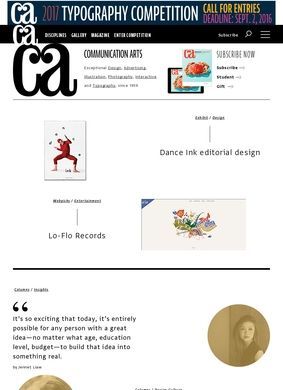
Pull up the Award Winners gallery on Communication Arts and you are looking at work that has already cleared a jury of practicing creative directors, sorted across six disciplines: advertising, design, illustration, interactive media, photography, and typography. Communication Arts has been publishing since 1959 under Coyne & Blanchard, and it describes itself as the largest creative magazine in the world. That is a big claim, but six decades of selected work is not a thing you can fake by redesigning a homepage. The archive is the evidence.
Award competitions across six creative disciplines
The competitions are the gravitational center. For people inside advertising, design, and the related crafts, the annuals are treated as a genuine mark of recognition. Creative directors routinely name them among the most prestigious juried competitions in the field. Winning studios put it on their own sites and in pitch decks. So when Communication Arts opens its galleries of award-selected work, it is not browsing for entertainment. It is a curated record of what a panel of practitioners judged to be the strongest output in a given year, which makes it useful as a benchmark and as a way to track who is doing notable work right now.
Editorial coverage beyond the galleries
Beyond the awards, the editorial spread is wider than a casual visitor might expect. Features cover individual creatives. Columns carry industry commentary. Exhibit functions as a deeper gallery. Webpicks pulls together web design worth studying, and the Book Reviews section covers titles specific to visual communications, a narrow shelf that general review outlets tend to ignore. A Fresh section is given over to emerging talent, so the coverage reaches students and junior designers looking for direction alongside seasoned art directors checking this year's jury results. That range is harder to find in one place than it sounds.
Account tiers and subscription options
Communication Arts splits content across a few layers, and it is worth understanding before deciding how deep to go. A free account gives access to material beyond what an anonymous visitor sees. Paid magazine subscriptions come in individual, student, and gift tiers, with a newsletter option for lighter engagement. The student tier is a sensible inclusion given how much of the audience is in school or freshly out of it.
Archive access through the customer store
Subscription mechanics and digital access run through a separate customer service store at store.commarts.com. That side handles print-subscriber needs: digital editions, PDF back-issue access, and a library Communication Arts puts at more than 18,000 award-winning images and videos. If you treat that archive as a working reference rather than a one-time read, the number alone justifies a subscription. A creative researching a campaign approach, a typographic treatment, or a photographic style has a deep, pre-vetted well to draw from, and the fact that back issues are available as PDFs means older material does not vanish into dead links.
Submitting work, pitching articles, finding jobs
There are also participatory routes. Work can be submitted to the competitions. Articles can be pitched through a Write For Us channel. Job hunting is covered through a Creative Hotlist partnership that surfaces listings. The Write For Us option is worth noting: a publication that opens its pages to outside contributors sees itself as a forum for the discipline, a two-way exchange, not a broadcast from an editorial desk.
What is harder to judge from the outside is how value distributes across different readers. Someone who only wants to study winners can get a lot from the free galleries without paying anything. Someone who wants the full archive, PDF back issues, and the complete image library has to commit to a subscription, and Communication Arts does not make it obvious where the free tier ends and the paid one begins. You find the wall when you hit it. For a publication this established, a clearer map of what each tier contains would save prospective subscribers some guesswork.
Breadth versus depth across visual crafts
The breadth across six disciplines is genuinely useful, but it raises a fair question about depth. Advertising, design, illustration, interactive media, photography, and typography are six very different crafts with six different sets of conventions and audiences. A magazine covering all of them is doing something ambitious, and the obvious risk is that no single discipline gets the sustained, specialist attention it would receive in a publication devoted to that field alone. The annuals are organized so each craft is judged on its own terms, which helps, and the long track record of Communication Arts suggests the editorial team has learned how to give each area room. A typographer who lives and breathes letterforms, or a photographer steeped in the medium, may still find a generalist publication broad where they want it narrow.
Emerging talent and industry commentary
The Fresh section is where Communication Arts does something a pure awards archive cannot. Surfacing people early, before they have a recognizable name attached, takes editorial judgment and a willingness to be wrong in public. When it works, it gives readers a look at where the field is heading rather than only where it has been. The Columns serve a similar function on the commentary side, carrying opinion and analysis that galleries alone cannot. A reader who wants to understand what a win says about shifting tastes in the craft is better served here than by a site that only posts pictures.
For practitioners, the practical pull is the combination. Study the best current work through Communication Arts, read about the people making it, find a job through the Hotlist, submit work for judging, pitch an article. That consolidation is rare. Most resources do one of those things. Communication Arts attempts the whole loop, from inspiration to recognition to employment, and the fact that it has sustained that for as long as it has gives the attempt real weight. The Creative Hotlist tie-in turns a reading habit into something with a career payoff, a smart use of an audience that is, almost by definition, looking to advance professionally.
There is enough substance in Communication Arts to recommend it without much hesitation for anyone working in or studying visual communications. The archive depth, the credibility of the competitions, and the spread across disciplines all point the same direction. Where a careful reader should pause is on the value calculation. The free galleries are generous, but the genuinely deep material, the full PDF archive and the 18,000-plus image library, sits behind a subscription whose contents the site does not lay out plainly. How often a given reader returns to mine that archive is the one variable Communication Arts cannot settle in advance, and the site does not quite make it easy to estimate.