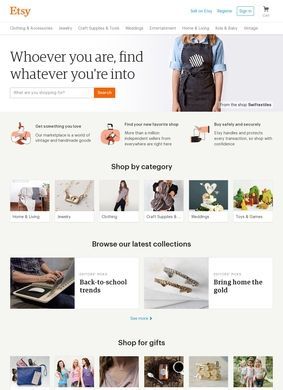
Where does someone go to buy a hand-thrown mug, a printable knitting pattern, and a brooch made from reclaimed silver, all in one checkout? Etsy is the obvious answer for most people, and the reason is structural: it is a marketplace built specifically for handmade goods, vintage finds, and the raw materials crafters use to make things themselves. That last category matters more than casual shoppers tend to notice. Alongside the finished pieces sits a deep shelf of craft supplies and tools, which means Etsy covers both ends of the making process, the person creating and the person buying the result.
How Etsy connects makers with buyers
The catalogue spreads across jewelry, clothing and accessories, home decor, art and collectibles, toys and games, and wedding items, plus a vintage tier reserved for objects twenty years old or older. Each shop is run by an independent seller who lists items with their own photos, descriptions, and prices. A buyer searches by keyword or browses by category, then purchases straight from the maker. It is a direct line between an artisan and a customer, with Etsy sitting in between to handle the plumbing.
Payment processing and seller tools
That plumbing is more substantial than the storefront suggests. Etsy Payments folds card payments, PayPal, Apple Pay, Google Pay, and gift cards into a single checkout, so a seller does not have to stitch together separate processors. Sellers can print shipping labels at discounted rates, which trims a real cost for someone mailing one parcel at a time. A dashboard tracks analytics, and Etsy Ads let a shop promote individual listings on the site itself. None of this is glamorous, but it is the difference between a hobby and a workable small business.
Finding one-of-a-kind items and downloads
Specificity. A search on a big-box retailer returns the same factory item under different labels; a search on Etsy returns variations made by different hands, often customisable, sometimes one of a kind. The platform leans into that with digital products too: printable wall art, sewing and knitting patterns, planner templates, and other downloads that arrive instantly and cost the seller nothing to restock. For anyone who wants something that does not exist in a warehouse, Etsy is the natural first stop.
Evaluating seller reliability
The Star Seller badge is worth understanding before you buy. Etsy awards it to shops that keep response rates high, ship on time, and maintain strong feedback, so it functions as a quick signal of reliability when you are deciding between two similar listings. It does not guarantee taste, but it does flag the operators who treat their shop like a job. Reading the badge alongside a shop's own reviews gives a buyer a reasonable read on whether the package will turn up when promised.
Building a storefront beyond Etsy
On the seller side, the supporting services stretch beyond a single shop page. The Pattern service lets a seller build a custom storefront under their own web address while still drawing on the same inventory and orders. Etsy wholesale connects makers with retail buyers looking to stock physical shelves. Both push the platform past simple retail and toward being the operational backbone for a small craft brand.
Shopping across millions of listings
Scale is the part that is easy to underestimate. Etsy runs globally, with localised versions handling multiple currencies and languages, and it reaches buyers and sellers across more than two hundred countries. Public filings put the inventory in the tens of millions of active listings, drawn from millions of active sellers. That depth cuts two ways. It means a niche search almost always returns something, and it also means the burden of judgement falls on the buyer, since quality ranges from polished professional shops to first-week beginners testing the water.
Standing out as a new seller
For a maker weighing whether to set up here, the calculation is fairly clear. The audience is already assembled and already in the mood to buy handmade, so a new shop is not starting from zero traffic. The trade-off is competition: standing out among millions of sellers takes good photography, sharp descriptions, and the patience to earn reviews. The tools are there to compete, but they do not do the work of differentiation for you.
One practical note for shoppers chasing the genuinely old: the vintage rule is enforced by age, twenty years or more, which keeps that section meaningfully distinct from the merely retro-styled. If you want a true period piece, Etsy is one of the few large marketplaces that draws the line clearly, so you are less likely to end up with a new reproduction dressed up to look weathered.
On outside reputation, Etsy carries a large volume of reviews on Trustpilot and the Google Play store for its app, with the totals running well into the hundreds of thousands. The picture that emerges there is consistent with what the site itself suggests: strong praise for the range of unique products and the direct seller relationships, with recurring complaints about customer service response times when disputes arise. That is not unusual for a marketplace of this scale, but it is worth factoring in if you are a seller who needs reliable support channels.
The honest summary is that Etsy does one thing extremely well and does not pretend to be everything else. It is not where you go for the cheapest commodity goods or the fastest two-hour delivery. It is where you go when the maker matters, when you want a download in seconds, or when you are building a craft business and need the checkout, shipping, and analytics handled so you can focus on producing. The breadth of categories and the supply-and-tools layer give Etsy a reach that few craft-focused platforms match, and the vintage section adds a tier that most competitors simply ignore.