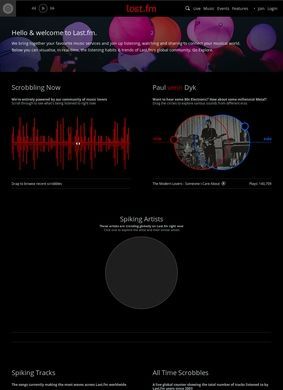
You finish a long stretch of listening, jumping between Spotify in the morning and YouTube at night, and you want to see the shape of it: which artists actually dominated your year, what you played to death in a single week, the records you forgot you loved in March. That is the itch Last.fm has been scratching since 2002. Connect a streaming account once, and the site quietly records every track you play, building a listening history that does not reset and does not vanish when you switch apps or phones.
How scrobbling works across streaming services
The mechanism behind this is scrobbling, the term Last.fm coined for automatic track logging. It hooks into Spotify, Apple Music, YouTube, Tidal and SoundCloud, and for anything outside that list there is a downloadable Scrobbler app and a browser plugin to catch the stragglers. Once the data accumulates, the payoff arrives: all-time and weekly charts, per-artist and per-album breakdowns, and statistics that let a heavy listener track their own habits with a precision most streaming services keep locked behind their own annual recap. That permanence is the real draw. Years of play counts sit in one place, owned by the user across whatever service they happen to be paying for that month.
Personalized recommendations from listening history
The charts are only the start. All that accumulated history powers personalized recommendations, curated radio stations, and concert alerts keyed to the artists someone keeps returning to. The logic is sound: the more you scrobble, the sharper the suggestions get, because they are drawn from what you genuinely play, not from what an algorithm guesses you might tolerate. An account with years of history behind it produces recommendations a fresh signup never could.
Community features and developer access
Around that core sit the community pieces. User profiles act as a public record of taste, there are forums, and a tagging system lets listeners label music by mood or genre in their own words, which improves discovery for everyone. Last.fm also runs an official merchandise store and offers some free music downloads. For developers, a public API opens the door to third-party apps and integrations, and a healthy number of those exist precisely because the scrobble data is worth building on. The interface comes in more than a dozen languages, which fits a user base spanning casual listeners to the genuinely obsessive across the globe. Last.fm does not appear in any music business directory, which is expected for a consumer web platform rather than a local or professional service.
Paid tier and corporate ownership
There is a paid tier, Last.fm Pro, which layers extra features over the free plan. The free version already covers scrobbling and the charts, so Pro reads as an enhancement for the data-hungry, not a wall in front of the basics. Ownership has sat with CBS Interactive since the 2007 acquisition, which gives Last.fm a corporate backstop that has kept it running far longer than the music startups of its era typically managed.
User reviews and community engagement
On reputation, the picture is mixed and worth being honest about. Sitejabber carries 43 reviews averaging 3.6 out of 5, and SmartCustomer lands in the same range with 42 reviews at 3.6. Trustpilot shows roughly 50 reviews, though a clean aggregate did not surface. PCMag has published an editorial review leaning critical, and the software-listing site Slashdot tracks Last.fm too. Perhaps the most telling marker is the r/lastfm community on Reddit, which stays active with long-term users still discussing the platform years on, a kind of staying power a quick rating average does not capture. None of this points to universal acclaim, but it does point to a service people stick with.
Getting in touch is the weaker spot. The homepage carries no phone number and no physical address, and support is pushed off to a separate portal at support.last.fm. Help and FAQ, About, and Jobs pages live in the footer, so the routes exist, but a visitor wanting to reach a human will not find that path obvious from the front page. For a free web service backed by a large media company this is unsurprising, and the support portal does the job a contact form would, yet the lack of anything immediate is a fair thing to flag.
Who benefits most from all this depends on commitment. A casual listener who wants nothing more than pressing play gets little out of Last.fm beyond the occasional recommendation, and may never bother connecting an account. The data enthusiast is the natural fit: someone who wants every play counted, who enjoys watching their charts shift week to week, and who values a listening record that outlives any single streaming subscription. The longer the history, the more Last.fm repays the effort.
One detail worth noting is how Last.fm treats its own data as a product worth opening up. The public API is far from a token gesture; third-party apps, visualizers and analysis tools have grown around it precisely because the scrobble history is rich enough to build on. A user who outgrows the native charts can take their numbers elsewhere, which is rare among services that usually fence their data in. That openness, combined with more than two decades of continuous operation under stable ownership, is the practical reason the listening record stays trustworthy across app switches and phone upgrades.
Set against the brighter parts, the rough edges deserve naming. The recommendation engine and curated radio depend entirely on input, so an account with a sparse history gets sparse results. The community forums and tagging feel like a holdover from an earlier web, useful but not where most listeners spend time now. And the buried contact path means anyone hitting a technical snag has to hunt for support. What Last.fm does, it has done consistently for over twenty years: it counts what you play and keeps the tally, and that single function still has no obvious rival doing it as completely.