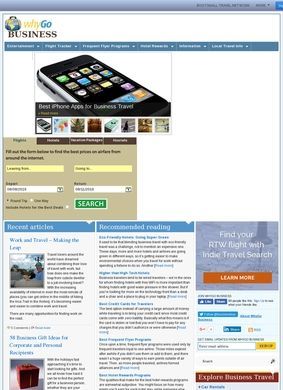
Picture someone with a 6 a.m. flight out of O'Hare, a connection through Frankfurt, two nights in an unfamiliar hotel near LAX, and a carry-on that has to hold a week of meetings. That traveler has questions the airline app will not answer: where to sleep close to the terminal, which credit card actually pays back the miles it promises, how to get from a Chicago airport to downtown without a taxi gouging. WhyGo Business is built for exactly that person. It is a written archive of business-travel knowledge, and it reads like it was put together by people who have done the trips themselves.
Articles sorted by travel topic
The site is editorial through and through. There is no booking widget, no shopping cart, no account to create. What you get instead is a back catalogue of articles sorted into sections like Flight Tracker, Frequent Flyer Programs, Hotel Rewards, and Expert Flyer, plus an Entertainment area and a general Information bucket. The strength is range within a single subject. Hotel pieces go beyond a list of names and dig into specifics, eco-friendly properties, hotels with usable pools, the cluster of options around LAX that frequent flyers actually return to. Airport coverage leans practical, with O'Hare write-ups and ground-transport guidance for getting around Chicago once the plane lands.
Germany guidance for business travelers
International work gets attention too, with a clear focus on Germany for anyone heading there on business. That kind of country-specific guidance is harder to find than generic packing advice, and it is the sort of thing WhyGo Business does well. The packing and efficiency tips fill the everyday gap, how to move through a trip faster and lighter, while the credit card comparisons aimed at frequent travelers tackle a question that costs people real money if they get it wrong. There are technology reviews of laptops and tablets pitched at the road warrior, gift guides for the colleague who flies constantly, and an interview series where seasoned business travelers talk about how they actually do it.
Comparing frequent flyer and credit card options
That interview thread is the part worth clicking through at length. Firsthand accounts from people who live out of a suitcase are more useful than another rewritten tip sheet, and they show that WhyGo Business is drawing on experience rather than padding a content calendar. The breadth WhyGo Business covers across hotels, airports, loyalty programs, gear, and destinations means a reader can land here for one narrow question and stay for three more they did not know they had. This is not a business directory of companies or services; it is a deep-read resource where the value accumulates the longer you stay.
Interviews with seasoned road warriors
The publication is connected to BootsnAll, a travel media company whose copyright credit sits at the foot of every page. That lineage explains a lot: BootsnAll has a long history in independent travel publishing, and WhyGo Business sits within that family as the corporate-travel arm. It explains the editorial tone and the absence of a hard sell. Nothing on these pages is trying to close a transaction, which is part of why the advice feels usable rather than steered toward a partner deal.
No contact information or update dates
Outside reputation is the blank spot. A search for independent reviews or ratings of WhyGo Business turned up nothing usable: no Google or Trustpilot footprint, no third-party write-ups pointing back to it. For a free reading resource that is less of a problem than it would be for a paid service, since a reader risks only their time, but it does mean the content has to stand entirely on its own. A first-time visitor has no crowd verdict to lean on.
No independent reviews or ratings available
Reaching anyone is the other gap. The site lists no phone number, no email, and no mailing address. The only identifying mark is that BootsnAll credit at the bottom. For an editorial site with no transactions, the lack of a direct line is a smaller fault than it would be elsewhere; you are not trying to reach customer support or chase an order. Still, a writer who wanted to pitch a piece, flag an outdated fare detail, or simply ask a follow-up has no obvious route in, and that is worth knowing before you treat any single article as the final word. Travel facts age quickly, and an archive without a visible update channel can drift out of date in the corners.
How to use the archive effectively
None of that undoes what WhyGo Business is good at. Where WhyGo Business holds its own is in the specificity of its coverage. It covers a real, specific need with material that goes past surface-level listicles, and the corporate-travel framing keeps it tighter than a general wanderlust blog. The Germany guidance, the airport ground-transport detail, and the frequent-flyer and card comparisons are the standout sections, the ones with enough substance to change a decision. A contact route and a visible date showing when older pieces were last refreshed would close most of the credibility gap on their own.
Worth bookmarking before the next trip plan comes together. The airport and hotel sections that match your route are the best place to start; cross-check anything time-sensitive like fares or card terms against a primary source, since the archive shows no update dates, and lean on the traveler interviews for the lived-in tips you will not get from an airline. WhyGo Business works well as a reading library. It does not work as a help desk, and knowing that distinction is most of what you need to get value from it. The site is what it is: a well-stocked archive that WhyGo Business has built around corporate travel, not a live service that picks up the phone.