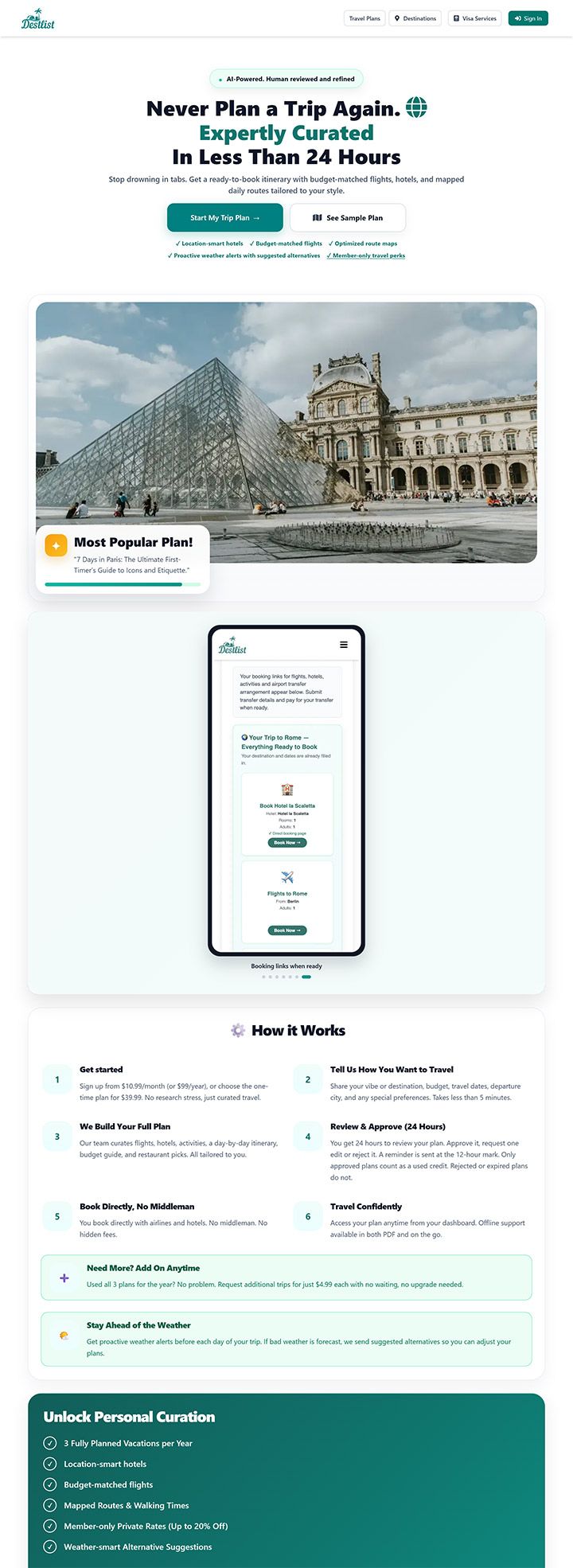
DestList is a paid travel planning service that hands you a finished, ready-to-book trip instead of a blank itinerary template to fill in yourself. The pitch is squarely aimed at people who want a holiday but have no appetite for the hours of tab-juggling that usually precede one. You answer the relevant questions, and within 24 hours a complete plan lands in a personal dashboard: flights matched to a stated budget, hotels chosen for location, and a day-by-day activity schedule routed to avoid doubling back across a city. That last detail is the sort of thing most DIY planners get wrong, and it is encouraging to see it called out as a deliberate feature.
How DestList plans get built
What pulls a DestList plan together is a mix of AI drafting with a human check before it goes out, which is the part worth pausing on. Automated trip generators are easy to spin up and tend to produce confident nonsense: a museum closed on Mondays slotted into a Monday, a two-hour gap that turns out to be a forty-minute taxi ride. A human verification layer is the right answer to that problem, assuming it is genuine and applied to every plan rather than advertised once on the homepage. The brief describes it as a real step in the process, so I will take it at face value, though it is the single claim a prospective buyer should test hardest before paying.
Human review of AI-generated itineraries
The itinerary itself goes deeper than a list of sights. Each plan carries walking times between stops, restaurant suggestions, a budget overview so the numbers are visible up front, and route maps built to cut out backtracking. Where a DestList itinerary separates itself from a generic packing app is in these connective details. There are also proactive weather alerts that flag a washout day and propose alternatives, which is a thoughtful touch for anyone who has watched a carefully scheduled beach afternoon dissolve into rain with no plan B. Everything can be exported to PDF for offline use, genuinely useful when you are standing in an airport with no signal and a dying roaming plan.
What each itinerary includes
Pricing is laid out without much mystery. A monthly tier runs $10.99, an annual option is $99 a year, and there is a one-time plan at $39.99 for people who travel once and have no interest in a subscription. Each subscription level includes three fully planned trips per year, and extra plans beyond that cost $4.99 apiece. Members are also told they can access private rates advertised at up to 20 percent below standard pricing. The booking itself happens directly between you and the airline or hotel; DestList says it takes no cut on the reservation, which is a cleaner arrangement than the opaque markups some travel sites bury in a final total. Whether those member rates consistently materialise is something only a paying user can confirm, but the structure is honest enough on paper.
Pricing and subscription options
Around the core product sits a set of free tools that do real work even if you never buy a plan. A Group Travel Friction Calculator addresses the genuinely thorny problem of coordinating a trip among people with different budgets and tolerances. A Smart Packing List generator and a Vacation Decision Tool, the latter framed as a destination quiz, round out the freebies. These low-stakes utilities get a curious visitor to stick around, and they point to the people behind DestList understanding the small frustrations of trip planning beyond just the big one.
Free tools for trip planning
The site also leans on affiliate partnerships for the practical odds and ends of travel: eSIM data coverage spanning more than 190 countries, travel insurance, EU flight compensation claims worth up to 600 euros, airport transfers, and VPN services. None of this is unusual; affiliate links are a fair way to fund a service that promises to take no booking commission. Anyone using the site should recognise these for what they are, recommendations the site earns a referral fee on, and weigh them accordingly. DestList is also listed in more than one business directory covering travel and planning tools, and its own blog at blog.destlist.com publishes destination guides and planning articles. The main navigation breaks out into Destinations, Hidden Gems, Tours, and Visa Services, which points to ambitions wider than a single 24-hour itinerary product.
On credibility, the picture is mixed and worth being plain about. DestList provides a contact page, so a buyer has a route to reach the company if a plan arrives wrong or a refund question comes up. What is missing is a phone number or a physical address; neither surfaced on the homepage or in a search. The form is a workable channel, and for a service that asks for money up front and promises personal, human-checked work, a little more transparency about who is behind it would go a long way toward earning trust. A contact form is a reasonable baseline, but travelers handing over a credit card tend to want to know there is a real operation on the other end.
Outside reputation is where DestList is hardest to read. A search turned up no Google reviews, no Trustpilot or Yelp presence, nothing on the usual platforms where travelers compare notes. That absence is not damning on its own; plenty of newer or niche services have no review trail at all simply because they have not been around long enough or loud enough to accumulate one. But it does mean a first-time buyer is largely trusting the site's own description of itself, with no chorus of past customers to cross-check against. One oddity worth dismissing outright: a separate domain, desirelist.store, has been flagged for phishing, but it is an unrelated site and should not colour anyone's view of DestList. The name similarity is coincidence and nothing more.
The feature set is concrete and the no-commission booking model is a point in DestList's favour. The reservations are equally concrete: an unverified human-review claim and an almost invisible reputation trail mean the prudent move is to start with the one-time plan and judge the output on its own terms. Set against something like Wanderlog, the free itinerary builder a lot of travelers already use, the trade is clear: Wanderlog hands you the tools and the map and leaves the assembly to you, which suits people who enjoy that part. DestList sells the assembly itself, finished and checked, for a fee. The $39.99 single plan is a low-risk way to find out whether the execution matches the pitch, and the answer to that question is the only thing worth knowing about this service.
Important pages
Business address
DestList
Tangermünder Strasse,
Berlin,
Berlin
12627
Germany
Contact details
Phone: +4917656914117