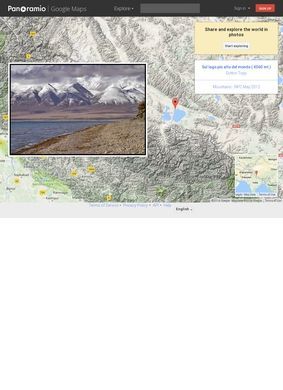
Type the address today and you land on a single page that says the service has been shut down permanently. That is the whole of Panoramio now: a discontinuation notice, a short set of FAQs, and a row of links pointing somewhere else. Anyone arriving here expecting to upload a photo, browse the map, or search through years of geotagged images will find none of those things switched on. The doors are closed, and the page does not pretend otherwise.
How the service worked
What sits behind that notice is worth understanding, because the idea was a good one. Panoramio let people pin photographs to exact geographic coordinates, and those images then surfaced inside Google Earth and Google Maps as overlays tied to the spot where each shot was taken. A photographer who climbed a ridge or stood in a particular town square could leave a visual marker there, and the next person looking at that location on the map could see what the place actually looked like through someone's lens. Over the years this grew into a crowdsourced layer of millions of geotagged photos contributed by people all over the world. It was a picture of the planet assembled by the public, location by location.
Geographic tagging as the core feature
The geographic tagging was the core of it, and it is the part I find genuinely interesting to think about even in retrospect. Plenty of photo sites let you scatter images into albums; Panoramio insisted that every photo belonged to a place, and that constraint is what made the whole thing useful. The coordinates were the point. A search by region returned not a random gallery but a documentary record of how a stretch of coastline or a mountain pass looked to the people who had been there.
Integration with Google Maps and Earth
Because the images fed directly into Google's mapping products, the contribution did real work. A photo uploaded to Panoramio might end up shown to a stranger planning a trip, checking a landmark, or simply wandering through Google Earth out of curiosity. That tight coupling between the upload and the map was the reason the platform mattered, and it is also, in a roundabout way, the reason it no longer exists as a standalone product. The function it served got folded into the larger map.
It is also fair to note what the model demanded of its contributors. Pinning a photo to a precise location asked for a small act of accuracy that a casual album never requires. The reward was that the work counted toward something shared rather than sitting in a private folder. At its peak the volume of geotagged photos running through the system was enormous, the product of countless individual decisions to mark exactly where a picture belonged. That scale is hard to grasp from the bare notice that greets a visitor now, but it is the backdrop to everything the page is trying to wind down gracefully.
What happened to user photos
The shutdown page does more than apologise. It lays out what happened to people's photographs and where the same activity continues. Users whose accounts were tied to a Google account had their photo libraries automatically copied into Google Album Archive, so the images were not simply deleted into the void. The FAQs walk through how to reach those archived photos, how to manage past contributions through the Contributions screen in Google Maps, and how to keep doing the kind of place-tagging that Panoramio was built for.
Retrieving archived images
That last route points to the Local Guides program. If you still want to attach photographs to locations and have them appear on the map, Google's answer is to join Local Guides and contribute there. So the page is partly a tombstone and partly a forwarding address. It tells you the original product is gone and then hands you the keys to its replacement, which is a more honest way to retire something than letting the links rot. The migration options are spelled out plainly enough that a former Panoramio contributor can find their old work and figure out their next step without much hunting.
Where to continue geotagging
The FAQs read like they were written by people who expected to be missed. Each question covers a concrete worry: where did my photos go, can I still get to them, how do I keep contributing. The answers do not dress anything up. They point you at Google Album Archive for retrieval, at the Contributions screen for managing what you already posted, and at Local Guides for going forward. There is no pretence that the replacement reproduces the old experience exactly, only an acknowledgement that the underlying activity has a new home. That restraint is welcome on a page that could easily have been a single cold line and a dead link.
Current limitations of the shutdown page
Still, there is no softening the fact that everything interactive about Panoramio is switched off. No upload form, no browsing, no search across the old collection, no community to speak of. The page describes the service as a former product of the Panoramio team under Google, which is to say it talks about itself in the past tense throughout. For a current visitor, the practical value is limited to two things: recovering archived photos and learning where the activity moved to.
Legacy and impact on mapping products
As a piece of internet history this entry in a business directory has weight. The model of inviting the public to photograph the world and pin each image to its true coordinates shaped how mapping products think about user-contributed imagery, and the work those millions of photos did has not vanished so much as migrated. The geographic photo layer people built here lives on inside Google Maps in a different form. There is something quietly satisfying about a project ending by feeding its purpose into a bigger system rather than being switched off and forgotten.
Visiting Panoramio today
The trouble, for anyone consulting this listing today, is that the thing being reviewed is essentially a redirect. A former Panoramio contributor who wants their pictures back, or who is curious where to keep tagging photos, will get a clear answer in a minute or two.
Someone who hears the name and hopes to explore a working archive of geotagged photography, to search a place and see what others saw, will hit a wall. The notice is tidy and the migration paths are documented, yet none of it changes the central fact: the product that made Panoramio worth visiting is no longer something you can use, and the page can only tell you where it went, not give it back. Whether that forwarding address is enough to make the visit worthwhile depends entirely on whether you had something stored here to begin with, and most people arriving now did not.